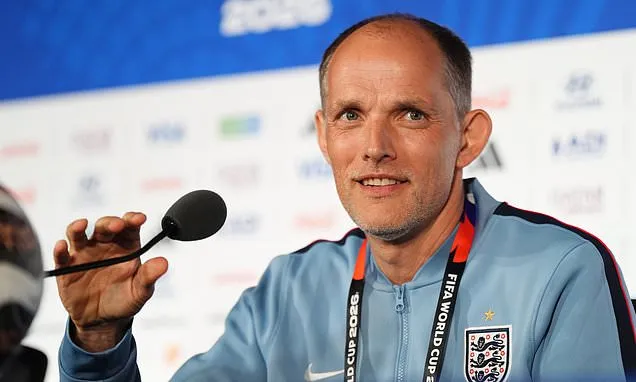
As England prepares for a high-stakes World Cup semi-final clash against Argentina, head coach Thomas Tuchel is emphasizing a focus on the present game rather than historical rivalries. While the Argentinian camp has alluded to past conflicts, including the 1982 Falklands War and Diego Maradona’s infamous “Hand of God” goal, Tuchel stated that such historical events will not serve as motivation for his team. Instead, he plans to use personal rejuvenation methods like bike rides and ice cream to maintain his own focus and energy.
Focusing on the Football, Not the Falklands
Speaking ahead of the pivotal match, Tuchel acknowledged the significant rivalry between England and Argentina, recognizing it as a contest between two major footballing nations. He anticipates an intense and emotional game with potential shifts in momentum. However, he firmly believes that dwelling on historical grievances or past encounters is counterproductive. “We don’t speak about the historic events. The tension is big enough,” Tuchel explained. “We try the opposite and to influence the players in how we want them to behave. It does not help if we engage emotionally.”
Tuchel’s strategy is to shield his players from external narratives and concentrate on controllable aspects of the game. He believes the inherent significance of a World Cup semi-final, with the prize of a final appearance and the chance to end a 60-year wait for major silverware, is sufficient motivation. “We know why we are here, what we want,” he stated. “We were never shy of saying it, of dreaming it. We arrive very hungry. We want the next win. We don’t dip into historical events or make it bigger than it is. We are hungry and ready to go.”
England’s Uncharted Territory and Personal Recharge
The German coach also suggested that England has yet to reach its full potential in the tournament. He expressed confidence that a match of this magnitude could be the catalyst for his team to perform at their peak. “We haven’t peaked yet, but a match like this will bring the best out of my players,” Tuchel admitted.
When asked about his personal methods for managing the pressure and recharging between matches, Tuchel offered a glimpse into his relaxed approach. “Sometimes you need a big parking lot, a bike and an ice cream and you feel like a 15-year-old (again),” he shared. “You reconnect to the beauty of that feeling we all have inside of us.” This personal philosophy underscores his belief in maintaining a sense of joy and perspective amidst intense competition.
Facing the Messi Challenge and National Expectations
Should England advance, they will face the formidable challenge of Lionel Messi, a player Tuchel has never encountered in this context before. While keeping his tactical plans close to his chest, Tuchel humorously mused about employing an “old school man-mark” to contain the Argentinian superstar.
Tuchel acknowledged the immense national expectation and the passion England’s progression has ignited back home. He views the World Cup as an event that unites a nation, providing a welcome distraction and a source of collective pride. “That’s what the World Cup is for,” he said. “To excite country, excite the fans, to transmit energy and make people forget their worries, make people’s lives better for 90, 120 minutes. And to just be combined and united and represented by a team. There’s so much to love about this England squad.”
Despite the weight of expectation, Tuchel insisted he and his team do not feel burdened. “We feel the tension and I will be nervous but I feel no burden,” he stated. “I feel the players are very competitive, excited, hungry to play this match. The two shirts are just iconic. Everyone recognises these shirts straight away, the players straight away. The magnitude of the match is beautiful, I don’t feel it as a burden.”
Kit Choices and Argentina’s Stance
Addressing a question about Argentina’s request to wear their preferred navy change shirts, which they wore during past victories against England, Tuchel remained unfazed. He quipped that he typically doesn’t know his team’s shirt color until just before kickoff and credited Argentina with a strategic move. “I would have done the same so credit to them. We have our lucky charms but I will not tell you what they are,” he added.
Meanwhile, Argentina’s coach, Lionel Scaloni, reiterated his position on the sensitive topic of the Falklands. He expressed sympathy for the historical loss of life but strongly advocated for separating the conflict from the sporting event. “It’s a football match,” Scaloni stated. “I can’t mix things up, out of respect for what happened so many years ago. It was a very sad time in our history, and there isn’t much we can do about it. Mixing the two would be madness. We criticise that there was war. We have to remember the people who lost their loved ones. But what fault is it of the players? We remember it, of course, but we are mistaken if we mix the two things together.” Scaloni’s comments emphasize a desire to keep the focus squarely on the football match itself.
Conclusion: A Focus on Performance
As the semi-final approaches, the narrative surrounding the match is a blend of sporting anticipation and historical undertones. Thomas Tuchel’s approach prioritizes mental preparation and a focus on the immediate task, aiming to harness the players’ competitive spirit without the distraction of past conflicts. Argentina’s coach, Lionel Scaloni, echoes this sentiment, calling for a clear distinction between the football game and historical events. Both coaches seem intent on ensuring their teams concentrate on the 90 minutes (or more) of play, where skill, strategy, and performance will ultimately decide who advances to the World Cup final.