Rugby league’s governing body is exploring ambitious strategies to expand its global footprint, with a radical rule change proposed to enhance international appeal. The suggestion involves allowing one attacking kick or a forward pass to an offside receiver per set of six tackles, a move aimed at capturing the attention of audiences in soccer-dominated Europe and American football-centric the USA.
A Bold Proposal for Global Reach
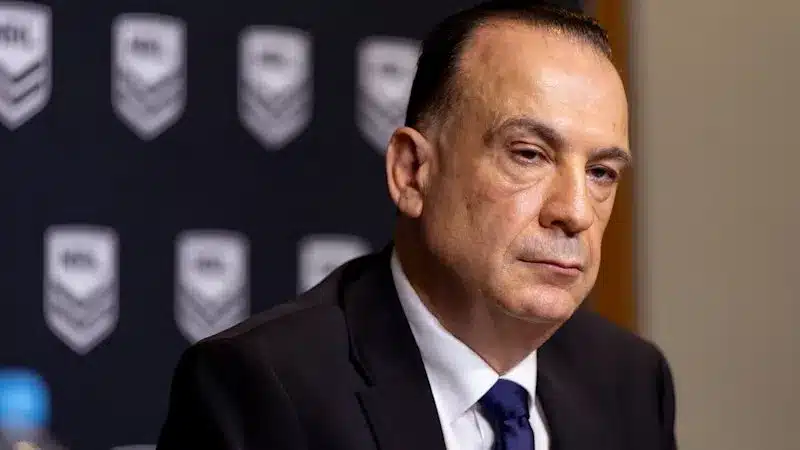
NRL chief Peter V’landys has articulated a vision for the sport’s “global domination,” targeting Europe and the USA for future franchises by 2050. To achieve this, a significant alteration to the game’s fundamental rules has been put forward: permitting a single instance within a set of six tackles where a player can kick or pass the ball forward to a teammate who is in an offside position. This hypothetical change is designed to address perceived barriers to international adoption, such as rugby league’s characteristic backward passing, while introducing elements that might resonate with fans of other football codes.
The proposed rule change could dramatically alter game dynamics. Imagine a scenario on tackle three: instead of a traditional kick or pass, a halfback could opt to pass laterally to exploit a weakened defensive line, advancing the ball deep into opposition territory. The team would still retain the option of using its one offside kick or pass later in the set. If this kick were successfully caught and grounded in goal by an onside teammate, it would result in a try, adding a new layer of strategic complexity and potential for spectacular plays.
Proponents argue that this adaptation would make the 13-a-side game more palatable to international audiences. While most major football codes, including soccer, American football, and Gaelic football, permit forward passes, rugby league’s unique restriction has often been cited as a point of confusion or disinterest for newcomers. By introducing a controlled forward element, the game could potentially bridge the gap with these established sports.
Strategic Considerations and Domestic Landscape
The potential impact of this rule change is amplified by the NRL’s substantial broadcasting rights deal, reportedly worth $5.3 billion. This financial power enables significant investment in international expansion. Global streaming partner DAZN, with its 100 million subscribers, could play a crucial role in broadcasting future NRL contests from international hubs like New York, London, or Miami.
However, the discussion around the NRL’s future also encompasses its domestic challenges and the ongoing competition with Australian Rules Football (AFL). The concept of the “Barassi Line,” a historical demarcation of rugby league’s dominance in southern Australian states, is invoked to highlight the shifting landscape. While the AFL has expanded into traditional rugby league heartlands like New South Wales and Queensland, the NRL faces its own set of strategic decisions regarding talent development and resource allocation.
Unlike the AFL, which provides significant subsidies to its teams in New South Wales and Queensland and dedicates a portion of revenue to grassroots development, the NRL distributes funds equally among its clubs. This difference in approach comes as the AFL actively targets Queensland for growth, even as some traditional rugby league areas in regional New South Wales see a more even split between the two codes.
Talent Development and Future Expansion
Beyond international ambitions, a critical area for investment stemming from the NRL’s broadcasting windfall is the deepening of its player talent pool. Despite producing exceptional athletes, concerns have been raised about the football IQ and depth of skill within the current player base. Some observers note a decline in defensive capabilities and positional play, leading to instances where scoring opportunities are missed.
With the NRL set to expand to 18 teams next year (including Perth) and potentially 19 and 20 teams in subsequent years, the demand for skilled players will increase significantly. The current talent pathways are reportedly not producing players with the same level of skill as a decade ago. The inclusion of Christchurch as a potential 20th team is seen as a strategic move to tap into the rugby union player base, while Victoria, home to the successful Melbourne Storm, remains another key region for growth, with the club itself advocating for increased investment in participation and pathways.
The departure of former NRL chief executive Andrew Abdo, who expressed confidence in the game’s growth strategy and valuation, underscores the forward-looking perspective within the league. As the AFL also prepares for its next broadcasting deal with an expansionist mindset, the NRL’s ability to leverage its current financial strength and adapt its rules will be crucial in shaping its long-term success, both domestically and on the international stage.
Women’s Game Momentum
In a notable development, the women’s State of Origin match recently achieved higher television ratings than the AFL’s top game, attracting 1,009,000 viewers compared to the AFL’s 663,000. This surge in viewership for NRLW indicates a growing audience and potential for further growth, especially as the competition expands its schedule.