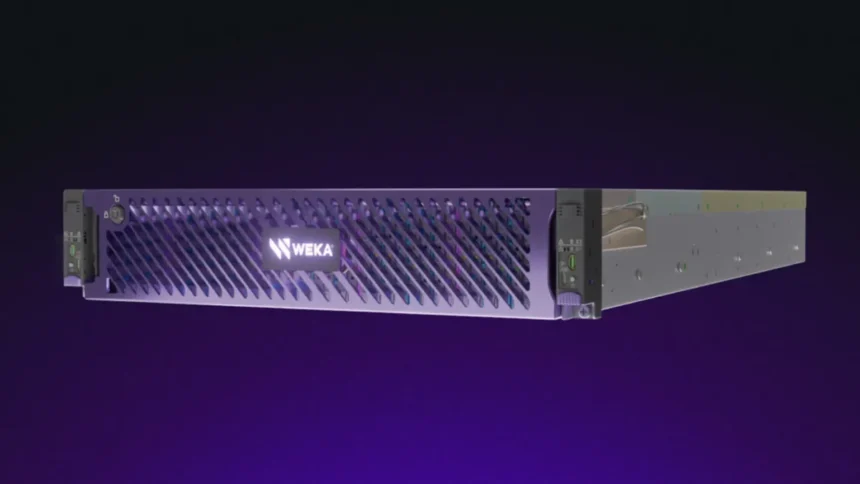
Weka has introduced its latest storage appliance, the WEKApod 3, designed to achieve unprecedented storage density by integrating its new NeuralMesh 6 software. The flagship Prime Max configuration boasts an impressive claimed effective capacity of 1.1 exabytes within a standard 56U rack. This milestone positions the WEKApod 3 as the first system to surpass the exabyte threshold in a single rack unit.
Innovative Software and Hardware Integration
The remarkable capacity of the WEKApod 3 is achieved through a sophisticated combination of dense hardware and advanced software capabilities. While the system utilizes approximately 1,800 of Micron’s 245.76 TB 6600 ION SSDs, the raw hardware capacity amounts to 441.5 petabytes (PB). The significant leap to over an exabyte is made possible by Weka’s NeuralMesh 6 software, which employs aggressive data reduction techniques.
These data reduction technologies, including fingerprinting, similarity hashing, deduplication, and compression, are enabled by default across all deployments. Weka asserts that these processes can achieve substantial capacity savings, particularly for AI training data, with reported savings of up to six times the raw storage. The company backs this claim with a contractual guarantee that covers both the reduction ratio and performance metrics.
AlloyFlash Tiering for Optimized Performance and Cost
NeuralMesh 6 and WEKApod 3 operate as a unified product, enhancing the overall functionality. A key component is the AlloyFlash tiering technology, which intelligently manages data placement. This system automatically routes data requiring low latency to faster TLC flash drives, while less time-sensitive bulk data is directed to QLC drives. QLC drives offer a significant cost advantage, being approximately 30% to 40% cheaper per terabyte than TLC flash.
This intelligent tiering contributes to the system’s impressive performance metrics. Weka reports per-rack throughput reaching 10.2 terabytes per second (TB/s) and 210 million input/output operations per second (IOPS). The company claims these figures represent an 114% improvement in throughput density compared to the next best publicly available alternative.
Industry Collaboration and Performance Benchmarks
Micron has been a key partner in this development. Jeremy Werner, senior vice president at Micron’s Core Data Center Business Unit, highlighted the synergy between Weka’s architecture and Micron’s high-capacity SSDs. He noted that this combination can deliver 15.8 petabytes of storage within a compact 2U footprint, emphasizing the density achievable.
However, industry analysts suggest that different metrics may be crucial for evaluating storage solutions, especially for inference workloads. Steve McDowell, chief analyst at NAND Research, pointed out that for production-scale inference, metrics such as tokens per rack and cost per inference are more relevant for buyers to consider than raw throughput or IOPS alone.
Addressing Industry Constraints and Future Outlook
Weka attributes its focus on extreme density and efficient storage to several prevailing industry pressures. A notable factor is the projected decrease in new US data center construction in 2025, coupled with lengthy grid connection queues in major markets, which can extend up to seven years. Furthermore, a forecast from Morgan Stanley predicts a significant power shortfall across the United States through 2028, exacerbating existing supply chain constraints for NAND flash memory.
The company argues that inefficient storage solutions directly compete with critical resources like GPUs for limited rack space and power budgets. By managing its own hardware supply chain, rather than relying on third-party original equipment manufacturers (OEMs), Weka aims to provide more stable pricing and reliable delivery schedules for its customers.
Availability and Product Tiers
The NeuralMesh 6 software is slated for release in the second half of 2026. Weka is offering existing customers an upgrade path at no additional cost. The WEKApod appliance line, including the Nitro, Prime, and Prime Max configurations, is available for order now through Weka’s distributor network. Deliveries for these models are scheduled to commence in the fall of 2026.
The WEKApod 3, powered by NeuralMesh 6, represents a significant advancement in storage density, addressing the growing demand for high-capacity, high-performance solutions in an era of constrained resources. Its reliance on advanced software to maximize hardware potential offers a compelling proposition for organizations dealing with massive datasets, particularly in fields like artificial intelligence.