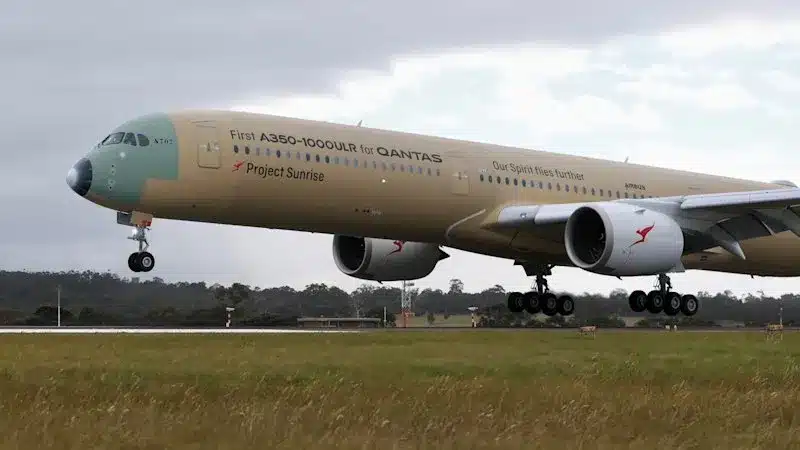
An Airbus A350-1000, specially configured for Qantas’ ambitious Project Sunrise, has successfully completed a groundbreaking non-stop flight spanning over 24 hours. The aircraft departed from Melbourne, Australia, and landed in Toulouse, France, marking a significant milestone in ultra-long-haul aviation. This epic journey, covering an impressive distance, was closely monitored by millions worldwide, highlighting the intense public interest in the future of direct long-distance air travel.
Project Sunrise Takes Flight: A New Era of Non-Stop Travel
The Qantas A350-1000 ultra-long-range (ULR) aircraft touched down in Toulouse after an extraordinary flight that lasted 24 hours and 24 minutes. The journey began in Melbourne, Australia, and concluded at the Airbus factory in Toulouse, France, where the plane was built. During its flight, the aircraft covered a staggering 23,075 kilometers (14,337 miles) without a single stop. This feat was accomplished thanks to the aircraft’s specialized design, which includes an additional 20,000-liter fuel tank, enabling it to carry the substantial fuel load required for such an extended journey.
This particular A350-1000 is a specially modified model developed to meet Qantas’ stringent requirements for its Project Sunrise initiative. This ambitious project aims to introduce direct, non-stop commercial flights connecting Australia’s major cities, such as Sydney and Melbourne, with international destinations like London and New York. Qantas has placed an order for 12 of these advanced A350-1000 ULR aircraft, signaling a strong commitment to pioneering ultra-long-haul routes.
Record-Breaking Flight Garnered Global Attention
The sheer scale and ambition of this non-stop flight captured the imagination of aviation enthusiasts and the general public. Flight tracking website FlightRadar24 reported that more than 3.6 million people followed the journey in real-time on its platform. This level of engagement made it the second most-tracked flight in FlightRadar24’s history, surpassed only by the flight carrying Queen Elizabeth II’s coffin in 2024. The data from FlightRadar24 indicated that 3,652,947 individuals tracked the A350’s progress, underscoring the immense global interest in this aviation milestone.
While the flight has set a new benchmark for an Airbus aircraft, its status as an official world record is still under review. Airbus and relevant authorities are meticulously evaluating the data collected during the flight. The current Guinness World Record for the longest commercial flight by an unmodified aircraft is held by a Boeing 777-200LR Worldliner. This record was set in November 2005, with a flight from Hong Kong to London lasting 22 hours and 42 minutes, covering a distance of 21,601.7 kilometers.
The Significance of Ultra-Long-Haul Flights
Ultra-long-haul flights, typically defined as those exceeding 12 hours in duration, represent the cutting edge of commercial aviation. They offer significant advantages to passengers by eliminating the need for layovers, thereby reducing overall travel time and the associated fatigue and inconvenience. For airlines, these routes can open up new markets and enhance connectivity, particularly for destinations that are geographically distant.
The development of aircraft like the A350-1000 ULR is crucial for making such flights commercially viable. These advanced planes are engineered for maximum fuel efficiency, passenger comfort over extended periods, and the capability to carry the necessary fuel for journeys spanning thousands of kilometers. Factors such as:
- Aerodynamics: Optimized wing design to reduce drag and improve fuel efficiency.
- Engine Technology: Highly efficient engines that minimize fuel consumption.
- Weight Reduction: Extensive use of composite materials to lower the aircraft’s weight.
- Cabin Environment: Advanced air quality systems and lighting designed to mitigate jet lag and enhance passenger well-being.
- Fuel Capacity: Increased fuel storage, as demonstrated by the A350-1000 ULR’s supplementary tank.
Project Sunrise, spearheaded by Qantas, is a prime example of an airline pushing the boundaries of what is possible in commercial aviation. The successful completion of this 24-hour test flight is a critical step towards realizing the airline’s vision of connecting Australia directly with far-flung global cities. This not only streamlines travel for passengers but also strengthens Australia’s position as a key hub in global air travel.
Future Implications for Air Travel
The successful demonstration flight of the Qantas A350-1000 ULR is more than just a technical achievement; it signifies a potential shift in the landscape of long-distance air travel. As airlines continue to invest in ultra-long-haul capabilities, passengers can anticipate more direct routes, reduced travel times, and potentially new travel experiences. The data gathered from this flight will be invaluable for further refining operations, optimizing flight paths, and ensuring the safety and comfort of passengers on future ultra-long-duration journeys.
The collaboration between Qantas and Airbus on Project Sunrise showcases the industry’s drive for innovation. The development of aircraft capable of such extended flights addresses a growing demand for seamless global connectivity. While the official world record status is pending, the flight has undeniably set a new benchmark and captured the public’s imagination, paving the way for a future where the world feels a little smaller and more accessible.