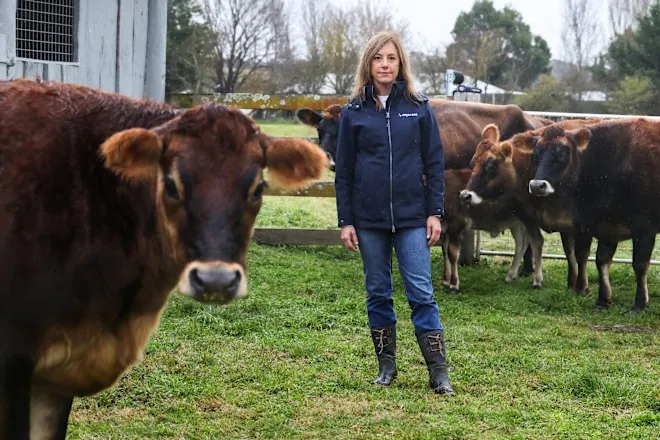
A groundbreaking technology, dubbed the Agscent sensor, is poised to transform agricultural practices by analyzing the breath of livestock. Developed by Dr. Bronwyn Darlington, this innovative device functions much like a breathalyser for cattle, employing nano-sensors to detect chemical compounds in an animal’s exhalation at incredibly low concentrations, down to parts per billion. This non-invasive method holds significant promise for early disease detection and, notably, for confirming pregnancy in cows as early as 18 days after conception – a substantial improvement over traditional veterinary examinations that typically require at least 35 days and involve invasive physical procedures.
Revolutionizing Livestock Health Monitoring
The Agscent sensor represents a significant leap forward in animal welfare and farm management. Dr. Darlington highlights the inherent risks associated with conventional methods. “Every time you bring an animal in and you do something invasive to it, you create a risk to the person, often a veterinarian, and a risk to the animal,” she explained. “But by doing a breath sample, it’s non-invasive and it gives you a really rich biological sample.” This approach not only enhances safety for both humans and animals but also provides a wealth of biological data without causing stress or discomfort.
The technology utilizes electrodes coated with specialized nanoparticles to identify a diverse array of chemical compounds present in an animal’s breath. Artificial intelligence and machine learning algorithms then process this complex data, decoding the information and learning to recognize specific markers associated with various health conditions. This includes the detection of bacteria, viruses, and diseases, as well as identifying metabolic imbalances such as ketosis, a condition where the body burns fat for energy instead of carbohydrates.
AI as a Game-Changer for Farmers
The agricultural sector has seen numerous technological advancements throughout history, from the “green revolution” of the 1960s that introduced high-yield crop varieties to the “agtech revolution” of the 1990s, which leveraged GPS for precision farming. However, the integration of new technologies often presents challenges for farmers, who already manage a wide array of responsibilities. Katie McRobert, director of the Australian Farm Institute, notes the overwhelming influx of new devices and applications aimed at improving farm productivity. “The problem is finding the time to learn how to use them,” McRobert stated.
McRobert further elaborated on the critical role AI can play in overcoming these hurdles. “AI can be a game-changer because the thing that makes farming difficult is the plethora of decisions that everybody has to get through on any given day,” she said. Farmers often act as agronomists, soil scientists, livestock management specialists, and accountants simultaneously. The sheer volume of tasks and decisions required daily can be overwhelming.
McRobert pointed out a common oversight by technology developers: assuming that increased productivity alone will drive adoption, without adequately considering the learning curve. This is precisely where AI’s contribution becomes invaluable. “AI can accelerate decision-making processes when given robust information and good guidelines to work within. It can speed up people’s learning and adoption of technology,” she added. By simplifying complex data and providing actionable insights, AI can significantly reduce the time and effort required for farmers to understand and implement new technologies.
The Future of Farming: Precision and Prediction
Dr. Darlington likens her Agscent product to a futuristic evolution of ancient sensory capabilities. She draws parallels to a dog’s ability to detect stress or even cancer in humans, or a bull’s instinctual drive towards a receptive cow. “Our technology simply means we can create a map of that,” she explained, referring to the chemical signatures detected in breath. “And if you can create a map of it, the task going forward is how many different productivity benefits can you get.”
The potential applications extend beyond pregnancy detection and disease monitoring. By mapping the chemical profiles in an animal’s breath, farmers could gain unprecedented insights into their livestock’s overall health, nutritional status, and even stress levels. This data can inform precise adjustments to feeding regimens, optimize breeding programs, and proactively manage herd health, leading to enhanced productivity and profitability.
The Agscent sensor, powered by AI, represents a paradigm shift in how farmers interact with and manage their animals. It moves away from reactive, often invasive, interventions towards proactive, data-driven insights derived from a simple, non-invasive breath sample. This technology has the potential to usher in a new era of precision agriculture, where understanding the subtle biological signals from livestock becomes key to maximizing efficiency, sustainability, and animal welfare.
Addressing Adoption Challenges
While the technological promise is immense, the successful integration of Agscent and similar AI-driven tools hinges on addressing the practical concerns of farmers. The Australian Farm Institute’s insights underscore the need for user-friendly interfaces and comprehensive support systems. Developers must focus not only on the efficacy of their technology but also on its accessibility and ease of use for a diverse farming community, many of whom are already stretched thin by their demanding workloads.
The integration of AI aims to mitigate these adoption barriers. By processing vast amounts of data and presenting clear, actionable recommendations, AI can empower farmers to make informed decisions more rapidly. This not only boosts immediate productivity but also facilitates a quicker learning curve for new technologies, fostering a more adaptable and technologically advanced agricultural sector. The Agscent sensor, therefore, is not just a diagnostic tool; it is a facilitator of a more informed, efficient, and sustainable future for global agriculture.