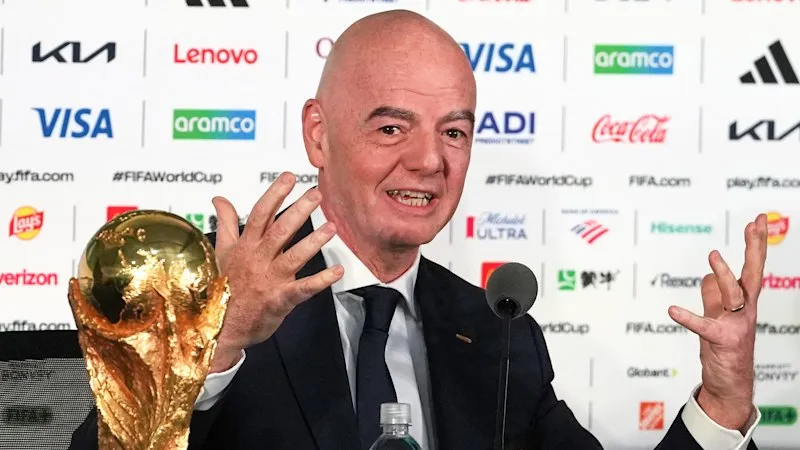
FIFA President Gianni Infantino is facing an unprecedented challenge to his leadership, with Europe’s football governing body, UEFA, demanding his resignation or threatening an emergency no-confidence vote. The ultimatum comes after Infantino was forced to abandon a controversial plan to sell a stake in the World Cup’s commercial rights, a move that sparked widespread opposition and internal dissent within FIFA.
UEFA’s Ultimatum and Loss of Confidence
UEFA, representing 55 European member nations, announced its loss of confidence in Infantino on Saturday morning. Sources indicate that if Infantino refuses to step down, all 55 UEFA member nations would vote to oust him. UEFA possesses the authority to initiate such a vote with the support of just 43 member nations, highlighting the significant leverage the European body holds.
The crisis erupted following Infantino’s attempt to sell a 30% stake in the World Cup’s commercial rights to private investors for a reported £15 billion ($28 billion). This proposal, which would have placed control of FIFA’s premier men’s and women’s competitions’ commercial interests in the hands of external investors, was met with fierce criticism. UEFA accused FIFA of attempting to “trade away football’s soul,” and its member associations, including the English FA, voted unanimously to boycott the World Cup in protest.
Widespread Opposition and Governance Concerns
The opposition to Infantino’s plan was not confined to Europe. CONCACAF, the governing body for North and Central America, also issued a strong demand for change, labeling Infantino’s actions as an “egregious act of poor governance and leadership.” The organization stated that the proposal bypassed established governance frameworks, lacked transparency, and was developed without adequate consultation.
England’s Football Association publicly backed UEFA’s stance, emphasizing the need for a “full and robust review of FIFA’s leadership and governance.” The FA stressed the importance of ensuring the global game is managed transparently for the benefit of all 211 member nations, with the long-term stewardship of football as a priority.
Within FIFA itself, staff reportedly described the situation as an effort to “kill the monster,” indicating deep dissatisfaction with the leadership’s direction. Senior advisor to Infantino, Carlos Cordeiro, resigned in protest, and FIFA’s chief operating officer, Kevin Lamour, suggested that staff had been “deceived” by the plan.
Infantino’s Promises and UEFA’s Accusations
UEFA’s statement detailed Infantino’s perceived failures to uphold promises made during his 2016 presidential campaign. At the time, Infantino pledged transparency and emphasized that FIFA’s funds belonged to the member associations and should be used for football development. UEFA contends that the “shabby, back-room, opaque deal” demonstrated a lack of transparency and that, despite FIFA holding over $5 billion in reserves, funds had not been adequately utilized for the game’s benefit.
In response to the failed proposal, UEFA announced its intention to work with global partners and stakeholders to devise a new strategy for resource distribution through the existing FIFA Forward program. The aim is to utilize FIFA’s substantial reserves to provide a much-needed boost to grassroots football and the wider game across all 211 member countries, without resorting to selling off valuable assets.
The Failed World Cup Rights Deal
Infantino’s plan to sell a significant portion of the World Cup’s commercial rights to private investors ultimately unraveled when FIFA could not secure the necessary support from its member nations. While FIFA initially issued a statement insisting the plan would proceed and denying it constituted “selling football,” the tide turned when the Asian Football Confederation declared its solidarity with UEFA and CONCACAF in opposing the scheme.
The revolt gained further momentum with the withdrawal of support from key confederations. Even Donald Trump, the US President and a noted ally of Infantino, revealed he had not been consulted on the proposal, adding to the political pressure.
Support for Infantino Amidst Criticism
Despite the overwhelming opposition, Infantino did receive a measure of support from the Qatar FA. Its president, Sheikh Hamad bin Khalifa bin Ahmed Al Thani, welcomed the withdrawal of the FIFA Forward Enterprise proposal, stating it was made “in the interest of the global football community.” The Qatar FA applauded the prioritization of unity among member associations and affirmed its support for Infantino’s efforts to strengthen the game globally.
However, this support stands in contrast to the broader sentiment expressed by UEFA and other footballing bodies. Political strategist Ashish Prashar commented that Infantino had “co-ordinated an attempt to steal and gut football to line his own pockets,” underscoring the severity of the allegations and the call for Infantino’s removal.
Conclusion: Rebuilding Trust
The failed World Cup rights deal represents a significant blow to Gianni Infantino’s presidency. While the immediate threat of the proposal has been averted, UEFA’s call for a no-confidence vote signals a deeper crisis of trust within FIFA. The organization’s statement concluded that the “task of rebuilding trust in FIFA has only just begun,” indicating a long road ahead to restore confidence in the global football governing body’s leadership and governance.