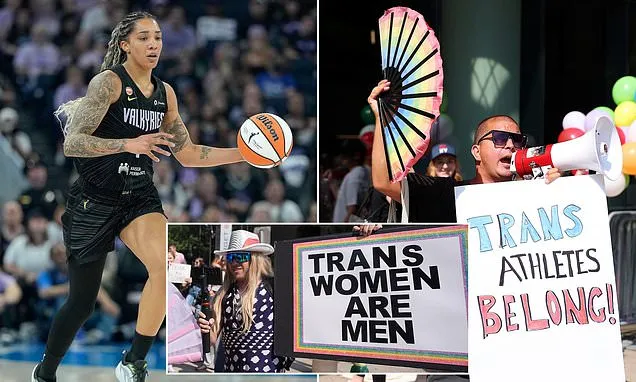
Golden State Valkyries player Gabby Williams has publicly stated she would welcome a transgender athlete to play in the WNBA, emphasizing that transgender rights are a significant issue. Her comments come as the league navigates a broader cultural discussion surrounding the inclusion of transgender athletes in women’s sports.
Gabby Williams on Transgender Inclusion
In a recently circulated interview, Williams expressed a clear and open stance on the matter. “I would welcome a trans athlete on my team or against my team, anytime,” she stated. Williams views the fight for transgender rights as a critical contemporary battle, noting the ongoing efforts to restrict these rights. “I think it’s trans, trans rights, right now, is our new battle,” she remarked, observing that “people’s trans rights being stripped away from them.” She added that the discourse around trans athletes and their eligibility to compete is a prominent part of this larger conversation.
Williams further elaborated on her perspective, suggesting that the issue is not as complex as some might portray. “I don’t think it’s a problem in the world. It’s just another way to kind of trans people,” she said, implying that the focus should be on acceptance rather than exclusion. Her remarks also touched upon the experiences of transgender and non-binary athletes within professional sports, referencing Layshia Clarendon, who made history as the WNBA’s first openly non-binary player. Clarendon, who came out as non-binary in 2020, concluded an 11-year WNBA career in 2024.
Sophie Cunningham’s Stance and League Reactions
Williams’ inclusive viewpoint contrasts with the position taken by Sophie Cunningham of the Indiana Fever. Cunningham recently ignited a debate with her comments suggesting that young girls should not have to compete against “biological men” in sports. This statement has drawn both support and criticism, highlighting the divisions within the WNBA and the broader sports community.
Following Cunningham’s remarks, the Indiana Fever have experienced varied receptions during their recent road games. While some fans have shown solidarity with Cunningham, displaying signs and messages in support of her stance, others have expressed opposition. In Seattle, Portland, and Minnesota, the team encountered protests and counter-demonstrations. Notably, Minnesota Lynx coach Cheryl Reeve wore a T-shirt during a game with the message “Trans kids belong,” signaling support for transgender youth participation in sports.
Upon returning to Indianapolis, the Fever were met with a more welcoming atmosphere, though a lone protester outside Gainbridge Fieldhouse continued to voice support for Cunningham’s position. Cunningham herself has maintained her stance, stating that she was asked a question and responded honestly, without intending to make a broad statement. “I wasn’t trying to make a statement. I was trying to clear the air, and I did that, back in February, so it is what it is,” she said recently. “We’re in the middle of the season, so I’m going to keep it at that. Our team is good, my teammates are good, our locker room is great.”
Context of Transgender Athletes in Sports
The discussion surrounding transgender athletes in the WNBA takes place against a backdrop of limited representation. Currently, the league does not have any players who were assigned male at birth and identify as transgender women. Historically, there have been no such players in the WNBA. The issue has seen more visibility at the collegiate level, with a few high-profile cases making national news. However, the number of transgender student-athletes competing in NCAA sports remains extremely low. In 2024, NCAA president Charlie Baker estimated that fewer than 10 transgender athletes were competing across all NCAA divisions at that time.
Broader Implications and Future Considerations
The differing perspectives within the WNBA, as exemplified by Gabby Williams and Sophie Cunningham, underscore the complex and evolving nature of inclusivity in professional sports. Williams’ call for welcoming transgender athletes and her framing of trans rights as a crucial issue for the community suggest a forward-looking approach for some within the league. Conversely, Cunningham’s focus on biological differences highlights ongoing concerns about fairness and competition in women’s sports categories.
As the WNBA season progresses, the conversation is likely to continue, influenced by player statements, fan reactions, and the broader societal dialogue on transgender rights and participation in athletics. The league’s approach to these issues will shape its culture and its role in the ongoing debate about inclusivity and equality in sports.
The emergence of non-binary athletes like Layshia Clarendon also adds another layer to the discussion, pushing the boundaries of traditional gender categories in professional sports. The experiences of these athletes, alongside the broader debate on transgender inclusion, are critical elements as the sports world grapples with how to balance competitive integrity with the principles of diversity and inclusion.