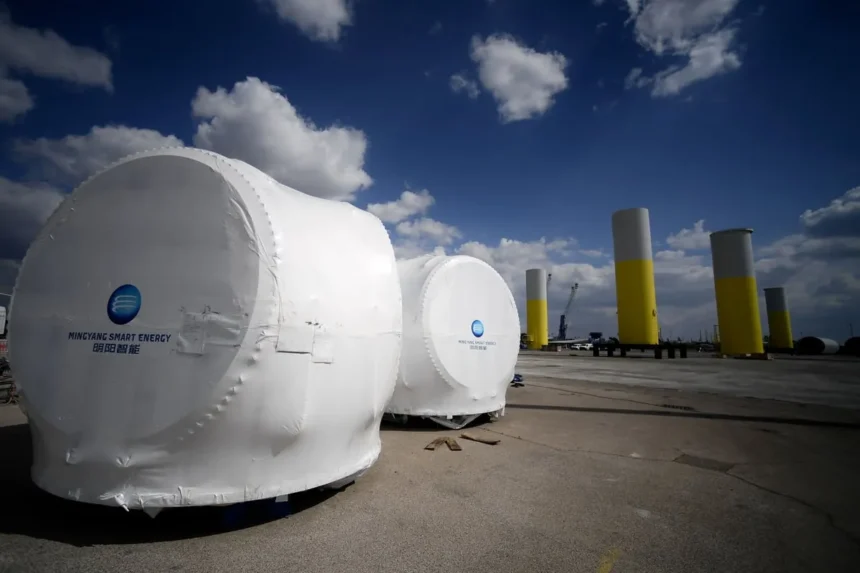
Plans by Chinese wind turbine manufacturer Ming Yang to establish a significant manufacturing presence in Scotland have reignited a complex debate in the United Kingdom, pitting economic opportunities against national security concerns. The proposed £1.5 billion factory, which promised up to 1,500 jobs in the Highlands, was blocked by the UK government in March, drawing criticism from both the Chinese and Scottish administrations.
Economic Opportunities and the Case for Ming Yang
Ming Yang, a rapidly growing player in the global wind energy sector, has been actively advocating for its UK project. The company argues that its investment would bolster the UK’s offshore wind ambitions, particularly in the development of floating wind farms crucial for harnessing the strong winds off Scotland’s coast. A key aspect of their proposition is the potential to create substantial employment in the Highlands, an area often targeted for industrial regeneration. Furthermore, Ming Yang’s turbines are reportedly more cost-effective than those offered by European competitors like Vestas and Siemens Gamesa, presenting a financially attractive option for the UK’s burgeoning renewable energy sector.
Following the UK’s decision, Ming Yang swiftly explored alternative European locations, engaging with Spain and hosting Prime Minister Pedro Sánchez at its headquarters in Guangdong. This strategic move highlights the company’s determination to secure a European foothold. The ongoing lobbying efforts by Ming Yang to reverse the UK government’s decision have brought the merits of Chinese involvement in critical national energy infrastructure back into sharp focus.
National Security Concerns and Counterarguments
The primary objection to Ming Yang’s UK plans centers on national security. Critics raise concerns about potential vulnerabilities within the UK’s energy infrastructure if it becomes reliant on Chinese technology. A significant worry is the control manufacturers retain over the operational software of their turbines, even after installation. This raises the possibility that a wind farm equipped with Chinese turbines could be remotely deactivated, potentially disrupting power transmission and the national grid. Cyber espionage is another cited risk, a concern that led Germany to ban Chinese wind turbines from its offshore wind projects a year prior.
Ming Yang has attempted to address these security fears by proposing a joint venture with UK energy firm Octopus. This venture would reportedly include ringfenced UK governance to manage security aspects. Aman Wang, Ming Yang’s UK chief executive, has stated the company’s commitment to meeting UK government requirements for national security. However, some experts remain unconvinced, pointing out that intellectual property and algorithms embedded in turbine software would still be under the control of the Chinese manufacturer. There are also concerns that Ming Yang, like other Chinese companies, could be compelled by the Chinese Communist Party to comply with directives that might compromise UK security.
The article notes that some European competitors have historically been able to access turbines remotely, sometimes without the operator’s full awareness. This raises questions about the efficacy of technical workarounds and governance safeguards when dealing with manufacturers operating under different national legal and political frameworks. Given these uncertainties, allowing a Chinese manufacturer into the UK’s offshore wind ecosystem is viewed by some as potentially irresponsible, especially in light of the UK’s Strategic Defence Review, which identified China as a “sophisticated and persistent challenge.”
Broader Implications for Critical Infrastructure
The debate extends beyond just wind turbines to the broader question of who should be involved in building and connecting to the UK’s critical national infrastructure for the long term. The case of British Steel, where Chinese ownership led to concerns about the supply of essential materials, serves as a cautionary tale about the risks of economic dependency in the current geopolitical climate. Wind turbine supply chains involve long-term operational and maintenance contracts, often spanning up to 15 years, creating sustained dependencies.
In contrast, the UK has been strengthening ties with other nations in the offshore wind sector. A recent pact with Japan positions the UK as a leading clean energy partner for the European nation, fostering collaborations that also generate jobs, such as the 180 announced at the Port of Nigg by its Japanese owner, Mitsui. The UK is also deepening cooperation with European states, evidenced by the Hamburg Declaration on pan-European collaboration in the North Sea. Vestas, a European competitor, is also considering a significant investment in a factory in Edinburgh, potentially creating 500 jobs.
Constitutional Divide and Future Outlook
The differing perspectives on Ming Yang’s involvement highlight a potential constitutional divergence between the Scottish and UK governments. While the Scottish government has expressed concerns about the decision’s impact on industrial development, the UK government emphasizes national security. Experts suggest that a unified approach between Holyrood and Westminster is essential, as division could inadvertently benefit China. The ultimate decision on Ming Yang’s future in the UK will likely hinge on the government’s ability to balance the undeniable economic benefits against the perceived national security risks associated with Chinese technology in critical infrastructure.