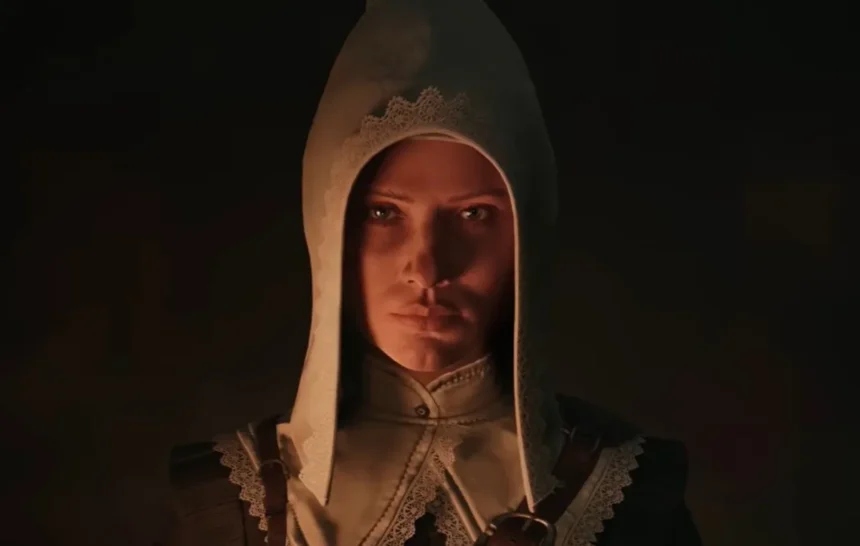
Patrice Désilets, the visionary behind the original Assassin’s Creed and Prince of Persia: The Sands of Time, is embarking on a new journey with his long-gestating project, 1666: Amsterdam. After a decade-long struggle involving legal battles and development hurdles, the game is finally set to launch in early access on August 25th. This title marks the second release from Désilets’ studio, Panache Digital Games, following their 2019 survival game, Ancestors: The Humankind Odyssey. While 1666: Amsterdam shares DNA with Désilets’ previous works, featuring a blend of stealth and action within a sandbox environment, it introduces new elements like roguelike mechanics, witches, and playable cats.
The Genesis of 1666: Amsterdam
The concept for 1666: Amsterdam has been in development since 2010, originally conceived at THQ Montreal. However, its path to realization was fraught with challenges. After Ubisoft acquired THQ Montreal, Désilets was dismissed, leading to a protracted legal dispute over the intellectual property. He eventually regained the rights in 2016, but the journey to bring the game to fruition continued, further complicated by the global pandemic.
Speaking about the evolution of the game, Désilets highlighted how significantly the current iteration differs from its initial concept. “Oh it’s totally different,” he explained. “The only thing between the two that remains is 1999 and 1666, and Amsterdam.” The inclusion of witches as central characters emerged in 2020, after the successful launch of Ancestors. Désilets envisioned them as powerful, badass figures, akin to his reimagining of assassins in his earlier work. “Quickly [I said], ‘let’s do to the witches what I did to the assassins’; to have a witch as a main character that’s badass in the style of games that I make,” he stated.
A Decade-Long Drive to Create
The persistent motivation to complete 1666: Amsterdam stems from a sense of commitment and unfinished business. “I guess so. Maybe it’s because when it all went down at the beginning, I said I’m going to fight to get it back. And then I did get it back, so I was like, ‘OK so, I guess now I need to do it,'” Désilets reflected. With his team at Panache Digital Games capable of handling open-world development, the opportunity arose to revisit the project. He views having the rights to a known IP as a significant advantage in the current market, providing a crucial “jumpstart” for his business.
The Allure of Multiple Timelines
A recurring motif in Désilets’ games, including Assassin’s Creed and 1666: Amsterdam, is the exploration of multiple timelines. He sees this as a powerful narrative device and a reflection of humanity’s complex relationship with time. “I feel [time] is also something that as humans we cannot control yet. It’s the only thing we don’t control and it drives us crazy,” he commented. This fascination with time began early in his career, with games like 1999’s Hype: The Time Quest predating his more widely known works.
Looking back, Désilets humorously notes his consistent focus on time-spanning narratives. “I’ve been doing the same game for 30 years now. That’s crazy,” he admitted, acknowledging that some might view his work as lacking originality. Yet, he finds profound inspiration in history, seeing it as a realm as fantastical and wild as any imagined future.
Embracing Early Access and AI
1666: Amsterdam’s decision to launch in early access is a deliberate departure from the norm for single-player narrative-driven games. Désilets views it as a collaborative process, allowing players to contribute to the game’s development, particularly its mechanical and systemic aspects. “For me, it’s always been the vision of Panache. I’m an old monkey. I come from a time in the video game industry where we would give you a disc and there was nothing we could do. And now it’s not this time anymore. We can update the game,” he explained.
The development process also touched upon the use of generative AI. While acknowledging its utility for rapid iteration and variation, especially for smaller teams, Désilets emphasized a commitment to human oversight. “We use it in development and in the final product we’ll make sure everything that’s in the game has been retouched by a human,” he assured. He has since halted the use of AI prompts for the game’s development, citing ethical concerns.
A Conscious Separation from Assassin’s Creed
Désilets maintains a deliberate distance from the modern Assassin’s Creed franchise. He has not played the games since Assassin’s Creed 3, where he stopped after two hours, feeling too close to the project. “I understand [it], and then I see the matrix,” he said, preferring to protect himself and the perception of the games’ current developers. He recognizes the immense difficulty in creating an Assassin’s Creed title and the impossibility of pleasing everyone.
His current independent status offers a different perspective on game development. Unlike the political complexities of large AAA studios, Désilets values the close-knit, personal environment of his smaller team at Panache. “In a big, big studio – because I’ve been there – it becomes more politics than game creation, which is totally normal,” he observed. The ability to maintain direct connection and creative synergy, especially after experiencing the challenges of remote development during the pandemic, is paramount to his process.
Reflections on Prince of Persia and History’s Appeal
Regarding the recently cancelled Prince of Persia remake, Désilets confirmed he was not consulted, stating, “Ubisoft don’t talk to me.” He attributes this lack of communication to past conflicts, but expresses no lingering resentment. “It’s OK. I don’t wake up at night thinking about them. I don’t care anymore,” he stated.
Désilets’ enduring fascination with history as a source of inspiration is a cornerstone of his creative output. He likens historical periods to “fantasy worlds” that offer profound insights into human experience, drawing parallels between the vast changes witnessed by his grandmother over her lifetime and the dramatic shifts across centuries. “It’s as strange to us as a totally invented world,” he concluded, underscoring history’s power to evoke wonder and understanding.