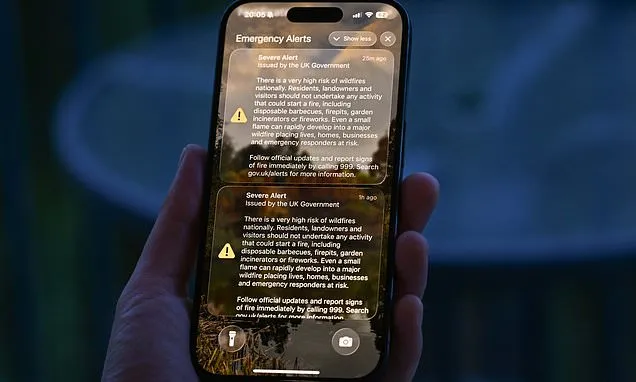
Millions of mobile devices across England and Wales recently emitted a loud siren, triggering a government Emergency Alert warning about the risk of wildfires. The alert advised against activities that could ignite fires, such as using barbecues, campfires, and fireworks. While intended to protect the public, the alert caused significant distress and panic for many, with some individuals reporting receiving the notification multiple times. This incident has drawn attention to past instances where emergency alert systems have malfunctioned, leading to public concern and questions about their reliability.
A History of Emergency Alert Malfunctions
The recent UK alert is not an isolated event. Across the globe, emergency alert systems have experienced significant errors, sometimes with severe consequences for public safety and trust. These incidents highlight the complexities and potential pitfalls of deploying mass notification technologies.
Hawaii’s Ballistic Missile Scare (2018)
One of the most infamous emergency alert failures occurred on January 13, 2018, in Hawaii. Residents and tourists received a terrifying alert stating: ‘BALLISTIC MISSILE THREAT INBOUND TO HAWAII. SEEK IMMEDIATE SHELTER. THIS IS NOT A DRILL.’ The false alarm, which was sent manually by an employee of the Hawaii Emergency Management Agency during an internal drill, caused widespread panic. Drivers abandoned their vehicles on highways, and residents sought refuge in tunnels and garages, genuinely fearing a nuclear attack. While the error was corrected via Twitter 12 minutes later, a subsequent alert confirming it was a false alarm took 38 minutes to be issued. Officials explained that the system lacked a template for retracting alerts, necessitating a manual entry process that caused the delay. The administrator of the agency at the time, Vern Miyagi, issued a profound apology for the distress caused, acknowledging the mistake during a period of heightened concern over missile threats.
Los Angeles Wildfire Evacuation Error (2025)
In January 2025, a critical error in the emergency alert system for Los Angeles County resulted in 9.6 million residents mistakenly being told to evacuate due to wildfires. The alert was intended only for the West Hills area, which was directly threatened by the Kenneth Fire. However, a technical glitch caused the evacuation warning to be broadcast across the entire county. Los Angeles County Supervisor Janice Hahn confirmed the mistake on social media, stating it was a technical error and a correction would follow. The incident sparked outrage among residents already on edge due to the ongoing wildfires. Many expressed their frustration and anger online, criticizing the system’s failure and the panic it induced. Some comments highlighted the potential for such errors to lead to dangerous situations or erode public trust in emergency communications.
Dallas Siren System Hacking (2017)
In April 2017, the city of Dallas experienced a different kind of alert failure when its emergency siren system was hacked. For approximately 1.5 hours overnight, all 156 of the city’s sirens, typically used for severe weather warnings, were activated maliciously. The unexplained activation of the sirens in the middle of the night caused considerable alarm among residents, leading to a surge in calls to emergency services. Officials from the Office of Emergency Management had to take the system offline to regain control, a process that involved carefully following protocols to avoid further compromising the siren network. The incident underscored the vulnerability of public alert systems to cyber threats.
UK Network Alert Failure (2023)
More recently, in 2023, a planned test of the UK’s Emergency Alert system encountered issues with the Three mobile network. While tens of millions of phones across the UK received the 10-second siren and accompanying test message, a significant number of Three customers reported not receiving the alert at all. Others reported receiving it at the wrong time. Investigations suggested a configuration error within the Three network was responsible. Unlike other networks that repeated the alert to ensure widespread delivery, Three reportedly sent it out only once at 3 p.m., meaning only devices actively connected at that precise moment received the notification. This failure meant a portion of the population was not included in the crucial test, raising questions about the system’s reach and reliability across different providers.
Managing Emergency Alerts on Your Phone
For individuals concerned about the potential for disruptive or erroneous emergency alerts, most smartphones offer options to disable them. While disabling these alerts means you will not receive official warnings for imminent dangers, it provides peace of mind for those who find the notifications overly alarming or disruptive.
Disabling Alerts on iPhones
On an iPhone, users can turn off ‘severe alerts’ and ‘extreme alerts’ by navigating to the Settings app. From there, select ‘Notifications,’ and scroll down to the ‘Government Alerts’ section. Toggling off the relevant options will disable these specific types of notifications.
Disabling Alerts on Android Devices
For Android users, the process typically involves going to the Settings menu and searching for ‘Emergency Alerts.’ Within this section, users can usually find options to disable or customize the types of alerts they receive. The exact steps may vary slightly depending on the specific Android version and manufacturer.
Conclusion
The recurring issues with emergency alert systems, from accidental missile warnings to widespread evacuation errors and network failures, underscore the critical need for robust testing, stringent protocols, and reliable technology. While these systems are designed for public safety, their malfunctions can cause significant anxiety and erode public trust. For those seeking to avoid potential disruption, understanding how to manage alert settings on personal devices offers a direct solution, though it comes with the trade-off of foregoing official warnings.