Calls are mounting for the UK to adopt an approach similar to Ireland’s to address a significant rise in unauthorized traveller encampments. The proposed solution, dubbed the ‘Irish Option,’ advocates for making trespass a criminal offense, a move proponents argue would empower police to act swiftly against illegal land seizures.
The Surge in Unauthorized Encampments
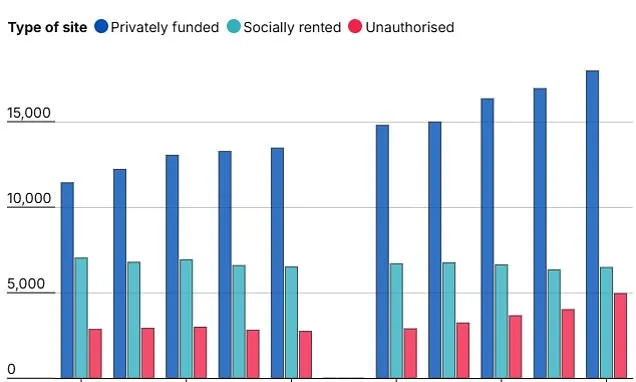
Recent official figures reveal a stark increase in caravans occupying land without planning permission. In January, there were 4,950 caravans on unauthorized sites, marking a 73 percent jump from five years prior. This surge has placed considerable strain on local authorities, who often face lengthy legal battles to clear these encampments after receiving complaints from residents.
The current legal framework treats trespass primarily as a civil matter, placing enforcement responsibility with local councils rather than the police. This distinction, critics argue, hinders rapid intervention and allows illegal sites to become entrenched before any action can be taken.
Proposals to Criminalize Trespass
Conservative politicians are championing the ‘Irish Option,’ proposing legislation that would criminalize trespass when two or more individuals arrive on land with a vehicle and refuse to leave when asked by the landowner. Sir James Cleverly, a Conservative housing spokesman, stated that such a measure would serve as a potent deterrent against trespass, exposing those who break the law to the risk of criminal prosecution.
He further suggested that leaving the European Convention on Human Rights (ECHR) would insulate such legislation from legal challenges, referencing the High Court’s 2024 decision to strike down a previous law enacted under Boris Johnson’s administration that criminalized illegal camping. That law, which carried a penalty of up to three months in prison, was deemed discriminatory against travellers under the ECHR.
Notably, Ireland, also a signatory to the ECHR, has seen its trespass law upheld by its courts against similar legal challenges. This precedent is seen by supporters of the ‘Irish Option’ as evidence that criminalizing trespass can be effective and legally sound.
Concerns Over Planning Law Revisions
Simultaneously, concerns have been raised about recent changes to national planning laws, with critics suggesting they may inadvertently facilitate the establishment of new encampments. Amendments made by the housing, communities, and local government department, reportedly under Angela Rayner, have drawn particular scrutiny.
Specifically, references to potential environmental damage and the health and well-being impacts of unauthorized encampments were reportedly removed from the final version of the National Planning Policy Framework. Additionally, language suggesting that locations not closely related to existing settlements might be appropriate for traveller sites has been introduced.
Critics, including Sir James Cleverly, argue that these revisions could be exploited, allowing individuals to establish sites and then seek retrospective planning permission. He expressed dismay, stating that watering down the rules invites unauthorized camps and allows them to be rubber-stamped after construction, much to the frustration of local communities.
However, the Ministry of Housing, Communities & Local Government has refuted these claims. A press notice asserted that the reforms do not ease the process for securing permission for unauthorized development. Instead, the ministry contends that the framework has been clarified and strengthened, giving greater weight to intentional breaches of planning rules and telling councils to give substantial consideration to whether a site was built without permission when reviewing retrospective applications.
Traveller Perspectives and Counterarguments
Traveller groups and advocates offer a different perspective, arguing that the current system leaves them with little choice but to break the law. Cliff Codona, who leads the National Travellers’ Action Group, claimed that planning applications are often immediately stalled once an applicant’s identity as a traveller is known. These groups also contend that criminalizing trespass effectively criminalizes their nomadic way of life.
The government has maintained its commitment to tackling illegal encampments, emphasizing that current powers are robust. A government spokesperson stated that new planning rules explicitly address potential environmental and transport impacts and make retrospective permission harder to obtain for developments lacking prior approval.
The ‘Irish Option’ in Practice
Ireland’s approach, implemented in 2002, criminalized trespass. This shift allowed An Garda Síochána (the Irish police force) to intervene more effectively when unauthorized encampments were established. The law has reportedly withstood legal scrutiny, providing a model that UK policymakers are now considering.
The debate highlights a complex intersection of property rights, planning law, cultural practices, and law enforcement. While proponents of the ‘Irish Option’ seek stronger deterrents and swifter police action, opponents and traveller advocates raise concerns about criminalizing a way of life and the potential for discriminatory application of the law.
Conclusion: A Path Forward?
The escalating numbers of unauthorized traveller sites present a significant challenge for communities and authorities across the UK. The ‘Irish Option’ offers a potential legislative pathway, focusing on criminalizing trespass to enable more decisive action. However, any such reforms would need careful consideration to balance the rights of landowners and the broader community with the rights and traditions of the travelling community, while also navigating complex legal and human rights frameworks.