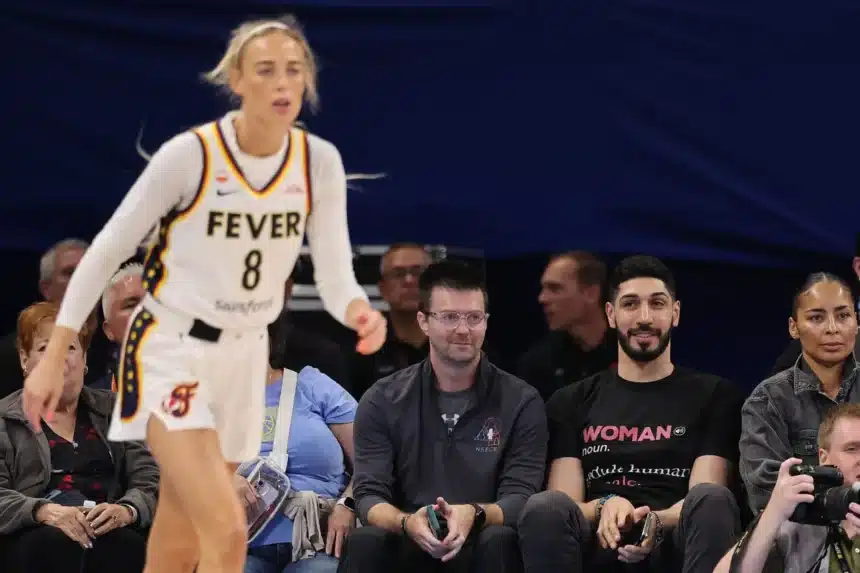
The recent Indiana Fever vs. Chicago Sky game on Sunday, August 23, saw an incident involving former NBA player Enes Kanter and Sky guard Natasha Cloud that has drawn significant attention. Following Kanter’s removal from the arena, a segment of WNBA fans has directed criticism towards Fever guard Sophie Cunningham, attributing the controversy to her prior public statements regarding transgender athletes in women’s sports. Cunningham herself played a minimal role in the game, logging just 10 minutes and scoring three points, with a plus/minus of -10 in the Fever’s 110-93 victory. Despite her limited on-court presence and lack of public comment on the matter, many observers believe Cunningham is the root cause of the escalating tensions.
The Genesis of the Controversy: Cunningham’s Statements
The debate surrounding transgender athletes in the WNBA has become a prominent topic in recent weeks, largely fueled by comments made by Sophie Cunningham in July. Cunningham expressed her views on the importance of protecting biological women in sports. While transgender athletes have not historically been a significant factor in WNBA roster decisions, the discussion has intensified, with Cunningham positioned by some fans and commentators as a central figure in this ongoing dialogue. This narrative suggests that her statements have created an environment where such incidents, like the one involving Kanter and Cloud, are more likely to occur.
Fan Reactions and Accusations
Following the events at the Wintrust Arena, social media platforms and fan forums buzzed with commentary. Many fans expressed frustration, believing that Cunningham’s stance has negatively impacted the WNBA’s inclusive atmosphere. One WNBA reporter and fan articulated this sentiment, stating, “Multiple WNBA players and the league itself have been under attack for over a month, and Sophie Cunningham is at the center of it.” This perspective suggests that the league has allowed Cunningham’s influence to disrupt what was intended to be an open and welcoming environment.
The incident involving Kanter and Cloud further inflamed these feelings. A fan remarked after the altercation, “This league has let Sophie Cunningham destroy what was supposed to be an inclusive environment, but Cloud’s willingness to fight against that is refreshing.” This highlights a perceived shift from inclusivity to contention, with Cunningham’s earlier remarks seen as the catalyst. Some fans have called for significant repercussions for Cunningham, with one individual advocating for a lifetime ban, deeming her actions to have caused “irreparable damage to the league.”
Further expressions of discontent included calls for accountability. Another fan stated, “Cunningham needs to be asked targeted questions about this until she takes accountability for what she’s brought to the league.” The sentiment was echoed by others who directly linked Kanter’s actions and the surrounding atmosphere to Cunningham. One fan observed, “The shirt he is wearing explains it all. It’s the Sophie Cunningham effect. Honestly, it’s disgusting to see how there’s so much hate lately. Whichever team faces the Indiana Fever, there are rallies related to hating the trans community, and it’s unacceptable.” This fan explicitly blamed Cunningham for fostering an environment of animosity and division within the WNBA community.
Another WNBA reporter summarized the prevailing sentiment among this group of fans by stating, “This is on Sophie Cunningham, and I will not be explaining any further.” This indicates a strong conviction among some observers that Cunningham bears direct responsibility for the current climate and the specific incident that unfolded.
The Enes Kanter Incident: Details of the Event
The controversy unfolded during the Indiana Fever vs. Chicago Sky game at the Wintrust Arena in Chicago on Sunday, August 23. Enes Kanter, a former NBA center, attended the game and was seated courtside. He wore a t-shirt featuring a definition of a woman and actively shared his experience on social media, including his attendance at an “XX-XY rally” protesting the inclusion of transgender athletes in women’s sports.
During the game, Sky guard Natasha Cloud reportedly directed words toward Kanter after a play. Kanter responded by appearing to egg her on, which escalated the situation. Arena security intervened, and Kanter was subsequently escorted out of the building. Following his removal, Kanter made a statement suggesting that Cloud’s actions demonstrated that “women don’t support women.” This comment was widely interpreted as a provocative and perhaps ironic remark, given Kanter’s public persona and his stated aspirations to be a 2027 WNBA draftee, a move where he has identified himself as a woman.
It is important to note that Sophie Cunningham was not physically present at the altercation between Kanter and Cloud, nor was she involved in the immediate exchange. However, the timing of the incident, occurring shortly after Cunningham’s public statements on transgender athletes in July, has led many fans to connect the events and attribute the underlying tension to her influence. The situation highlights the broader cultural and political discussions intersecting with professional sports, particularly concerning gender identity and inclusivity.
Broader Context and Fan Perspectives
The incident involving Enes Kanter and Natasha Cloud, and the subsequent fan reactions placing blame on Sophie Cunningham, underscore the polarized nature of discussions surrounding transgender participation in women’s sports. While Cunningham’s team, the Indiana Fever, secured a decisive victory over the Chicago Sky, the off-court narrative has become a significant talking point. The perception among some fans is that Cunningham’s public stance has inadvertently or intentionally amplified divisive rhetoric, creating a climate where confrontations like the one involving Kanter can occur.
Kanter’s own actions, including his choice of attire and his engagement with the crowd and players, are also central to the incident. His subsequent commentary, framing the interaction with Cloud as a lack of female solidarity, adds another layer to the complex situation. This has led to a multifaceted debate, with different fan groups focusing on various aspects: Cunningham’s initial statements, Kanter’s behavior, Cloud’s reaction, and the WNBA’s broader policies on inclusivity.
The intensity of some fan reactions, including calls for severe penalties against Cunningham, reflects the deep emotions involved in this debate. Whether these sentiments are justified or represent an overreach is a matter of ongoing discussion among WNBA followers. The situation serves as a stark reminder of how public figures and their statements can influence the discourse surrounding sensitive social issues within the realm of professional sports.
Conclusion
The incident at the Indiana Fever vs. Chicago Sky game, which led to Enes Kanter’s ejection and a subsequent verbal exchange with Natasha Cloud, has ignited a debate among WNBA fans. A significant portion of this discussion has focused on Sophie Cunningham, with many blaming her for creating an environment conducive to such controversies due to her prior comments on transgender athletes. While Cunningham was not directly involved in the altercation, her public statements have been identified by some fans as the foundational element that has led to increased tension and division within the league. The situation highlights the ongoing and often contentious dialogue surrounding inclusivity, gender identity, and sports.