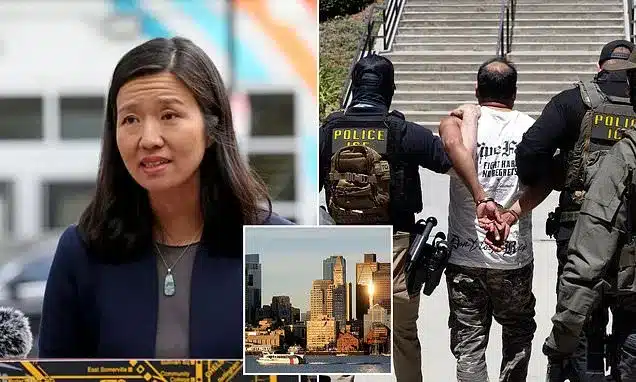
Boston Mayor Michelle Wu has ignited a public dispute with the Department of Homeland Security (DHS) over Immigration and Customs Enforcement (ICE) efforts to lease nearly 250 parking spaces in the city’s downtown business district. The conflict escalated when Wu urged local business owners not to rent parking spots to the federal agency, a move the DHS characterized as an overreach and a threat to public safety.
Mayor Wu’s Stance on ICE Parking Leases
The controversy began when a notice appeared on a federal procurement website indicating ICE’s interest in securing 249 consecutive parking spots. In response, Mayor Wu dispatched a letter on August 18 to parking garage and lot owners in Boston. She expressed alarm over the potential procurement, labeling it a “distressing news” and an “unprovoked and unwarranted escalation” that could pose significant risks to public safety and disrupt the region’s economic activity.
Wu’s letter implored business owners to “Reject any proposition by ICE to facilitate an attack on the people of Boston.” She highlighted that Boston had previously banned ICE from using city property for immigration enforcement activities in February. This earlier executive order, Wu noted, followed deadly shootings in January during clashes involving immigration agents.
The mayor also indicated that the city had submitted a Freedom of Information Act (FOIA) request to ascertain any local responses or collaborations with ICE. She pledged to keep property owners updated on the progress of this request, emphasizing the importance of partnership in safeguarding the city.
Department of Homeland Security’s Rebuttal
The DHS swiftly condemned Mayor Wu’s actions, taking to social media platform X to label her efforts as “unhinged.” A DHS spokesperson stated that Wu lacks the authority to block federal agencies from using private property. The agency accused Wu of attempting to “intimidate law-abiding Bostonians” rather than focusing on apprehending individuals deemed to be in the country illegally.
In a statement, the DHS asserted that “sanctuary politicians must stop putting politics above public safety.” The agency argued that federal law enforcement officers require a visible presence to apprehend individuals who may pose a risk to communities. They criticized what they described as politicians hindering local law enforcement’s ability to cooperate with DHS, suggesting this leads to the release of individuals who then re-offend.
To underscore their concerns, the DHS provided a list of four individuals arrested by ICE in Massachusetts, citing them as examples of public safety threats. The list included two men with documented incidents in Boston: Jorge Luis Pena, convicted of child sexual offenses, and Omar Johnson, convicted of armed bank robbery. The DHS also named Phuc Trong Nguyen, convicted of rape and kidnapping, and Leonardo Miliano, convicted of firearm charges.
Economic and Legal Considerations
Estimates suggest that the parking spaces could cost ICE approximately $30 per day per spot. Greg Vasil, CEO of the Greater Boston Real Estate Board, indicated that over a proposed five-year lease, this could amount to roughly $13 million. ICE’s Boston office criticized Wu’s stance, accusing her of using “threats, intimidation and coercion” against private property owners who wish to cooperate with federal law enforcement.
The agency further contended that private citizens should be free to allow federal law enforcement onto their property without interference from local officials. They reiterated their stance that elected officials should prioritize public safety by cooperating with federal agencies rather than obstructing their operations.
Broader Implications and Support for Wu’s Position
A spokesperson for Boston city government defended Mayor Wu’s actions, stating that she and other leaders across the political spectrum agree that increased ICE activity, often referred to as “surges,” makes communities less safe. They cited instances where businesses have closed or reduced operations to protect employees and customers during such surges, leading to economic damage.
The city’s statement reiterated that the Mayor’s letter urged property owners to reject what they termed an “unwarranted escalation by ICE that will endanger our communities, hurt our economy and undermine public safety.”
Massachusetts Governor Maura Healey, a Democrat, has publicly supported Mayor Wu’s position. Governor Healey has been a vocal critic of ICE’s tactics, particularly concerning their potential to escalate enforcement activities. She has advocated against ICE securing a significant number of parking spots in downtown Boston while the agency is, in her view, engaging in “illegal tactics.”
Governor Healey’s stance aligns with the PROTECT Act, a law she was signing that aims to restrict ICE arrests at sensitive locations like schools, hospitals, and courthouses without a warrant. This broader legislative effort reflects a growing tension between state and local governments seeking to limit federal immigration enforcement and the federal government’s assertion of its authority.
Conclusion
The dispute between Boston Mayor Michelle Wu and the Department of Homeland Security highlights a significant policy clash over immigration enforcement and the role of local government. While Mayor Wu and her allies argue that ICE’s actions threaten public safety and economic stability, the DHS maintains its right to operate on private property and emphasizes the need for federal law enforcement presence. The situation underscores the ongoing debate about federal authority versus local control in immigration matters and the potential consequences for communities.