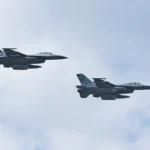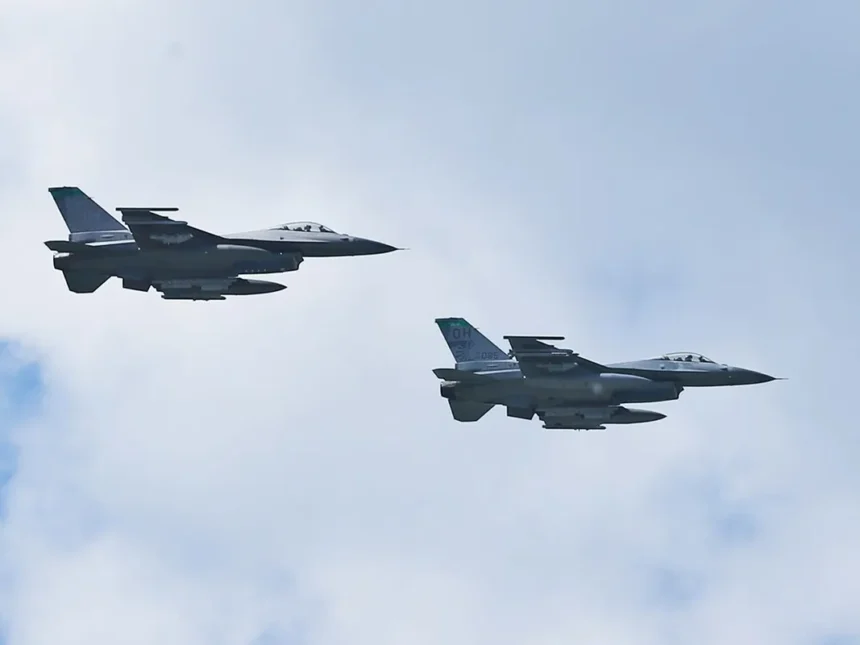
Organizers of the Canadian International Air Show (CIAS) in Toronto have stated that the withdrawal of the U.S. Air Force’s F-16 Viper Demonstration Team was due to a last-minute scheduling conflict, not political tensions or recent remarks made by U.S. officials about Canada’s military capabilities. The announcement came via a social media post earlier this week, confirming the team’s absence from the annual event held on Toronto’s waterfront.
Scheduling Conflict Cited as Reason for Withdrawal
The CIAS, recognized as North America’s longest-running air show, explained that sudden schedule changes are an inherent part of air show operations and are often beyond their control. “Last-minute schedule changes are a reality of real time Air Show operations, and these decisions remain outside of our control,” the organizers stated. They assured attendees that the rest of the planned lineup, including celebrations for the 55th anniversary of the RCAF Snowbirds and performances by the RCAF CF-18 Hornet and a WWII Heritage Flight, remains confirmed for an exciting weekend.
Lori Duthie, executive director of the CIAS, reiterated to reporters during the show’s media day that the decision was purely a matter of scheduling. “It was a scheduling issue,” Duthie confirmed. “We work very closely, our Canadian Forces and the United States Air Force across North America.” This explanation was echoed by a spokesperson for the F-16 Viper Demonstration team, who also cited a scheduling conflict as the reason for their inability to participate.
Staff-Sgt. Steven Cardo, a representative for the F-16 Viper Demonstration team, issued a statement expressing regret for the cancellation. “The team sincerely regrets to announce that, due to a scheduling conflict, they are unable to participate in this weekend’s Canadian International Air Show,” Cardo said. He added that decisions to withdraw from scheduled appearances are never taken lightly and extended apologies to the organizers, Canadian partners, and aviation enthusiasts.
Speculation Over Political Motives
The abrupt cancellation fueled speculation among the public and media, with some suggesting it was linked to ongoing trade disputes between the two countries, or recent comments from U.S. officials. There was particular attention on remarks made by U.S. Treasury Secretary Scott Bessent, who had recently commented on the perceived lack of military strength in Canada’s navy. Bessent had reportedly quipped about Canada’s naval capabilities, referencing “two submarines from the Edmonton mall” in a television interview.
Additionally, some observers pointed to a previous executive order by U.S. President Donald Trump, which humorously, or controversially depending on interpretation, renamed Lake Ontario as “Lake America.” However, organizers firmly dismissed any connection between these political discussions and the F-16 team’s withdrawal.
F-16 Team’s Conflicting Schedule
Further details emerged regarding the F-16 Viper Demonstration team’s conflicting commitments. The team was scheduled to perform at an air show in Batavia, New York, on September 5 and 6. The Canadian International Air Show in Toronto runs from September 5 to 7, overlapping with the New York event. This overlap appears to be the core of the scheduling conflict that prevented their participation in Toronto.
The U.S. Air Force team’s commitment to the Batavia air show, occurring on the same weekend as the Toronto event, highlights the logistical challenges and tight scheduling often faced by such demonstration units. Their participation in multiple events across different locations requires careful coordination, and sometimes, unavoidable conflicts arise.
Air Show Continues with Full Lineup
Despite the absence of the F-16 Viper Demonstration Team, the Canadian International Air Show is proceeding with its full roster of performers. The event is a major highlight of the Canadian National Exhibition (CNE) in Toronto, drawing large crowds to the city’s waterfront. Organizers emphasized their commitment to transparency with their audience and pledged to keep them informed of any further updates.
The CIAS has a long history of showcasing impressive aerial displays, and this year’s event continues that tradition with a diverse range of participants. The focus remains on delivering a memorable experience for aviation enthusiasts, celebrating both modern and historical aircraft, and honoring the contributions of military aviation. The organizers’ proactive communication aims to manage expectations and ensure a positive experience for all attendees, despite the unexpected change in the lineup.
Conclusion
The withdrawal of the U.S. F-16 Viper Demonstration Team from the Toronto air show has been officially attributed to a scheduling conflict, as confirmed by both the event organizers and the team itself. While speculation about political influences arose due to recent U.S. rhetoric, organizers have explicitly stated these factors played no role in the decision. The air show continues as planned, featuring a robust lineup of aerial performers, underscoring the dynamic and sometimes challenging nature of coordinating large-scale international events.