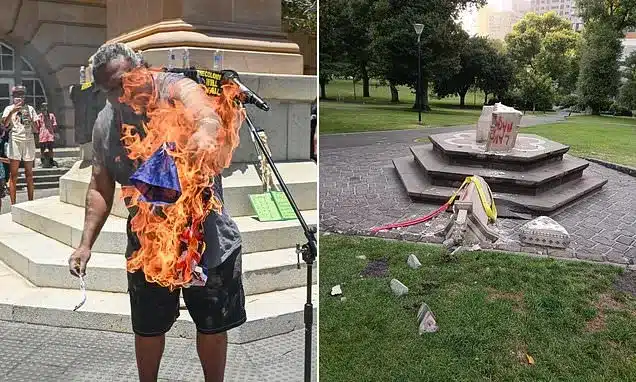
Proposed legislation in Australia could introduce jail time for individuals who burn the national flag or vandalize war memorials, under a plan unveiled by the Opposition. The proposed Australian National Symbols and Heritage Protection Bill aims to bolster legal protections for the nation’s symbols and historic sites. The plan includes creating a new federal offense for the serious public desecration of the Australian flag, particularly when such actions risk inciting hatred, violence, threatening public order, or causing a disturbance.
Stricter Penalties for Desecrating National Symbols
Opposition Leader Angus Taylor stated that while political criticism of Australia is permissible, flag burning crosses a line. “It is a symbol, it is part of our nation and our heritage that really matters,” Taylor commented. “And I know Australians feel very strongly about this. To see it being burnt is unacceptable to most Australians and certainly unacceptable to me. And I think it’s appropriate that a penalty of up to a year imprisonment is established.” This proposed penalty follows an incident earlier this year where an Australian flag was burned during an ‘Invasion Day’ protest in Brisbane.
Beyond flag desecration, the Coalition’s proposal also targets the deliberate damage, defacement, or desecration of war memorials, statues, plaques, and other monuments that commemorate Australian history. These new federal offenses could carry significant jail terms.
Recent Incidents Prompt Legislative Action
The push for stronger protections comes in response to a series of vandalism incidents affecting war memorials and national monuments in recent months. In western Victoria, a war memorial in Dobie was defaced, with a plaque honoring local veterans stolen and political graffiti applied to the site. This incident occurred shortly after the century-old Beaufort war memorial was vandalized with slogans such as ‘death to Australia’ and ‘death to the ADF’. In Melbourne, the 155-year-old Pioneer Monument in Flagstaff Gardens was also targeted with anti-Australian graffiti.
These acts have fueled public frustration, according to Taylor. “Australians are rightly proud of our country, its history and what generations of Australians have built together,” he said. “Our flag represents the country we love. Our war memorials honour Australians who put their lives on the line for us. And Australia Day is our national day that unites us all.” He emphasized that the Coalition intends to prevent the diminishment of these significant national symbols, stating, “These things belong to the Australian people and they should not be torn down, smashed, desecrated, or quietly stripped of their significance.”
Protecting Heritage and Entrenching Australia Day
The proposed legislation would also seek to legally entrench Australia Day on January 26th within Commonwealth law. Under this provision, any future alterations to the date would necessitate a national plebiscite for approval.
Shadow Attorney-General Michaelia Cash asserted that the reforms aim to balance freedom of speech with the imperative to protect national heritage. “Freedom of speech is fundamental in Australia, but freedom of speech does not mean freedom to destroy,” Cash stated. “There is a clear difference between making a political argument and taking a can of spray paint to the names of Australians who fought and died for this country.”
Phillip Thompson, Shadow Minister and Army veteran, highlighted the profound impact of attacks on war memorials on veterans, serving personnel, and their families. “When someone paints ‘death to the ADF’ across a war memorial, Australians know instinctively that something is badly wrong,” Thompson remarked. “Those memorials carry the names of ordinary Australians who left their homes, their families and their communities to serve our country. Many never came home. We will make sure there are real consequences.”
Details on Penalties and Scope
While the full specifics of the penalties are yet to be detailed, the Coalition has indicated that the new laws will offer enhanced protections for Australia’s flag, war memorials, monuments, plaques, and other sites deemed of national significance. The proposed legislation seeks to ensure that acts of desecration are met with serious consequences, reflecting a strong stance on preserving national symbols and historical commemoration.
Conclusion
The proposed Australian National Symbols and Heritage Protection Bill represents a significant legislative effort to curb acts of desecration against national symbols and historical sites. By introducing potential jail time for flag burning and vandalism of war memorials, and by seeking to entrench Australia Day, the Coalition aims to reinforce national pride and protect the heritage that they argue is deeply valued by Australians. The debate surrounding these proposals is expected to center on the balance between freedom of expression and the protection of national identity and historical memory.