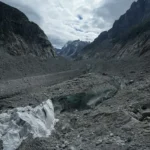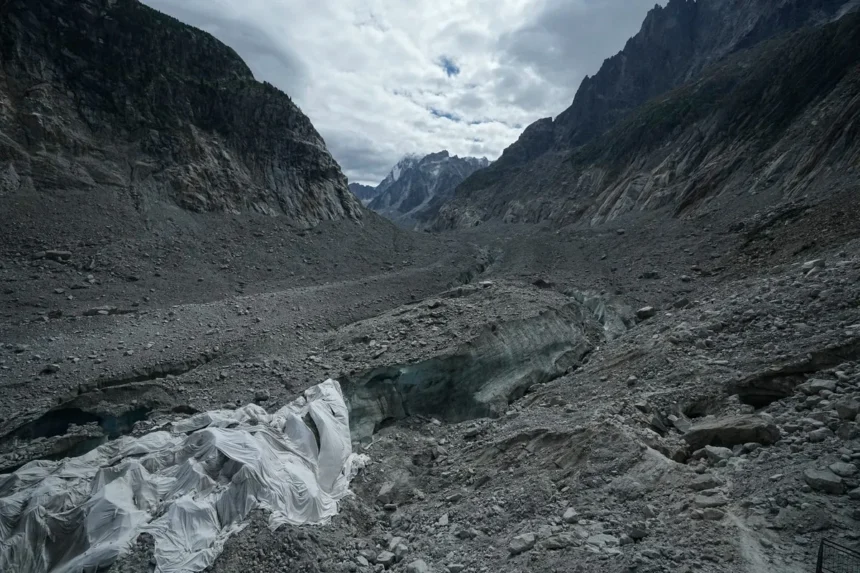
The iconic glaciers and snowfields that have long defined Mont Blanc, Western Europe’s highest peak, are rapidly diminishing due to accelerating climate warming. This dramatic transformation is causing increased rockfalls and posing new safety challenges for communities and climbers in the French and Italian Alps.
The summer’s record heat waves have severely impacted the permafrost that acts as a natural binder for the Alpine landscape. As temperatures rise, cliffs are becoming unstable, leading to frequent rockfalls cascading from the mountainsides. A notoriously challenging gully used by climbers ascending the 4,805-meter (15,766-foot) summit has become temporarily impassable due to these events.
“We weep for our mountain, the way it’s changing. It hits us in the gut,” said Stéphane Bozon, deputy mayor of Chamonix-Mont-Blanc, a French town situated at the foot of the mountain. “From mid-July onward, we saw an increase in rock falls. We saw areas becoming difficult to access because of glacial retreat and snowmelt on the glaciers, with crevasses opening up and rock collapses making some areas difficult to reach or traverse.”
The impact of even small temperature increases is significant at high altitudes. On the Aiguille du Midi peak, which reaches 3,842 meters (12,605 feet), the average temperature in July saw a stark rise. Meteo France, the national weather service, reported that the monthly average temperature climbed from a chilly 1.6 C (33.8 F) in 1994 to a record 3.3 C (37.4 F) this past July. “The mountain really dried out, with temperatures unlike any I had ever experienced,” Bozon added.
Himalayan Disaster Echoes in the Alps
The recent devastating floods in the Himalayas, which scientists largely attribute to climate change, have heightened concerns in the Alps. These floods, triggered by a collapse of bedrock and glacier ice that sent a torrent of debris and water through Himalayan rivers in Nepal and China, serve as a stark reminder of the escalating risks associated with a warming planet.
As global average temperatures climb due to the burning of fossil fuels, the likelihood of such extreme weather events and geological instability increases worldwide. In the Alps, glaciers that were once admired for their majestic beauty are now viewed with apprehension as they shrink and destabilize.
Stéphane Bozon, responsible for safety in Chamonix, emphasized the urgent need for preparedness. “We have to move quite quickly because this summer has shaken us and year after year we’re being shaken by the glaciers’ retreat,” he stated, highlighting the potential for large glacier or mountain sections to fall onto populated areas.
Evidence of Widespread Glacial Retreat
Researchers in Italy are also documenting significant damage to glaciers caused by this year’s heat. According to the Lombardy region’s glacier service, Alpine glaciers in the area have lost over 40% of their surface area since 1991. Vanda Bonardo, head of the Italian branch of the International Commission for the Protection of the Alps, noted the shift from snow to rain at high altitudes, which further impacts terrain stability.
Surge in Rock Falls on Mont Blanc
The permafrost, which has historically acted like cement holding steep rock faces together on Alpine peaks, has been severely affected by the prolonged heat waves. Ludovic Ravanel, a researcher at Savoie Mont Blanc University specializing in climate change’s impact on mountain environments, explained the consequences.
“That doesn’t mean that all the rock faces will collapse in the coming years or decades but quite a number of them are on the verge of becoming unstable and remain stable today only because of the presence of that ice. As the ice changes, we have seen a huge, huge number of rock falls and rock collapses this year,” Ravanel said. He described a “collapse” as a significant event involving more than 100 cubic meters (3,531 cubic feet) of rock.
Ravanel anticipates that the Mont Blanc massif will record approximately 400 such collapses this year, a figure roughly ten times higher than that seen two decades ago. He noted that 2022 was also a year of significant instability, with nearly 300 collapses, but this year’s events are particularly defining.
Climbing Guides Face New Realities
For mountain guides like Stuart MacDonald, based in Chamonix, the rapid and extensive retreat of Mont Blanc’s glaciers is alarming. He often points out to clients the visible difference in glacier extent year after year, and even decade after decade. This year, melting and the increased risk of rock falls have made his job exceptionally challenging, forcing him to cancel expeditions.
“You hear it before you see it and then you’ll turn round and you’ll just see an enormous cascade of rocks coming down a slope and it can be quite terrifying,” MacDonald recounted. “What’s most scary is that sometimes these rocks are falling on routes that we used to be climbing at this time of year.” He added, “It can be depressing sometimes when you look at something that you maybe climbed in July or August in the past and you see that it’s absolutely impossible to do it now.”
The changing conditions on Mont Blanc underscore the tangible and immediate effects of climate change, presenting unprecedented challenges for both the natural environment and the human activities dependent upon it.