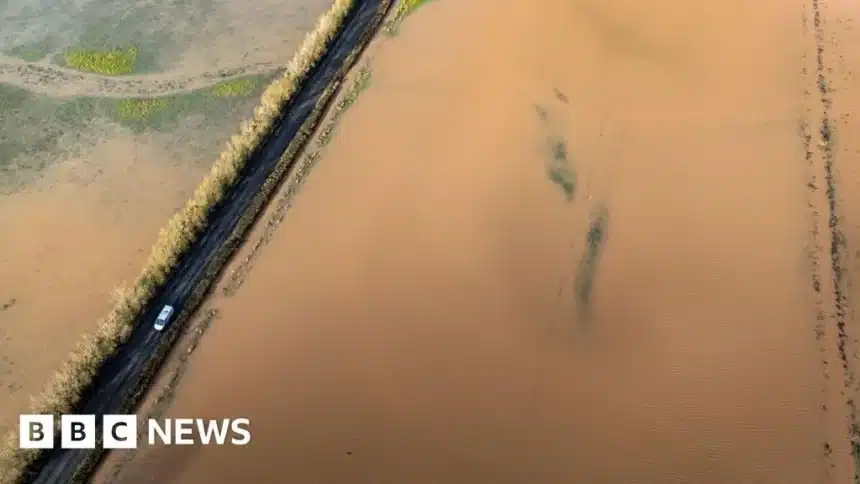
Regions across the UK, from Cornwall to County Down, endure the wettest January on record, with heavy February rains intensifying the downpours. A persistent high-pressure system over Scandinavia blocks these weather systems, trapping moisture over the country.
Shift Toward Frequent Wet Winters
Met Office projections indicate that current global warming rates transform wet winters from once-in-80-year occurrences to once-in-20-year events. This trend threatens housing stability, transportation networks, and food production.
A Somerset farmer describes his situation as living on a “knife edge,” with crops just days from rotting in floodwaters.
On Tuesday, over 100 locations received flood warnings, and more than 300 homes flooded, reports the Environment Agency.
Historical Patterns and Climate Drivers
Recent years mirror this pattern, with six of the ten wettest winters since records began nearly 250 years ago occurring this century, per Met Office data. While natural variability influences UK rainfall, the move toward wetter winters aligns with climate model forecasts.
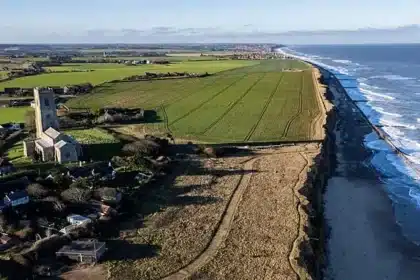
Fossil fuel combustion over two centuries releases greenhouse gases like CO2, warming the planet. Each 1°C rise allows the atmosphere to hold 7% more moisture, fueling intense rainfall. Sea levels around the UK have risen 20 cm since 1901 due to expanding oceans and melting glaciers, worsening coastal floods during storms.
The UK currently sees about seven days annually with over 80 mm of rain—deemed heavy. If global temperatures exceed 2°C above pre-industrial levels, this rises to nine days. Even with emission reduction policies, United Nations estimates point to at least 2.5°C warming by century’s end.
Prof. Lizzie Kendon, head of climate projections at the Met Office, notes: “That is really important, because that can lead to successive rainfall events, [which] can lead to very saturated soils, and as we’re seeing currently in the UK, that can lead to exacerbated flooding as well.”
Threats to Homes, Transport, and Farms
Saturated soils and deluges damage homes, roads, and crops. The Environment Agency projects one in four properties at flood risk by 2050, factoring in warmer climate effects for the first time. East Midlands, Yorkshire and The Humber, and south-east England face highest vulnerability, with risks growing if development expands on floodplains.
Government plans call for 1.5 million new homes this Parliament, with over 10% in flood-prone areas in some regions. Railways show similar exposure: one-third currently at risk, rising to over half within 25 years, according to official figures.
The National Farmers’ Union warned MPs last November of dual drought-flood threats: “Farmers and growers experience both [drought and floods] on an annual basis, and both severely impact their ability to produce food.” The 2024 wet winter—the second wettest on record—cost the sector £1 billion in crop losses.
Beef and arable farmer James Winslade in Somerset reports over 90% of his land submerged. “We can’t protect everywhere. There isn’t insurance for crop damage. We don’t get compensation,” he states. As a third-generation farmer, he adds that his father and grandfather never faced such repeated flooding.
Flood Defenses and Adaptation Efforts
The UK maintains extensive flood defenses through a mix of agencies, farmers, water companies, and charities. The Environment Agency oversees half—about 100,000—with 9% below target condition based on importance scores. Non-Agency defenses prove 45% more likely to fall short.
Urban development aggravates risks by replacing absorbent land with concrete, boosting runoff into overwhelmed drains and rivers.
An Environment Agency spokesperson affirms: “As a result of climate change, we are seeing more flooding and extreme weather. Whilst it is sadly not possible to stop all flooding, the Environment Agency is committed to helping communities to adapt. Through the government’s flood programme a further £10.5bn [will be] invested in protecting 900,000 more properties by 2036.”