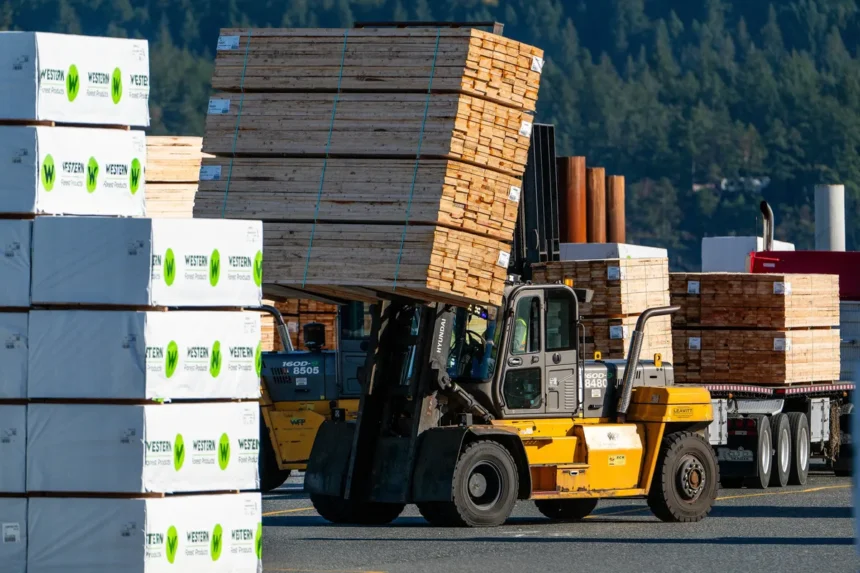
Canadian softwood lumber producers have surpassed US$8 billion in duties paid to the United States since 2017, amid ongoing efforts by British Columbia’s Forests Minister to ensure the issue remains a priority in federal trade negotiations.
Push for Resolution in USMCA Review
The United States-Mexico-Canada Agreement (USMCA), also known as CUSMA, does not directly cover Canadian softwood shipments to the U.S. With the trilateral deal under review this year, B.C. Forests Minister Ravi Parmar emphasizes its inclusion for success. “We’ve been very clear with the federal government that we believe for British Columbia, no CUSMA deal will be successful unless it includes resolving softwood,” Parmar stated. “Ottawa does forget about B.C. a lot. It’s why we continue to make noise.”
Producers continue posting punitive duties as cash deposits held in trust by the U.S., which accrue interest. Parmar stresses the need to recover a substantial portion to enable reinvestment. “A lot of money right now is sitting at the border, with no one being able to access it,” he noted.
Total Costs and Interest Accumulation
Forestry consultant Paul Krabbe calculates that approximately US$2 billion in interest has built up over nine years, pushing the combined value of duties and interest beyond US$10 billion.
The cross-border softwood lumber dispute traces back to the early 1980s and escalated in 2017. British Columbia leads as Canada’s top lumber-producing province, though output has dropped sharply over the past decade due to timber supply shortages. Some Canadian firms have expanded into U.S. forests, gaining duty exemptions for their American operations.
The U.S. Lumber Coalition views Canadian practices skeptically, noting most forests are on Crown land where loggers pay stumpage fees to provincial governments—unlike private U.S. timberland with market-rate pricing. Industry groups, including the BC Council of Forest Industries and BC Lumber Trade Council, argue U.S. import taxes on Canadian softwood lack justification.
Recent Duty Reductions and Challenges
Canada challenges the duties through USMCA trade panels, continuing from the prior North American Free Trade Agreement framework. The U.S. Department of Commerce recently announced preliminary reductions for most Canadian producers, with new rates set for late summer or early autumn 2026, pending final determinations.
Current total levies stand at 45.16 percent, comprising 35.16 percent in combined countervailing and anti-dumping duties plus 10 percent tariffs. Preliminary revisions lower anti-dumping rates to 10.66 percent from 20.53 percent and countervailing duties to 14.17 percent from 14.63 percent, yielding 24.83 percent combined duties plus tariffs for a total of 34.83 percent. These changes stem from a review of 2024 lumber markets.
U.S. President Donald Trump imposed additional Section 232 tariffs on lumber last fall, citing national security. Krabbe estimates Canadian producers have paid US$133 million in these tariffs since October.
Market Shares and Company Impacts
U.S. sawmills now supply 72 percent of domestic consumption, with Canada at 21 percent and others at 7 percent—a decline from Canada’s 33 percent share in 2016.
Preliminary rates vary by company: Vancouver-based Canfor Corp. faces 31.02 percent total levies, down from 47.59 percent; West Fraser Timber Co. Ltd. drops to 20.70 percent from 26.47 percent; and Resolute FP Canada Inc., a Domtar subsidiary, sees 24.95 percent from 35.16 percent.