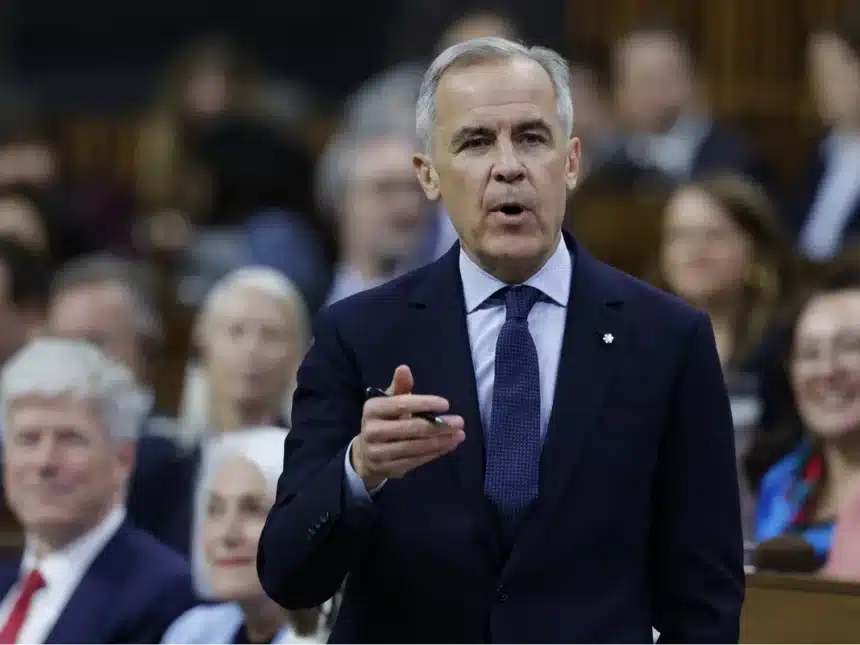
OTTAWA — Prime Minister Mark Carney strongly opposes claims of threats to private property rights in British Columbia amid Indigenous land title disputes. During question period on Wednesday, Carney expressed fundamental disagreement with last summer’s B.C. Supreme Court ruling that granted the Cowichan Tribes Aboriginal title over 300–324 hectares of land in Richmond, B.C.
“We immediately appealed that decision alongside the government of B.C., the city of Richmond and other First Nations,” Carney stated. He affirmed his commitment to “always advance viable legal arguments to protect private property.”
Carney addressed concerns raised by Richmond Liberal MP Parm Bains, who sought clarification on misinformation about the Cowichan ruling and a federal agreement reached with the Lower Mainland’s Musqueam Indian Band on February 20.
Conservative Leader Demands Stronger Defense
Conservative Leader Pierre Poilievre urges Carney to adopt a tougher legal approach in safeguarding B.C. property owners from Aboriginal title claims. Poilievre argues the Liberals weakened their position in the Cowichan case by not prioritizing fee simple private ownership over other titles.
He calls for reversing a 2018 directive that discourages federal lawyers from using the “extinguishment” argument, which holds that private land creation permanently eliminates Aboriginal title.
New Task Force on Property Rights
Poilievre recently announced a Conservative task force on property rights, led by Lower Mainland MP Tako van Popta, a former real estate and land development lawyer. Van Popta questions whether the extinguishment argument can now enter the Court of Appeal after federal abandonment.
“And here’s the question: can that argument (extinguishment) now be raised in the Court of Appeal, since Canada had abandoned it?” van Popta said.
Van Popta plans consultations with Richmond Conservative MP Chak Au, as the affected lands lie in his riding, along with Indigenous Conservative MPs Ellis Ross and Billy Morin. Details on the task force composition remain forthcoming.
Au, a former Richmond city councillor during the Cowichan decision, criticizes federal and provincial handling. “The leadership on the appeal right now is being provided by the city of Richmond. They’ve been arguing for extinguishment right from the beginning, and insisting that this argument can be brought forward in the Court of Appeal,” Au stated.
Impact on B.C. Politics
The Cowichan ruling fuels debates in B.C.’s Conservative leadership race. Candidate Caroline Elliott proposes banning land acknowledgements in schools and public service, arguing they promote the notion that B.C. sits on “stolen land.” Elliott receives advice from Katy Merrifield, former Poilievre communications director.
Vancouver pollster Mario Canseco advises caution against reversing reconciliation policies. “Poilievre’s been trying to build this blue-collar message of, hey, lets get some boots on the ground and build things. And I think that’s a message works in resource communities with a high proportion of First Nations,” Canseco noted.
Canseco highlights limited evidence of Aboriginal title issues damaging Carney’s standing in B.C., where he remains the most popular politician by a wide margin.
A spokesperson for Crown-Indigenous Relations Minister Rebecca Alty declined to comment on the federal legal strategy for the Cowichan appeal.