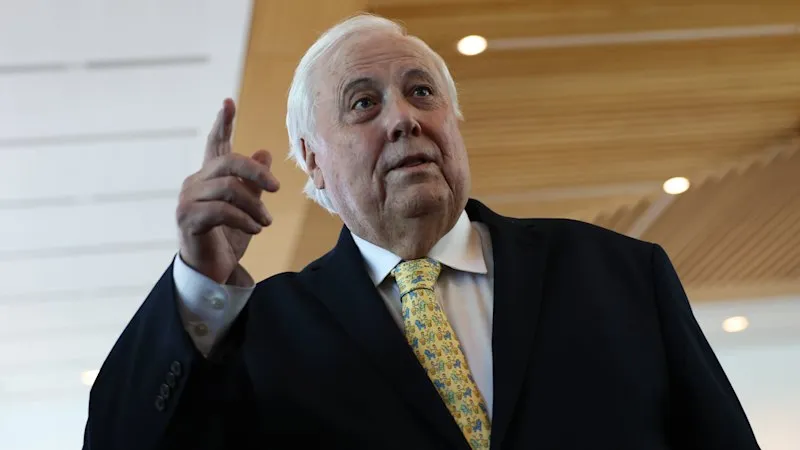
Mining magnate Clive Palmer has concluded a protracted legal battle, failing in his final attempt to sue the Australian government for nearly $300 billion. The Swiss Federal Supreme Court on Wednesday upheld a previous international tribunal’s decision, bringing a multi-year dispute to a close. This outcome means Palmer must now cover $13 million in court costs owed to the Commonwealth.
The Core of the Legal Dispute
The case originated from a claim filed by Zeph Investments, a company based in Singapore and owned by Palmer. Zeph Investments sought $296 billion in damages after a proposed iron ore project in Western Australia was blocked in 2020 under emergency legislation. Palmer, a former federal politician, contended that this action by the Australian government contravened the ASEAN-Australia-New Zealand Free Trade Agreement (AANZFTA).
Attorney-General Michelle Rowland stated that the Albanese government had strongly contested the claim. She emphasized that the Swiss Federal Supreme Court’s ruling confirmed Palmer is not recognized as a ‘foreign investor’ and therefore cannot claim protections under Australia’s free trade and investment agreements. Rowland noted the significant expenditure of time and resources, exceeding three years and costing $13 million, that the Commonwealth incurred defending against a claim that could have imposed a substantial financial burden on Australian taxpayers.
Previous Tribunal and Court Findings
The Permanent Court of Arbitration, an international body established by treaties, had previously dismissed Palmer’s claim. The tribunal ruled that the dispute was fundamentally between a national government and one of its own citizens, placing it outside the court’s jurisdiction. This decision followed Palmer’s unsuccessful challenge in Australia’s High Court regarding the validity of the Western Australian emergency legislation. That legislative move had the potential to financially cripple the state.
Following the High Court’s rejection of his challenge, Palmer, who is estimated to be Australia’s fifth-richest individual with a net worth of approximately $20 billion, described the legislation as being “akin to the actions of a banana republic” in his notice of arbitration to the international tribunal. In comments made to the Australian Financial Review in 2024, Palmer asserted that the treaty permits Australians to own offshore companies that remain operational and still receive treaty protections. He mentioned employing around 600 people in Singapore through such entities for several years.
Other Legal Actions and Political Endeavors
This is not the only significant legal action Palmer has pursued against the Commonwealth. He has initiated a similar claim concerning a project in Queensland, seeking $40 billion in damages. Additionally, he is reportedly funding a separate class-action lawsuit related to COVID-19 vaccine mandates in Queensland.
Palmer’s recent legal challenges have seen mixed results. He lost a case against a former chair of the Australian Securities and Investments Commission last month, which was described as “flimsy.” In a public address at the National Press Club the previous year, Palmer expressed his belief that he would manage any awarded funds more effectively than the federal government if his lawsuit were successful.
Beyond his legal pursuits, Palmer has also been involved in political activities. His political party, the Trumpet of Patriots, reportedly spent over $50 million on advertising for the 2025 election but did not secure any seats. Palmer was approached for comment regarding the latest court decision.
Conclusion of a Lengthy Legal Saga
The Swiss Federal Supreme Court’s decision marks the definitive end to a complex and costly legal saga that spanned several years. The ruling reinforces the principle that individuals cannot leverage international trade agreements to sue their own government for actions taken under domestic law, particularly when the claimant is a national acting through an offshore entity. The substantial court costs awarded to the Commonwealth underscore the perceived lack of merit in Palmer’s ambitious claim.