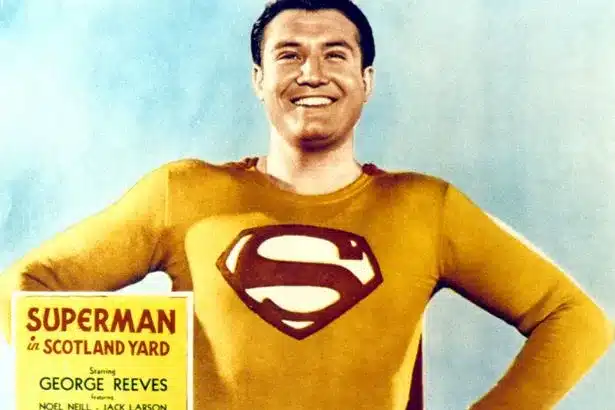
The untimely death of George Reeves, the actor who first brought Superman to life on screen, remains one of Hollywood’s most enduring mysteries. Reeves died at the age of 45 from a gunshot wound in 1959, a death officially ruled a suicide. However, a lack of concrete evidence, conflicting accounts, and Reeves’ complex personal life have fueled decades of speculation and alternative theories.
The Official Ruling and Lingering Doubts
On June 16, 1959, George Reeves was found dead in his Los Angeles home. The official cause of death was a gunshot wound to the head, and the Los Angeles Police Department ruled it a suicide. This conclusion, however, was met with immediate skepticism, even from those close to Reeves. His friend, actor Rory Calhoun, famously stated, “No one in Hollywood believed the suicide story.”
Several factors contributed to these doubts:
- Lack of Physical Evidence: Investigators reportedly found no fingerprints on the gun and no gunpowder residue on Reeves’ body.
- Conflicting Witness Statements: While guests present in the house claimed to have heard only one shot, a total of three bullets were found to have been fired from the weapon.
- Inconsistent Details: A shell casing found beneath Reeves’ body was later determined to be inconsistent with a suicide scenario.
Despite these discrepancies, the case was closed, and the ruling of suicide stood. Reeves’ mother, Helen Bessolo, vehemently disagreed with the official verdict and hired an attorney to pursue a second autopsy. While this revealed unexplained bruises on Reeves’ body, her attorney ultimately accepted the suicide explanation, much to her dismay.
The Fiancée Theory: Accidental Shooting
One prominent theory suggests that Reeves’ fiancée, Leonore Lemmon, may have accidentally shot him. According to this account, Reeves returned home late after an evening out with Lemmon and retired to bed. Lemmon then invited writer Robert Condon and two other friends to their home. In the early hours of the morning, Reeves came downstairs to ask the group to lower their noise levels. Lemmon allegedly made a cryptic remark, “He’s upstairs to shoot himself.” The fatal shot occurred shortly thereafter, between 1:30 and 2:00 a.m.
Author Jim Nolt, who extensively researched the case, proposed a scenario where an argument ensued between Reeves and Lemmon. Nolt suggested that Reeves’ dismissive attitude towards her guests, coupled with his potential declaration that he had no plans to marry her, might have provoked Lemmon. “I think George told her that he had no plans to marry her, and that she became very angry and pulled out a gun,” Nolt explained on ‘Unsolved Mysteries.’ “And I don’t think on purpose, but I think accidentally, shot George.” Lemmon passed away in 1989.
The Mannix Connection: Affair and Revenge
Another significant theory centers on Reeves’ affair with Toni Mannix, the wife of MGM studio executive Eddie Mannix. Eddie Mannix was reportedly aware of the relationship. Reeves ended the affair in early 1959, which allegedly devastated Toni Mannix.
This entanglement led to two potential revenge scenarios:
- Toni Mannix’s Involvement: Some speculate that Toni, heartbroken by the breakup, may have been driven to murder Reeves.
- Eddie Mannix’s Retaliation: Others point to Eddie Mannix, who was rumored to have ties to organized crime. The theory suggests he could have orchestrated Reeves’ death to punish him for the affair with his wife.
Toni Mannix died in 1983. Fifteen years later, publicist Edward Lozzi claimed he overheard her confessing to a priest that she had arranged Reeves’ murder, reportedly out of fear of divine retribution. Adding another layer to this theory, Phyllis Coates, who played Lois Lane opposite Reeves, recounted a peculiar phone call from Toni Mannix around 4:30 a.m. on the night of Reeves’ death. According to Coates, Mannix stated, “The boy is dead. He’s been murdered.” Eddie Mannix died in 1963.
Co-star’s Recollection: A Man Full of Life
Reeves’ co-star Noel Neill, who played Lois Lane in ‘Adventures of Superman,’ consistently described Reeves as being vibrant and full of life, directly contradicting any notion that he was depressed or suicidal. “I just saw George as someone so full of life, with so much going for him,” Neill recalled. She last saw him two days before his death, and he was enthusiastically discussing future projects, including films, an Australian tour, and directing upcoming episodes of the show.
Neill expressed her bewilderment at the unexplained aspects surrounding his death, noting, “There were so many things that were never explained.” Her testimony, along with that of other friends and colleagues who painted a picture of a happy and ambitious man, further fueled the doubts surrounding the official suicide ruling.
Conclusion: An Unresolved Enigma
Decades after his death, the circumstances surrounding George Reeves’ demise remain a subject of intense debate and speculation. While officially ruled a suicide, the inconsistencies in the evidence, the conflicting testimonies, and the various theories involving his fiancée and the Mannix couple continue to cast a shadow over the tragic end of the actor who embodied America’s favorite superhero. The mystery of George Reeves’ death endures as a somber reminder of the complexities that can lie beneath the surface of even the most public lives.