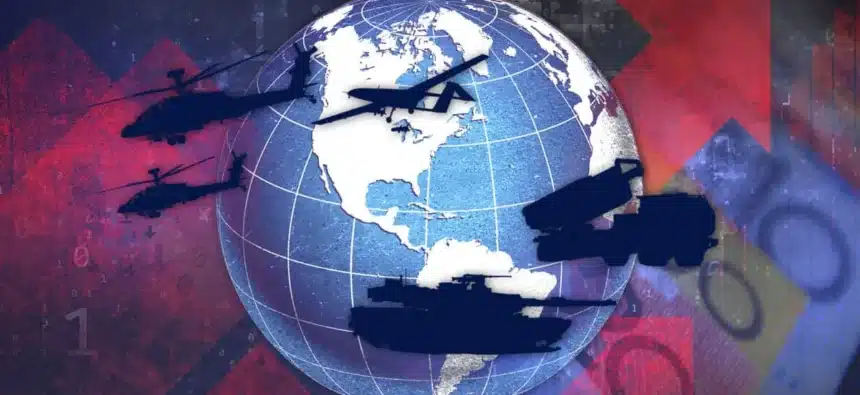
Global defense spending climbed to a record $4 trillion in 2025, marking the 11th straight year of increases, according to data from the Stockholm International Peace Research Institute (SIPRI). Expenditure rose 2.9 percent, driven by ongoing conflicts and geopolitical tensions.
Top Global Spenders
The United States led with $1.33 trillion, followed by China at $468 billion and Russia at $265 billion. These three nations accounted for 51 percent of the total. Completing the top 10 were Germany ($159 billion), India ($128 billion), the United Kingdom ($124 billion), Ukraine ($117 billion), Saudi Arabia ($116 billion), France ($95 billion), and Japan ($87 billion).
Australia allocated $49 billion, placing 17th worldwide—a drop of two spots from the prior year. This represented 1.9 percent of its GDP and 1.2 percent of global spending. Officials note current spending stands at 2.8 percent of GDP, set to reach 3 percent by 2033 under NATO metrics, though SIPRI calculations differ.
Trends and Growth Drivers
Worldwide military budgets have surged 41 percent over the past decade, averaging $491 per person. SIPRI researcher Xiao Liang stated, “Global military spending rose again in 2025 as states responded to another year of wars, uncertainty and geopolitical upheaval with large-scale armament drives.” He added that growth likely persists into 2026 and beyond amid ongoing crises.
The 2.9 percent rise marked the slowest since 2021, down sharply from 9.7 percent in 2024, largely due to a 7.5 percent U.S. drop—the first in a decade averaging 11 percent annual gains. This followed halted new aid to Ukraine after President Donald Trump’s return. Previously, the U.S. approved $177 billion over three years. Despite the dip, investments in nuclear and conventional capabilities continue.
SIPRI program director Nan Tian noted, “The decline in U.S. military expenditure in 2025 is likely to be short-lived.” Congress approved over $1 trillion for 2026, potentially rising to $1.5 trillion in 2027 if Trump’s budget passes. Figures exclude the Middle East war launched by the U.S. and Israel against Iran in February, costing tens of billions.
Regional Shifts
Among the top 15 spenders, only the U.S., U.K., and Israel cut budgets. Europe’s 14 percent jump and Asia-Oceania’s 8.1 percent rise offset the U.S. decline. Asia-Oceania hit $949 billion, the fastest growth since 2009.
China’s budget grew 7.4 percent—its 31st consecutive increase—fueling modernization. Taiwan rose 14 percent and Japan 9.7 percent in response to China. Australia’s spending increased 3 percent last year and 18 percent over the decade. SIPRI senior researcher Diego Lopes da Silva observed, “U.S. allies in Asia and Oceania such as Australia, Japan and the Philippines are spending more… due to growing uncertainty over U.S. support and pressure from the Trump administration.”
Middle East spending held steady at $303 billion, up 0.1 percent, excluding the ongoing war. Israel’s fell 4.9 percent amid reduced Gaza operations under a fragile October ceasefire with Hamas, marred by mutual breach accusations. Iran’s nominal spending rose despite a 5.6 percent real-term drop from 42 percent inflation.
Europe and NATO Dynamics
European spending more than doubled since 2016 (102 percent), spurred by Russia’s 2022 Ukraine invasion and U.S. guarantee doubts. Russia boosted outlays 5.9 percent to $265 billion (7.5 percent GDP). Ukraine’s rose 20 percent to $117 billion (40 percent GDP, the highest globally), aided by $73 billion from European NATO allies despite U.S. pauses.
SIPRI researcher Lorenzo Scarazzato predicted, “[Russia’s and Ukraine’s] spending is likely to keep growing in 2026 if the war continues, with revenues from Russia’s oil sales increasing and a major European Union loan expected by Ukraine.”
The 29 European NATO members spent $779 billion combined. Germany surged 24 percent to $159 billion (2.3 percent GDP, first above 2 percent since 1990). Spain jumped 50 percent to $56 billion, exceeding 2 percent for the first time since 1994. SIPRI researcher Jade Guiberteau Ricard said, “In 2025 military spending by European NATO members rose faster than at any time since 1953, reflecting… European self-reliance alongside increasing pressure from the United States to strengthen burden sharing.”
Trump has criticized NATO as a “paper tiger” and threatened withdrawal after allies skipped U.S.-Israeli Iran strikes. In June 2025, NATO pledged 5 percent GDP by 2035—3.5 percent core military, 1.5 percent broader security. SIPRI highlights calculation divergences and transparency risks, warning of reclassification like Italy’s proposed Sicily bridge.