




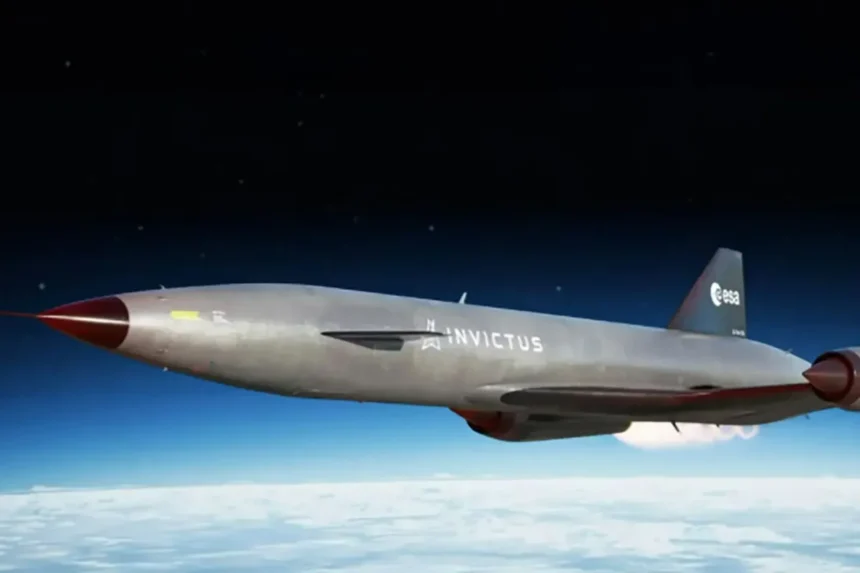
Revolutionary Hypersonic Jet Aims for Ultra-Fast Global Travel
British engineers are developing a groundbreaking hypersonic space plane, codenamed Invictus, which could dramatically reduce intercontinental travel times. The innovative aircraft, named ‘unconquered’ in Latin, is designed to reach speeds exceeding 3,800 mph, potentially shrinking the journey from London to Sydney from over 21 hours to a mere three.
This ambitious project is a collaborative effort between engineers from the European Space Agency (ESA) and the UK Space Agency, aiming to revive the spirit of supersonic travel pioneered by Concorde, which was retired in 2003. The Invictus jet is envisioned to fly at five times the speed of sound, reaching the upper limits of Earth’s atmosphere at approximately 80,000 feet. A key feature of the design is its ability to take off from conventional airport runways, mirroring the operation of commercial aircraft rather than relying on vertical rocket launches.
UK Spaceports Vie for Historic Test Flight Location
Several locations across the United Kingdom are competing to host the inaugural test flight of the Invictus plane. Among the leading contenders are Spaceport Cornwall in Newquay and Spaceport Machrihanish in Scotland. The latter, a former Royal Air Force base, has a history of hosting significant aviation trials, including those for the original Concorde and the B-2 stealth bomber. Its remote location in Kintyre is considered a significant advantage for testing advanced aircraft and rocket engines.
Gordon Stevenson, director of Spaceport Machrihanish, highlighted the benefits of their site. “Remoteness is a huge plus when you’re test-flying aeroplanes and testing rocket engines, and we’re pretty much at the end of the road in Kintyre,” Stevenson stated. He further suggested that the Invictus jet could serve multiple purposes. “Satellite delivery would be one of the obvious uses,” he noted, adding that “people have talked about passenger flights ultimately.” Stevenson elaborated on the potential passenger travel, remarking, “You could be in Sydney, Australia in three hours. It depends on the speed at which it flies and the success of the technology, but it would be amazing wouldn’t it?”
Timeline and Technological Advancements
While the Invictus plane is not currently slated to carry passengers, its successful development could pave the way for future high-speed global travel. Initial designs are anticipated to be finalized this year. Engine and hydrogen fuel system testing for atmospheric flight are scheduled for next year. However, the first flight of the Invictus jet is not expected until around 2034, with the achievement of hypersonic speeds targeted for 2036. If successful, the Invictus jet would set a new benchmark as the fastest manned aircraft, potentially reaching speeds of 3,600 mph.
James Cornish, a space business development manager at Frazer-Nash, explained the Invictus plane’s core functions. “Invictus’s primary roles are enabling runway-based access to space, such as future spaceplanes and flexible satellite launch,” Cornish said. He also pointed to potential defense applications, such as testing control systems at extreme velocities, and the long-term prospect of “ultimately underpin[ning] much faster long-haul travel” for the general public in future civilian aircraft.
Overcoming Hypersonic Challenges
The pursuit of hypersonic travel, while promising immense speed, presents significant engineering hurdles, particularly the extreme heat generated by such velocities. The European Space Agency is addressing this challenge with an innovative pre-cooled hydrogen/oxygen system designed to rapidly dissipate intense heat. Meanwhile, advancements in faster-than-sound travel are also being made by American entities. Earlier this month, NASA’s experimental jet, a successor to Concorde, successfully broke the sound barrier during an 81-minute test flight, reaching a speed of 713 mph.












.jpg "Apple iPhone 17e Evaluation: MagSafe Makes a Distinction")