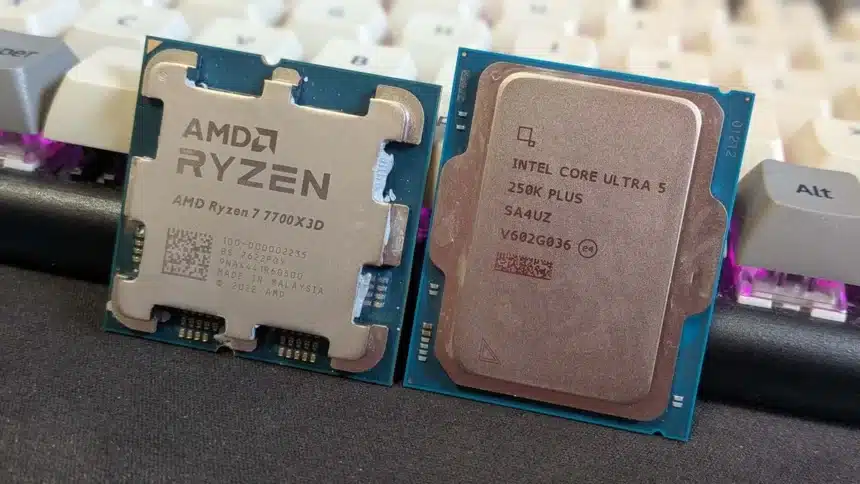
While AMD’s Ryzen 7 7800X3D remains a top performer for pure gaming frame rates thanks to its 3D V-Cache technology, the recent release of the AMD Ryzen 7 7700X3D and Intel’s Core Ultra 5 250K Plus presents a compelling new dynamic in the CPU market. The introduction of the 7700X3D, positioned as a more budget-friendly option for gamers on the AM5 platform, has unexpectedly led to a re-evaluation of value, even prompting consideration of Intel’s offerings.
AMD’s 3D V-Cache Strategy Under Scrutiny
AMD’s 3D V-Cache technology is designed to significantly boost gaming performance by incorporating a substantial amount of L3 cache directly onto the CPU. This approach has solidified the Ryzen 7 7800X3D’s position as a premier gaming processor. The Ryzen 7 7700X3D, essentially a slightly slower-clocked version of the 7800X3D, aims to bring this advantage to a more accessible price point, with an MSRP of $329 compared to the 7800X3D’s $450. However, the market realities present a challenge to this strategy.
Intra-AMD Competition and Pricing Dynamics
A primary hurdle for the 7700X3D is the availability and pricing of its more powerful sibling. Despite the lower MSRP, the 7800X3D has been on the market longer, leading to widespread availability. Consequently, actual retail prices often see the 7800X3D available at a similar or even lower cost than the 7700X3D. This pricing overlap diminishes the 7700X3D’s appeal as a distinctly more affordable 3D V-Cache option.
The Case for Intel in New Builds
The value proposition of the 7700X3D is most apparent for users looking to upgrade an existing AM5 system, such as those already equipped with a Ryzen 5 7600. However, for individuals building a new PC from scratch, the landscape shifts. Intel’s Core Ultra 5 250K Plus emerges as a highly attractive alternative, particularly at the budget-conscious end of the market. This Intel processor features a configuration of six Performance-cores and twelve Efficient-cores, totaling 18 threads, and demonstrates surprisingly strong performance not only in gaming but also in productivity tasks.
Performance Benchmarks: Gaming and Productivity
Testing conducted at 1080p resolution, which is ideal for highlighting CPU performance differences, reveals that the Intel Core Ultra 5 250K Plus is remarkably competitive. In several gaming scenarios, such as Cyberpunk 2077 and Baldur’s Gate 3, the Intel chip delivers frame rates that are not significantly behind the AMD Ryzen 7 7700X3D and even the more expensive 7800X3D. Notably, in Total War: Warhammer 3, the 250K Plus even surpasses the 7700X3D in average FPS and 1% low FPS.
Gaming Performance Comparison (1080p)
- Cyberpunk 2077 (1080p RT Ultra + DLSS Balanced): AMD Ryzen 7 7700X3D (112 FPS avg, 73% 1L FPS) vs. Intel Core Ultra 5 250K Plus (118 FPS avg, 93% 1L FPS).
- Baldur’s Gate 3 (1080p Ultra): AMD Ryzen 7 7700X3D (122 FPS avg, 52% 1L FPS) vs. Intel Core Ultra 5 250K Plus (109 FPS avg, 67% 1L FPS).
- Homeworld 3 (1080p Epic): AMD Ryzen 7 7700X3D (104 FPS avg, 56% 1L FPS) vs. Intel Core Ultra 5 250K Plus (98 FPS avg, 56% 1L FPS).
- Metro Exodus Enhanced Ed. (1080p High): AMD Ryzen 7 7700X3D (148 FPS avg, 78% 1L FPS) vs. Intel Core Ultra 5 250K Plus (145 FPS avg, 79% 1L FPS).
- Total War: Warhammer 3 (1080p High): AMD Ryzen 7 7700X3D (152 FPS avg, 77% 1L FPS) vs. Intel Core Ultra 5 250K Plus (174 FPS avg, 141% 1L FPS).
In synthetic benchmarks like 3DMark Time Spy, the Intel Core Ultra 5 250K Plus also shows impressive results, particularly in the CPU index score, where it significantly outperforms the 7700X3D and approaches the 7800X3D. While it may not possess the specific 3D V-Cache advantage, its overall performance in many games is remarkably close to AMD’s more expensive options.
Productivity Performance
Beyond gaming, the Intel Core Ultra 5 250K Plus demonstrates superior performance in productivity applications. Benchmarks in Cinebench 2024, Blender 4.2.0, 7zip, and Handbrake 1.8.1 consistently show the Intel chip outpacing the AMD Ryzen 7 7700X3D and even the 7800X3D in multi-core tasks. This makes it a more versatile option for users who engage in activities beyond gaming, such as content creation, streaming, or heavy multitasking.
- Cinebench 2024: Intel Core Ultra 5 250K Plus (138 single-core, 1817 multi-core) vs. AMD Ryzen 7 7700X3D (102 single-core, 1011 multi-core).
- Blender 4.2.0: Intel Core Ultra 5 250K Plus (132 samples/min) vs. AMD Ryzen 7 7700X3D (79 samples/min).
- 7zip: Intel Core Ultra 5 250K Plus (147 compressing GIPS, 146 decompressing GIPS) vs. AMD Ryzen 7 7700X3D (115 compressing GIPS, 124 decompressing GIPS).
- Handbrake 1.8.1: Intel Core Ultra 5 250K Plus (101 UHD fps) vs. AMD Ryzen 7 7700X3D (70.8 UHD fps).
Platform Longevity vs. Upfront Value
The primary advantage of AMD’s platform, particularly the AM5 socket, lies in its commitment to future compatibility. AMD has pledged support for the AM5 socket through 2029, mirroring the long lifespan of its previous AM4 platform. This offers users a clear upgrade path for future CPU generations without needing to replace their motherboard. In contrast, Intel typically changes its CPU sockets more frequently, meaning an upgrade to a new Intel chip generation often necessitates a new motherboard as well.
This difference in platform longevity is a significant consideration. For users who prioritize the ability to upgrade their CPU down the line, AMD’s AM5 platform offers a more future-proof solution. However, the question arises whether most PC gamers actually perform in-place CPU upgrades frequently. For the majority who primarily upgrade their graphics card or storage, the upfront cost savings offered by a processor like the Intel Core Ultra 5 250K Plus, which is priced around $200, could be more beneficial. This saving could be reinvested into a more powerful graphics card, potentially yielding a greater overall performance improvement for gaming.
Conclusion: A Shifting Landscape
The AMD Ryzen 7 7700X3D, while intended as a more accessible entry into 3D V-Cache technology, faces stiff competition from both within AMD’s own lineup and from Intel. The Intel Core Ultra 5 250K Plus emerges as a compelling alternative, especially for new system builds. It offers strong gaming performance that rivals more expensive AMD options and significantly outperforms them in productivity tasks, all at a more attractive price point. While AMD’s AM5 platform offers superior future upgrade potential, the immediate cost savings and robust performance of the Intel Core Ultra 5 250K Plus make it a highly tempting choice for budget-conscious builders who may not plan on frequent CPU upgrades.