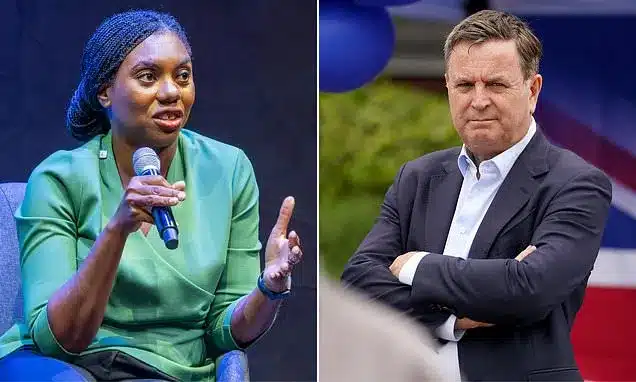
Conservative leader Kemi Badenoch has initiated a significant reshuffling of her frontbench team, signaling a strategic move to prepare the party for a potential general election. The overhaul sees key personnel changes within the Shadow Cabinet, aimed at bolstering the party’s image and policy platform.
Tory Shadow Cabinet Reshuffle: Key Changes
In a notable shift, Shadow Chancellor Sir Mel Stride has been removed from his position. Andrew Griffith, a former Treasury minister, has been appointed as the new Shadow Chancellor. Griffith, who previously served as Chief Financial Officer for Sky, brings extensive financial sector experience to the role, having been the only MP with a FTSE100 CFO background when appointed. He expressed his commitment to driving economic growth, stating, “Kemi and I are united in our view that Britain needs an economic revolution and a team working to deliver that.”
Dame Priti Patel, formerly the Shadow Foreign Secretary, has been moved to a newly created ‘international’ brief. This role will focus on maintaining relationships with right-wing political parties globally and assessing international returns agreements, particularly concerning immigration. Tom Tugendhat, a former Army officer, steps into the role of Shadow Foreign Secretary, with his responsibilities expanded to include defence matters.
Claire Coutinho, previously responsible for energy, is now taking on the business brief and will serve as Mr. Griffith’s deputy. Her position in energy will be covered by Julia Lopez during Coutinho’s maternity leave. Richard Fuller remains as Shadow Chief Secretary to the Treasury.
Other appointments include Damian Hinds as the new Shadow Health Secretary, replacing Stuart Andrew who is returning to the backbenches. Katie Lam takes over as Shadow Housing Secretary following Sir James Cleverly’s resignation to pursue a mayoral candidacy. Rebecca Paul has been appointed Shadow Culture Secretary, and Harriet Cross is the new Shadow Scotland Secretary.
Strategic Rationale Behind the Reshuffle
Sources close to the party suggest the reshuffle is designed to energize the Conservative ranks and present a fresh image to the electorate as speculation mounts over an early general election. An unnamed Conservative MP commented that the changes are about moving to a “next phase” and that the “new team will give us the energy we need to fight a general election.” This sentiment was echoed by a party insider who outlined the new team’s focus: “Andrew Griffith will ensure that Britain starts growing; Claire Coutinho will make sure people feel the benefit; Richard Fuller will keep an eye on the numbers and ensure we’re bringing down the deficit.”
Robert Buckland, former Conservative justice spokesman, noted that Badenoch is “looking ahead now to the next two years of this Parliament, which of course will lead us to an election. She wants the strongest possible team that is going to take the fight to Labour and which will draw a line under the past and look to the future.”
Badenoch’s Economic Strategy
A key element of the Conservative strategy appears to be rebuilding economic credibility. To this end, Badenoch has established a new Conservative Economic Unit. This unit is intended to focus the party’s efforts on promoting economic growth and fiscal discipline, positioning the Conservatives as a counterpoint to Labour’s perceived ‘tax-and-spend’ approach. Badenoch has voiced concerns that the current government’s manifesto commitments may restrict its ability to implement its economic agenda, hinting at the possibility of a snap election.
Badenoch acknowledged Sir Mel Stride’s contributions, stating, “He helped us steady the ship, rebuild economic credibility and become an effective opposition, and I am genuinely grateful for his contribution.” She specifically credited his work in challenging the government’s economic policies. Sir Mel Stride himself expressed pride in his efforts to “rebuild the Conservatives’ economic credibility.”
Economic Landscape and Election Speculation
The reshuffle occurs against a backdrop of significant economic challenges. The cost of servicing government debt has reportedly reached its highest level in nearly three decades. While the current government is bound by its manifesto not to raise income tax, VAT, or National Insurance, there have been calls from some quarters to increase capital gains tax.
Speculation about an imminent general election has intensified, with some analysts suggesting the current government might seek to capitalize on its position. Polling expert Julian Gallie observed that while Badenoch’s personal ratings have seen improvement, the wider Shadow Cabinet has yet to achieve significant public recognition. He suggested that for the reshuffle to be effective, Badenoch needs to “put in place more figures eager to cut through to the public as well as fresher faces not associated with the past government.”
Conclusion: Preparing for the Political Arena
Kemi Badenoch’s decisive actions in reshaping the Conservative frontbench underscore a clear intent to prepare the party for a general election contest. By bringing in new faces and reassigning key roles, the Conservatives aim to present a unified and dynamic opposition, focused on economic recovery and future growth, while challenging the government’s agenda. The effectiveness of these changes will likely be tested as political maneuvering intensifies in the lead-up to a potential electoral showdown.