A contentious dispute over the naming of Lake Ontario has escalated, with U.S. President Donald Trump taunting Canadian officials by doubling down on his executive order to rename the body of water “Lake America.” This move, initiated amid ongoing trade disagreements, has been met with firm resistance from Canadian leaders, who have reaffirmed the lake’s traditional name.
Presidential Executive Order Sparks International Debate
On Thursday, President Trump signed an executive order directing the U.S. Department of the Interior to officially recognize “Lake America” as the name for the lake on federal purposes. This action, however, does not compel Canada or international bodies to adopt the new designation. The move comes as U.S.-Canada relations are strained by trade disputes, with Trump threatening significant tariffs on Canadian goods and Canadian officials vowing retaliation.
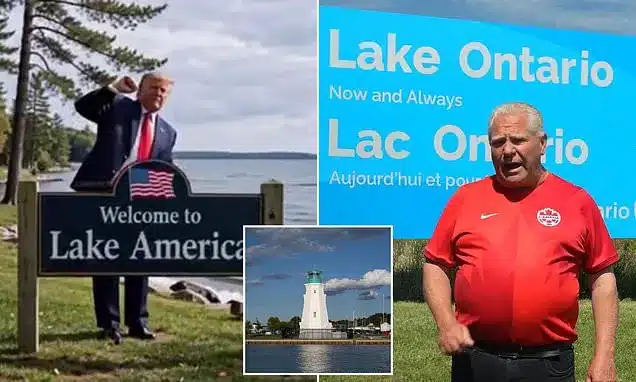
The president further amplified the controversy on Saturday by posting an AI-generated video on his social media platform. The video depicted him symbolically removing an existing sign and erecting a new one that reads “Welcome to Lake America,” followed by a celebratory dance. This digital display was released shortly after Ontario Premier Doug Ford unveiled a physical sign rejecting the proposed name change.
Ontario Premier’s Defiant Stand
Premier Doug Ford took a public stance against the renaming effort by unveiling a sign at a conservation area in Hamilton that declared: “Lake Ontario, Now and Always.” Standing before the sign at 50 Point Conservation Area, Ford stated his intention to send a clear message to President Trump.
“We are resilient, we are strong, and we will never, ever back down from a bully,” Ford asserted, as reported by The Globe and Mail. He emphasized that the lake would retain its name in Canada and globally, irrespective of any U.S. federal designation. Ford reiterated this sentiment in a video shared on X, formerly Twitter, from the shores of Lake Ontario.
“I’m here on the shores of beautiful Lake Ontario, a crown jewel of our province and our country,” Ford said in the video. He explained that the renaming attempt stemmed from President Trump’s apparent displeasure with Canada asserting its own interests. “Long before President Trump, this lake was called Lake Ontario and long after President Trump is gone, it will still be called Lake Ontario,” he declared, positioning the sign as a reminder.
Historical Roots and International Law
The name “Lake Ontario” originates from the Wendat word “Ontari’io,” which translates to “the lake is beautiful, the lake is big.” Canadian Prime Minister Mark Carney highlighted on X that this name predates both the Confederation of Canada and the U.S. Declaration of Independence, being over 400 years old.
Carney also alluded to broader shifts occurring in the United States under the current administration, noting changes in trading relationships, foreign policies, national monuments, and even hydronyms. He underscored that for Canadians, the reality of the lake’s identity is its long-standing name: “Lake Ontario – then, now and always.”
Lake Ontario forms a significant part of the international border between New York State and the Canadian province of Ontario. For over a century, its waters have been jointly managed under the 1909 Boundary Waters Treaty, a testament to enduring bilateral cooperation on shared natural resources.
Broader Trade Tensions Fuel the Dispute
President Trump indicated that the contemplation of the name change had been ongoing for an extended period. During the signing of the executive order, he made light-hearted remarks about potentially renaming other major bodies of water, including the Atlantic or Pacific Oceans, referencing a past instance where the Gulf of Mexico was referred to as the “Gulf of America” for U.S. federal purposes.
The timing of this naming dispute coincides with a particularly volatile period in U.S.-Canada relations. Trade negotiations have faltered, leading to threats of substantial tariffs from the U.S. on Canadian goods, such as cars, trucks, automotive parts, and steel, with Trump aiming to boost domestic manufacturing. Canada has pledged to respond with retaliatory measures.
President Trump articulated that the conflict with Canada extended beyond the lake’s name, stating, “The whole Canadian thing has to come to a stop.” He expressed a desire for more manufacturing to occur within the United States, suggesting that Canada should focus on producing goods for its own market rather than for export to the U.S.
Furthermore, Trump raised concerns about Canada’s reliance on U.S. military protection without commensurate financial contribution. He characterized Canadian representatives as difficult to deal with, describing Canada as one of America’s most challenging trading partners and suggesting a sense of entitlement among Canadian negotiators. These remarks followed earlier characterizations of Canadian officials as “nasty people.”
Conclusion: A Symbol of National Identity
The renaming of Lake Ontario, while seemingly a minor issue, has become a potent symbol in the broader context of U.S.-Canada relations. The firm stance taken by Canadian leaders, emphasizing historical identity and national resilience, contrasts sharply with President Trump’s assertive executive actions. As trade tensions continue to simmer, the dispute over the lake’s name underscores the deep-seated disagreements and differing approaches to international relations between the two North American neighbors.