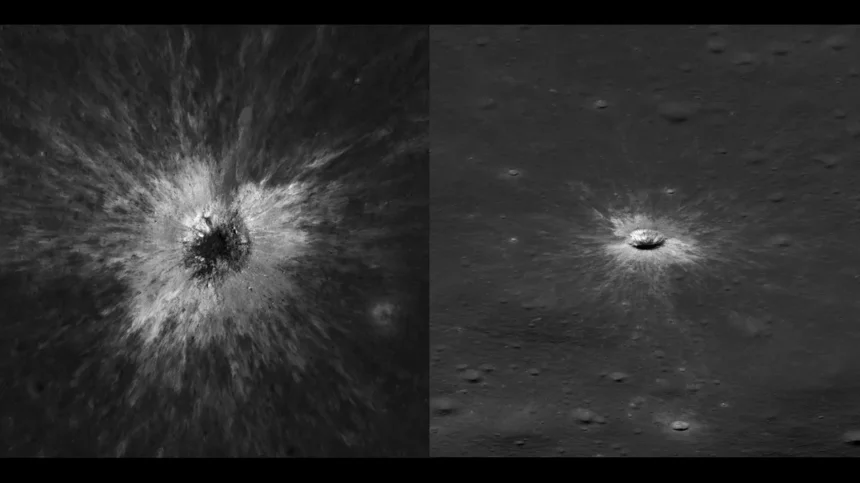
NASA’s Lunar Reconnaissance Orbiter (LRO) has captured images of a newly formed impact crater on the Moon, identified as the largest modern-day crater within our solar system. This significant geological event, resulting from the impact of a celestial body estimated to be between the size of a three- to six-story building, is an occurrence scientists suggest happens only about once a century.
Discovery of the McGetchin Crater
The discovery was made by NASA scientist Robert Wagner, who observed anomalies in lunar surface imagery captured by the LRO’s wide-angle camera in October 2025. By meticulously comparing images taken before and after the suspected impact, Wagner confirmed the formation of a new crater. This crater has since been officially named the McGetchin crater, in honor of scientist Tom McGetchin.
While the exact moment of impact could not be observed in real-time, the LRO’s subsequent flyover in December 2025 provided detailed photographic evidence of the aftermath. The images, taken by the orbiter’s narrow-angle camera, showcase the scale and characteristics of this rare lunar event.
Scale and Rarity of the Impact
The McGetchin crater measures approximately 728 feet in width and 141 feet in depth. While this is a substantial feature, it is important to note that it is not the largest crater on the Moon. That distinction belongs to the vast South Pole-Aitken Basin, which spans an immense 1,550 miles in diameter. However, the McGetchin crater stands out due to its recent formation and the rarity of impacts of this magnitude. Scientists estimate that an impact event of this size occurs on the Moon roughly once every 132 years.
Most impacts on the lunar surface are considerably smaller and occurred in the distant past. The formation of the McGetchin crater represents a significant modern geological event, offering a unique opportunity for scientific study.
Scientific Implications and Future Research
Given the infrequent nature of such impacts, the McGetchin crater is expected to be the subject of extensive scientific investigation. Early studies have already revealed intriguing details about its effects on the lunar environment.
Thermal Anomalies Near the Crater
A team of researchers has identified a specific area, approximately 4 miles wide, surrounding the crater that exhibits a noticeable temperature difference. This region is found to be about 16 degrees Fahrenheit cooler at night compared to surrounding areas. Scientists attribute this cooling effect to the impact’s disturbance of the lunar regolith, the loose layer of dust and rock covering the Moon’s surface.
The impact appears to have altered the density of the regolith in this zone, reducing its capacity to retain heat. This phenomenon has potential implications for future lunar exploration.
Impact on Lunar Operations
According to NASA, these cooler spots could influence the interaction between rover wheels and the lunar surface. Understanding how impacts affect surface properties, particularly in areas near new craters, is crucial for planning and executing future robotic and human missions to the Moon. The data gathered from the McGetchin crater will contribute valuable insights into lunar geology, impact dynamics, and the long-term evolution of the lunar landscape.
The Lunar Reconnaissance Orbiter’s Role
The LRO, launched in 2009, has been instrumental in mapping the Moon’s surface in unprecedented detail. Its sophisticated instruments, including the wide-angle and narrow-angle cameras, allow scientists to monitor changes on the Moon, detect new features, and study its geological history. The orbiter’s ongoing mission continues to provide critical data that enhances our understanding of Earth’s closest celestial neighbor.
Conclusion
The discovery of the McGetchin crater by NASA’s LRO marks a rare and significant event in lunar science. As the largest modern-day impact crater in our solar system, it offers a unique window into the processes that shape planetary surfaces. The ongoing analysis of its thermal properties and geological characteristics promises to yield valuable knowledge, aiding in both fundamental scientific understanding and the practical considerations for future lunar endeavors.