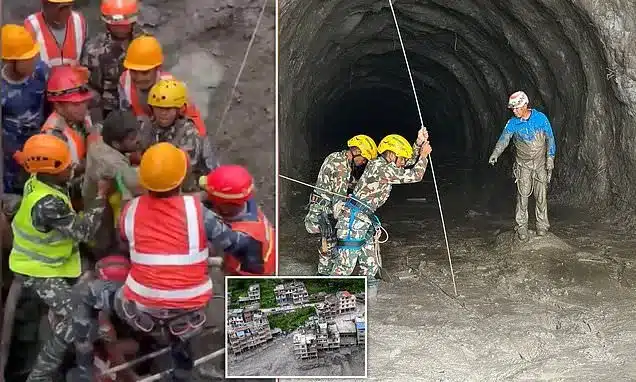
Two workers have been successfully rescued from a tunnel at a hydropower plant in Nepal, nine days after devastating floods struck the region. The successful extraction on Friday has ignited hope for dozens of other individuals still believed to be trapped in submerged tunnels, as rescue teams report hearing additional voices from within the complex.
Dramatic Rescue Operation Underway
The two rescued men, identified by officials as a mechanical foreman and a mechanical supervisor, were pulled from a small opening at the Trishul 3A hydropower plant. Local television channels broadcast images of the workers, covered in mud, being carried to safety by rescuers. Dramatic video footage also captured the moment a team of approximately a dozen rescuers worked to pull one man from a hole in the ground, erupting in applause as he reached the surface.
Both individuals are currently under medical observation. Army spokesperson Brig. Gen. Raja Ram Basnet confirmed the details of the rescue, highlighting the perilous nature of the operation conducted nine days after the catastrophic floods.
Devastating Floods and Ongoing Crisis
The floods, which occurred on August 26 and are suspected to have been triggered by a glacial collapse, have inflicted widespread devastation across towns and valleys in Nepal. The scale of the disaster is immense, with official figures from the country’s disaster management agency indicating that at least 1,259 people have lost their lives and over 5,000 remain unaccounted for.
The impact extends beyond Nepal’s borders. On the Tibetan side of the border, China reported 21 fatalities and 541 missing individuals as of late Wednesday. The situation at the hydropower projects is particularly concerning, with approximately 900 workers missing from 12 different sites. Authorities estimate that around 500 of these missing individuals may be trapped within tunnels.
Challenges and Hope for Trapped Workers
The rescue of the two workers offers a crucial morale boost to the ongoing efforts to locate and save others. However, the challenges remain significant. The submerged tunnels and the unstable conditions created by the floods make access extremely difficult and dangerous for rescue teams. The exact number of people still trapped and their precise locations are not yet fully known, adding to the complexity of the search and rescue operations.
Rescuers are employing various methods to locate survivors, including listening for sounds from within the tunnels. The report of hearing additional voices is a critical development, suggesting that more individuals may be alive and awaiting rescue. This has intensified the focus on specific areas within the hydropower plant complex.
The Role of Hydropower Projects in Nepal
Nepal, a country with abundant water resources, has been actively developing its hydropower sector to meet domestic energy needs and for export. The Trishul 3A hydropower plant, like many others, is situated in a region prone to natural disasters, including flash floods and landslides, especially in the context of climate change and its impact on glacial melt. The recent disaster underscores the vulnerability of such critical infrastructure and the human cost associated with these events.
International Response and Support
The scale of the disaster has prompted an international response, with various countries and organizations offering assistance. Search and rescue teams, medical aid, and financial support are being mobilized to aid Nepal in its recovery efforts. The focus, however, remains on the immediate task of saving lives, particularly those still trapped in the perilous conditions.
Future Preparedness and Mitigation
While the immediate priority is the ongoing rescue mission, the devastating floods also bring to the forefront the critical need for enhanced disaster preparedness and mitigation strategies in Nepal. This includes improving early warning systems, reinforcing infrastructure in vulnerable areas, and developing robust emergency response plans. Understanding the risks associated with glacial lake outburst floods (GLOFs) and other climate-related hazards is paramount for safeguarding communities and vital infrastructure.
The successful rescue of the two workers, despite the overwhelming tragedy, serves as a testament to the resilience and determination of the rescue teams. The hope now is that these efforts will lead to the safe recovery of all those still missing and trapped, bringing some measure of solace to the affected families and communities.