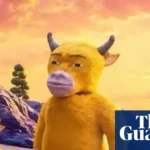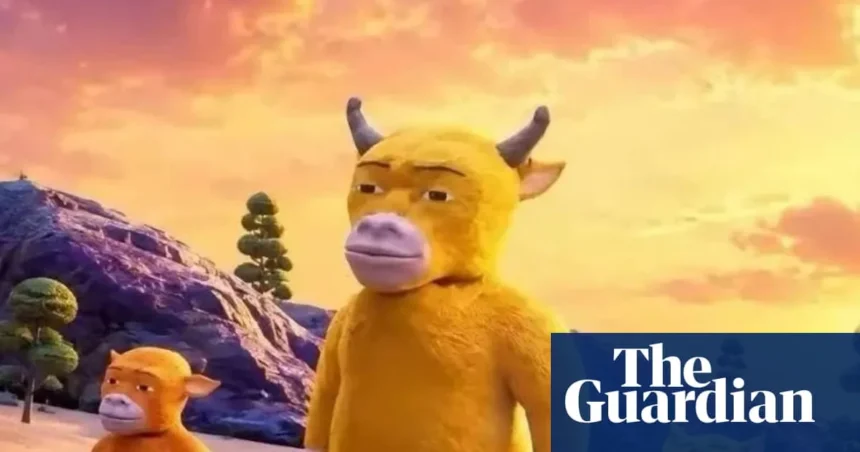
A humble, low-budget animated film, Niu Lai, which translates to The Cow is Coming, has defied expectations by becoming a surprise hit at the Chinese box office. This 86-minute feature, characterized by its rudimentary animation and abstract dream sequences, has found itself listed alongside major Hollywood and domestic blockbusters. The film chronicles the developing relationship between a newborn calf and a skylark.
From Obscurity to Online Sensation
Released on August 5th, Niu Lai initially garnered minimal attention. Reports indicate that in its first ten days, the film earned a mere 7,700 yuan (approximately £842), with fewer than 300 tickets sold nationwide. Crucially, the production lacked any conventional promotional efforts, including pre-release publicity or even a trailer. However, a peculiar phenomenon began to unfold online: widespread discussions about the film’s perceived poor quality inadvertently transformed it into an internet meme.
This online buzz, driven by a mix of bemusement and curiosity, spurred a significant number of film enthusiasts to seek out the movie in cinemas. What started as an obscure release has now achieved a remarkable box office total exceeding 14.9 million yuan, according to data from the movie tracking site Mao Yan. This figure places it among the year’s notable performers, especially within a competitive release window that included high-profile films such as Christopher Nolan’s The Odyssey.
Context of the Chinese Box Office
The Chinese film market has seen substantial releases throughout the year. The Odyssey, for instance, generated 192 million yuan during its initial three-day run in China. It was, however, outperformed by the domestic film Once Upon a Time in the Middle East, which depicts the story of a Chinese chef caught in conflict while running a restaurant in the Middle East. This homegrown production grossed 477.9 million yuan between August 14th and 16th alone.
Against this backdrop of slick, high-production value films, Niu Lai‘s success is particularly striking. Its appeal seems to stem less from technical or narrative prowess and more from what is often described as a “so bad it’s good” quality. This unique characteristic has resonated with audiences seeking something unconventional.
The Artisans Behind Niu Lai
The creation of Niu Lai is a testament to dedication and a distinct artistic vision. The film was reportedly developed over five years by a minimal team of just two individuals, Xin Yumeng and Sun Lifang. They are understood to be a mother-and-son duo who handled all aspects of production, including writing, directing, voice acting, and producing. This hands-on, intimate approach stands in stark contrast to the polished, large-scale animations that have dominated China’s box office in recent years, such as the popular Ne Zha franchise.
Even the film’s distributor expressed initial reservations, having been advised against releasing Niu Lai due to its perceived quality issues. Nevertheless, the distributor proceeded with the release, reportedly as a favor to a friend involved in the production. This decision, against conventional industry wisdom, ultimately paved the way for the film’s unexpected journey.
“So Bad It’s Good” and the Age of AI
The unconventional aesthetic of Niu Lai has sparked considerable discussion among viewers and industry observers. Some audience members have lauded the film’s deliberately crude, handcrafted animation style as a refreshing counterpoint to the increasing prevalence of artificial intelligence in creative fields. On the popular Chinese film review site Douban, one user pondered whether the filmmakers intentionally adopted this visual approach:
“In an era where AI is so popular, did the creative team choose a handcrafted, somewhat crude visual style to convey a sense of ‘returning to one’s true self?’”
This sentiment suggests that the film’s perceived imperfections have been interpreted by some as an intentional artistic choice, a deliberate move towards authenticity in an increasingly digitized world. The film’s unique qualities have been highlighted by industry professionals, with one individual, who preferred to remain anonymous, describing it as:
“bad in every aspect imaginable, including the story, special effects and almost every element that a movie is expected to have. Ironically, this is exactly what attracted audience curiosity.”
This perspective underscores the paradoxical nature of the film’s success: its weaknesses have become its greatest strengths, drawing in audiences precisely because of its unconventionality and perceived flaws.
Industry Reactions and Future Implications
While Niu Lai‘s box office performance has been a talking point, its reception within the broader film industry has been mixed. Some commentators have voiced concerns that the film’s popularity might detract from or overshadow productions of higher artistic or technical merit. The anonymous industry professional further elaborated on this sentiment:
“Niu Lai’s success feels like an embarrassment to the Chinese film industry.”
This viewpoint suggests that the success of a film widely regarded as technically deficient raises questions about audience taste and the criteria by which films are valued. It highlights a potential tension between commercial success driven by novelty and meme culture, and the industry’s aspirations for artistic and critical acclaim.
Despite these reservations, Niu Lai‘s journey from an unpromoted, low-earning film to a box office anomaly serves as a fascinating case study in modern audience engagement and the unpredictable nature of viral phenomena. It demonstrates that in the digital age, a film’s cultural impact can transcend traditional metrics of quality and marketing, finding success through unexpected avenues like internet memes and a desire for the unconventional.