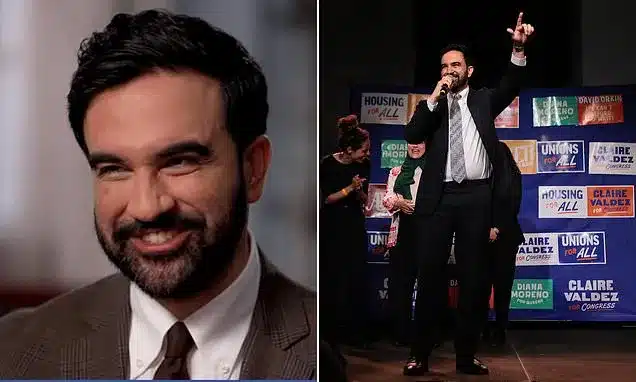
New York City Mayor Zohran Mamdani has addressed speculation about his political future, including a potential presidential run, stating his belief that the U.S. Constitution’s eligibility requirements for the presidency should remain unchanged. Mamdani, who recently celebrated the electoral success of several progressive candidates he endorsed, was questioned about the constitutional clause requiring presidents to be “natural born citizens.” This requirement currently prevents him from running for the nation’s highest office due to his birth in Kampala, Uganda, in 1991. He did not become a naturalized U.S. citizen until 2018.
Mamdani’s Stance on Constitutional Amendments
During a Sunday interview on ABC’s ‘This Week’ with Jonathan Karl, Mamdani was directly asked if he favored amending the Constitution to alter the “natural born” citizenship requirement for presidential candidates. Karl posed the question, “Do you think that’s a — something that should be changed in the constitution? It would take an amendment, but do you think that that’s — we should change that.” Mamdani’s response was unequivocal: “No,” he stated, adding, “I think the constitution looks good the way it is.”
Following his direct answer, Mamdani lightened the mood, remarking, “I’m very excited to focus on New York City, but thank you for reminding me of my upcoming mortality.” He is currently 34 years old and will turn 35 in October, just shy of the constitutional age requirement of 35 for a sitting U.S. President, though the citizenship clause remains the primary barrier to his eligibility.
The ‘Natural Born Citizen’ Clause
The requirement for a U.S. President to be a “natural born citizen” is enshrined in Article II, Section 1, Clause 5 of the Constitution. This clause has historically been interpreted to mean individuals born within the territorial jurisdiction of the United States or those born abroad to U.S. citizen parents under certain conditions. The exact definition has been a subject of legal and political discussion over the years, particularly concerning individuals born in U.S. territories or those with dual citizenship from birth.
For Mamdani, his birth in Uganda means he does not meet this specific criterion, regardless of his U.S. citizenship obtained later in life. This constitutional stipulation has been a consistent factor in presidential eligibility for all candidates throughout American history.
Broader Context: Constitutional Amendments and Presidential Terms
Mamdani’s comments come at a time when discussions around constitutional amendments, particularly concerning presidential terms and eligibility, have surfaced in political discourse. While Mamdani’s situation involves the “natural born” clause, other recent proposals have focused on presidential term limits.
For instance, shortly after the start of a presidential term, a Republican representative from Tennessee proposed an amendment to the 22nd Amendment. This proposed amendment aimed to allow a president to serve more than two terms, specifically referencing the possibility of a third term for then-President Donald Trump. However, the proposal also included provisions that would have prevented former presidents who had already served two consecutive terms, such as Barack Obama, George W. Bush, and Bill Clinton, from seeking the office again.
The Difficulty of Amending the Constitution
The process for amending the U.S. Constitution is deliberately rigorous, designed to ensure broad consensus. To pass an amendment, it requires a two-thirds majority vote in both the House of Representatives and the Senate. Following congressional approval, the amendment must then be ratified by three-fourths of the state legislatures. Given the current political landscape, characterized by a near even split between the major parties, achieving the necessary supermajorities for such significant constitutional changes is exceedingly difficult, especially for amendments perceived as benefiting specific individuals.
Focus on New York City
Mayor Mamdani’s recent electoral successes, where three progressive candidates he endorsed secured victories in primary elections, underscore his current political focus. His endorsement played a significant role in these outcomes, highlighting his influence within the progressive wing of the Democratic Party.
Mamdani has consistently expressed his commitment to his role as Mayor of New York City. His remarks indicate a dedication to addressing the challenges and opportunities within the city, rather than pursuing national office at this time. The mayor’s firm stance on the constitutional requirements suggests a pragmatic approach, acknowledging the existing framework while prioritizing his current responsibilities.
Conclusion
New York City Mayor Zohran Mamdani has clearly stated his position on the constitutional requirements for the U.S. presidency, affirming that the existing rules, including the “natural born citizen” clause, should not be changed. While acknowledging the constitutional age requirement is approaching, his primary focus remains on governing New York City. His comments reflect a respect for the established constitutional order and a commitment to his mayoral duties, effectively putting to rest immediate speculation about a presidential bid.