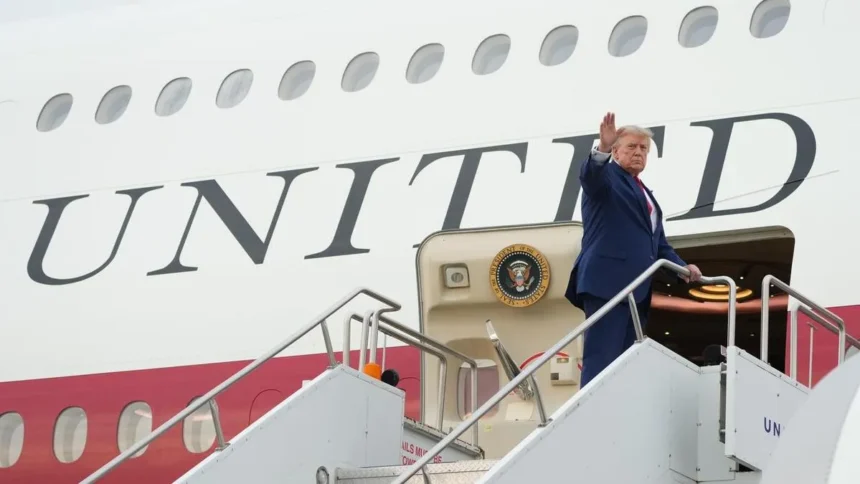
A credible and imminent threat of a shoulder-fired missile targeting the presidential aircraft, Air Force One, prompted the Secret Service to secretly reroute Donald Trump to a smaller government jet during his July visit to Turkey. The clandestine operation occurred on the final day of Trump’s trip to Ankara, where he attended a NATO summit amidst escalating tensions with Iran. Officials described the threat as significant enough to warrant an extraordinary measure to conceal the US president’s movements.
Secretive Aircraft Switch Amid Heightened Tensions
The intelligence regarding the potential missile threat emerged on July 8, the last day of Trump’s visit. A source familiar with the matter stated that the Secret Service deemed the threat credible and imminent, necessitating a last-minute plan to ensure the president’s safety. The exact origin of this intelligence was not disclosed, but the source indicated that preparations had to be made rapidly.
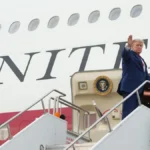
The elaborate plan involved using a catering truck to facilitate a discreet transfer of President Trump and a small contingent of aides from the large, distinctive blue-and-white presidential aircraft to a less conspicuous C-32A jet. This smaller plane was then used for the flight out of Turkey. Meanwhile, the larger Air Force One departed separately, carrying senior administration officials, White House staff, and the press corps, effectively serving as a decoy.
Speaking to reporters later, Trump confirmed the switch was directed by the Secret Service, emphasizing their role in presidential security. He stated that the flight on the smaller jet to a refueling stop in Britain proceeded without incident. Intriguingly, Trump suggested that the decoy Air Force One might have been the more likely target for any potential attack, though he offered no evidence to support this assertion.
Understanding the Missile Threat
Experts suggest the threat may have involved advanced heat-seeking missiles. Douglas Birkey, executive director of the Mitchell Institute for Aerospace Studies, explained that such missiles are designed to lock onto the heat emitted by aircraft engines. These weapons pose a growing concern for military planners because they are notoriously difficult to detect compared to traditional radar-guided threats. Birkey noted that these missiles “can kind of come out of nowhere” as they do not emit detectable radio waves, making them a stealthier danger.
Precedent and Secrecy in Presidential Travel
While presidents occasionally travel under heightened secrecy, particularly when visiting active war zones or regions with significant security risks, such operations typically involve advance notification for the traveling press. However, in the case of the Turkey trip, the source indicated that the Secret Service lacked the luxury of time for extensive planning or notification. “They were scrambling to head off what they thought was a credible, imminent threat,” the source stated.
Details of this covert operation were first reported by The Washington Post more than a month after it occurred. Separately, The New York Times reported that US officials expressed alarm upon discovering that individuals with ties to Iran were aware of Trump’s specific location in Ankara, including the hotel floor he was occupying.
Personnel Aboard the Decoy Aircraft
The decoy Air Force One, presumed by some to be carrying the president, was occupied by several high-ranking officials. According to the source, these included Secretary of State Marco Rubio, who was briefed on the maneuver, Treasury Secretary Scott Bessent, White House Communications Director Steven Cheung, and other aides. The typical traveling press pool of 13 individuals was also on board this aircraft.
Key White House staff who accompanied Trump on the C-32A jet via the catering truck included Deputy Chief of Staff Dan Scavino, Executive Assistant Natalie Harp, and Director of Oval Office Operations Walt Nauta.
Security Concerns and Official Responses
The unusual nature of the operation has led some media commentators and lawmakers to question whether the secrecy placed Trump’s aides and the journalists traveling with them at undue risk on the decoy plane. The source defended the decision, asserting that maintaining the secrecy of the ruse was deemed essential for President Trump’s best interests, particularly as hostilities with Iran, which shares a border with Turkey, were escalating. Turkish officials have not yet issued a public comment regarding the alleged threat.
This incident highlights the complex security challenges faced by the US government when transporting the president, especially in volatile geopolitical regions. The Secret Service’s primary mission is to protect the president, and their actions in Turkey underscore the lengths to which they will go to mitigate perceived threats, even if it involves unconventional and highly secretive maneuvers.