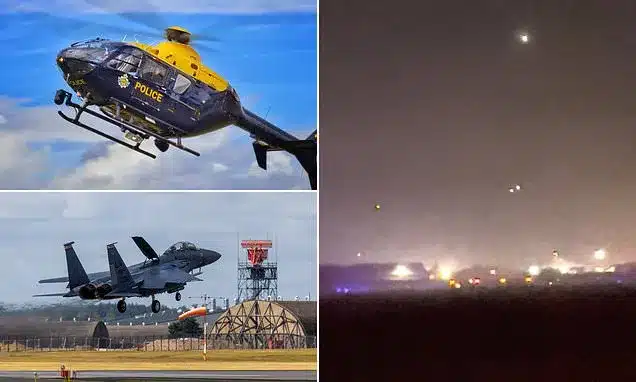
A police helicopter pilot experienced intense fear for his life during a close encounter over a US airbase in November 2024, as he was hunting for unidentified drones believed to have been launched from a Russian vessel. The pilot steered his aircraft downwards, fearing a collision with what he perceived as drones, but it was later identified as a US F-15 fighter jet. This incident, which occurred near RAF Lakenheath in Suffolk, has been detailed in a report by the UK Airprox Board, investigating near-misses in British airspace.
Near-Miss Incident Over RAF Lakenheath
The National Police Air Service (NPAS) EC135 helicopter was conducting monitoring activities above RAF Lakenheath, a sensitive airbase with historical ties to nuclear weapons storage. The pilot reported observing ‘red flashing lights’ and what he believed to be drones operating at a constant height above his helicopter. In an attempt to evade the perceived threat, the pilot descended rapidly at approximately 167 mph. The UK Airprox Board’s assessment report, detailing the events of November 22, 2024, indicated that the police helicopter and the US F-15 fighter jet came within 1,900 feet of each other.
Investigators concluded that the police helicopter crew likely misidentified the flashing lights of the F-15 Eagle fighter jet as those of drones. While the police helicopter had made transmissions to air traffic control regarding their observations, the crew had not been informed by RAF Lakenheath about the presence of the F-15. The report highlighted that while the fighter pilot was aware of the helicopter’s position, enhanced situational awareness for the EC135 pilot could have been achieved if reciprocal traffic information had been shared by the Lakenheath Approach Controller.
Pilot’s Account and Concerns
New details have emerged regarding the police pilot’s state of mind during the incident. According to a source quoted in The Times, the pilot harbored a significant fear that the perceived drones could cause his helicopter to crash. The source stated, “He had a real fear the drones would bring the chopper down. The pilot was worried he was going to die. He was told to disengage.” The report noted that the helicopter crew did not observe standard aircraft lights, and none were detected by onboard camera systems, which may have reinforced their belief that they were encountering drones. Radar readings, however, suggested the activity was more consistent with US F-15s operating in the vicinity, maintaining a safe altitude of approximately 1,000 feet above the police helicopter.
Broader Context: Russian Drone Activity
The near-miss incident occurred against a backdrop of broader concerns regarding Russian drone incursions into British airspace. A separate report revealed that Russian drones had indeed been observed flying over RAF and US military bases, including Lakenheath and RAF Mildenhall in Suffolk, RAF Fairford in Gloucestershire, and RAF Feltwell in Norfolk, over a four-day period in 2024. These unmanned aerial platforms were reportedly launched from the Russian fleet tanker HAV Dolphin, which was sighted off the coast of Humberside at the time.
In response to these suspected incursions, the British government deployed specialist troops with expertise in intercepting drones to the affected bases. These electronic warfare specialists, from the RAF’s 34 Squadron, were equipped with advanced technology, including thermal-imaging cameras, radio frequency and acoustic sensors, GPS jammers, and anti-drone guns. The deployment aimed to intercept any unmanned aerial vehicles (UAVs) posing a threat to aircraft or personnel and to maintain operational security.
International Security Concerns and Russian Tactics
The International Institute for Security Studies (IISS) has declared that the drone operations were part of a wider Kremlin campaign across Europe. The IISS found that Russia has utilized a ‘shadow fleet’ of vessels sailing in international waters to launch drones over Britain and mainland Europe, exposing critical gaps in allied air defense systems. Between August 2024 and February of the following year, Russia reportedly targeted 12 NATO member states and Ireland. These incursions led to the closure of major commercial airports and disruptions to military activities.
According to the IISS, these operations penetrated the perimeters of sensitive defense installations, including nuclear-sharing sites and France’s ballistic missile submarine base. The institute assesses that the UAV campaign likely aimed to probe response times, map vulnerabilities around critical national infrastructure, impose economic and psychological costs, and disrupt civilian aviation. The IISS report suggests that the Russian drone sorties could have been a response to Ukraine’s use of US and UK ballistic missiles against mainland Russia.
RAF Lakenheath and Military Preparedness
RAF Lakenheath, home to the US Air Force’s 48th Fighter Wing, operates advanced aircraft including F-15 and F-35A supersonic jets. The base has been a focal point for discussions regarding potential nuclear weapons storage, with reports emerging earlier in the year about facilities being prepared to house powerful bombs. Documents, some of which were later withdrawn by US defense officials, suggested preparations for an ‘upcoming nuclear mission’ at the base.
The security crisis prompted the Government’s emergency Cobra committee to hold meetings to discuss potential risks not only at RAF Lakenheath but also at other bases, including RAF Mildenhall, RAF Fairford, and RAF Feltwell. The incidents, including the near-miss involving the police helicopter and the F-15, underscore the complex and evolving security challenges faced by military installations in the UK and across Europe.
Conclusion
The near-miss incident over RAF Lakenheath, initially perceived as a drone threat, highlights the critical importance of clear communication and accurate situational awareness in complex airspace. The subsequent revelations about Russian drone activity and the broader geopolitical context underscore the ongoing security challenges posed by unconventional warfare tactics. The events serve as a stark reminder of the vigilance required to protect sensitive military installations and maintain national security in an increasingly unpredictable global environment.