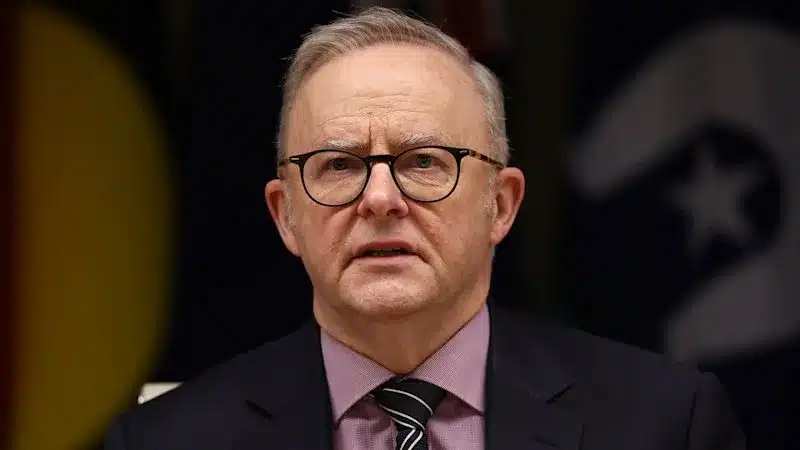
State and territory leaders are poised to demand increased federal funding as a condition for their continued support of a controversial Goods and Services Tax (GST) distribution deal favouring Western Australia. Prime Minister Anthony Albanese has firmly stated his commitment to the existing arrangement, which originated during the Morrison government era and is projected to cost federal taxpayers approximately $60 billion. This deal is considered crucial for securing electoral success in Western Australia.
GST Deal Sparks Inter-State Tensions
Sources close to the recent national cabinet meeting in Sydney indicated that the GST arrangement was a brief topic of discussion. However, premiers from New South Wales, Victoria, and South Australia have reportedly been informed by federal officials that a more in-depth discussion regarding the Western Australian GST deal is scheduled for a national cabinet meeting in February or March of the following year. This timeline suggests a prolonged period of negotiation and potential friction.
The Productivity Commission’s interim report earlier this month sharply criticised the GST deal, labelling it a significant misstep that has resulted in “perverse fiscal outcomes.” The report highlighted that the benefits have disproportionately accrued to Western Australia, largely at the expense of other states and federal taxpayers. Projections suggest the deal could ultimately cost federal taxpayers up to $12 billion annually.
The report’s findings have ignited a strong reaction from Western Australian Premier Roger Cook, who has publicly disparaged the Productivity Commission, referring to its members as “east coast clowns” and critics of the deal as “whingers.” Prime Minister Albanese, who has publicly declared that the GST deal will remain unchanged under his leadership, weighed into the debate by characterising the commission’s report as the product of “economic rationalists.”
Following the national cabinet meeting, Mr. Albanese sidestepped direct questions about whether New South Wales Premier Chris Minns, Victorian Premier Ben Carroll, or South Australian Premier Peter Malinauskas had raised concerns about the GST. When pressed on New South Wales’s grievances, Mr. Albanese instead emphasised his positive working relationship with Mr. Minns, who faces a state election in March. “This bloke here, the premier of New South Wales: I’ll be working hard to make sure he stays the premier after March next year. And under my government, NSW will always get support,” Mr. Albanese stated.
Premiers Seek Permanent ‘No Worse Off’ Guarantee
Key state leaders are reportedly planning to press Mr. Albanese to make permanent the most financially significant component of the Western Australian GST deal: the “no worse off guarantee.” This guarantee, currently costing around $6 billion per year, is paid to all states except Western Australia to ensure they do not suffer financial penalties due to the specific GST distribution arrangement. The Albanese government has already extended this guarantee until the end of 2030. However, the states and territories are not only seeking its permanence but also an increase in the guaranteed amount, aiming for additional federal financial assistance.
Treasurer Jim Chalmers publicly admonished Premier Cook for his remarks concerning the Productivity Commission, describing some of the commentary on the report as “unfortunate.” Mr. Chalmers stressed the importance of respecting the commission and its work, even when disagreeing with its conclusions. “I don’t believe that is appropriate. I think you can disagree with the conclusions of the Productivity Commission without denigrating them,” he said. “I think it is important that even when those conclusions are contested – as they often will be – that we continue to respect the people of the PC and the really important work that they do.”
National Cabinet Addresses Other Key Issues
Beyond the GST dispute, the national cabinet reached agreements on several other significant policy matters. A new plan to combat domestic violence was advanced, alongside measures to ban 3D-printed firearms and prohibit foreign nationals from holding Australian gun licences. These gun control measures were prompted by the tragic events in Bondi.
A proposed national gun buyback scheme continues to face opposition from all states and territories, with the exception of New South Wales and the Australian Capital Territory. Despite this, leaders agreed to enhance intelligence sharing related to firearms. This development occurred on the same day that the antisemitism royal commission concluded its final hearings.
AI Framework and Data Centre Energy Policy
Prime Minister Albanese also secured agreement on his proposed national Artificial Intelligence (AI) framework. This was achieved after accommodating the concerns of conservative state governments regarding energy policy for data centres. The governments of Queensland and the Northern Territory had previously expressed reservations about a federal proposal mandating that data centres exclusively use green energy sources. Opposition Leader Angus Taylor has voiced support for Queensland’s stance on this issue.
The recent agreement represents a concession to Queensland, which operates a significant fleet of state-owned coal-fired power plants that compete with renewable energy sources like wind and solar farms. The Northern Territory, meanwhile, is backing the development of a gas field in the Beetaloo Basin, which it anticipates will stimulate industrial growth.
Mr. Albanese acknowledged the distinct energy landscapes in Queensland and the Northern Territory, particularly given their public ownership of power generation, transmission, and distribution infrastructure. Queensland Premier David Crisafulli highlighted his state’s unique position: “We own distribution, transmission, generation, and that enables us to control that energy mix,” he explained. “We believe that we can control our data sovereignty, protect the rights of local communities, and enable that energy mix to bring those data centres on.”
The official communiqué issued after the meeting did not specifically mention renewable energy mandates for data centres. Instead, it focused on the “generational opportunity” presented by AI and indicated that environmental considerations for large data centres would be addressed through federal legislation early in the new year. This approach allows for flexibility while acknowledging the need to manage the environmental impact of burgeoning data infrastructure.
Conclusion
The national cabinet meeting underscored the ongoing fiscal tensions between federal and state governments, particularly concerning the Western Australian GST deal. While immediate changes to the deal were not made, the commitment to further discussions signals that this issue will remain a significant point of negotiation. Concurrently, the cabinet advanced progress on critical domestic policy areas, including public safety and the burgeoning field of artificial intelligence, demonstrating a capacity to address multiple complex issues simultaneously.