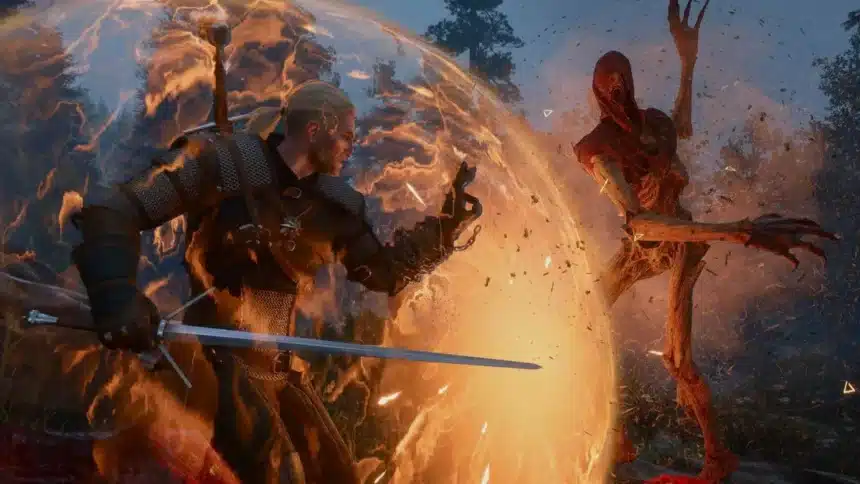
A new expansion for The Witcher 3: Wild Hunt, titled Songs of the Past, is on the horizon, focusing on the beloved bard Dandelion. Alongside this upcoming content, a comprehensive remaster of the entire game is also slated for release, aiming to modernize the 2015 classic. The expansion will introduce players to a never-before-seen region, while the remaster promises significant gameplay and visual enhancements.
Dandelion’s Return in Songs of the Past
Contrary to expectations of Ciri or Yennefer-centric narratives, Songs of the Past centers on the disappearance of Dandelion, Geralt’s flamboyant biographer and friend. The expansion kicks off with Geralt venturing to Letten, Dandelion’s ancestral home in the kingdom of Redania, to find him. This new region, described as a lush, hidden valley untouched by war, offers a peaceful setting that contrasts with the typical turmoil of the Continent.
Karolina Kuzia, Vision Director for Songs of the Past, explained that the expansion delves into the personal matters affecting Dandelion, requiring Geralt’s assistance. “We visit because of personal matters that put a toll on him, so he needs his best friend at his side,” Kuzia stated. “Imagine you enter a lush green valley, hidden in a mountain range.” Despite its apparent tranquility, Letten harbors a darker side, ensuring Geralt will find plenty of challenges.
A Personal Quest in a New Land
The narrative begins with Geralt waking up hungover after local Belleteyn celebrations, only to discover Dandelion is missing. His search leads him to the opulent Lettenhove manor, the seat of Dandelion’s noble family. Here, Geralt finds himself mediating between Dandelion’s formidable grandmother and cousin, Lilla, who are debating his disappearance. The expansion emphasizes the strong bond between Geralt and Dandelion, described by developers as a “bromance.”
Geralt and Lilla will venture into the foreboding woods of Letten, investigating a family legend tied to the curse of Count Humbert de Lettenhove, an ancestor of Dandelion. Gameplay in the expansion retains the core mechanics of The Witcher 3, including the use of Witcher Senses for tracking and a choice-based dialogue system that allows for peaceful resolution or combat. One early encounter involves retrieving Dandelion’s lute from a local, with players able to choose their approach.
New Combat Mechanics and Enemies
Songs of the Past introduces new gameplay elements, most notably a silver chain weapon for Geralt. This weapon, reminiscent of one used in The Witcher 1‘s opening cinematic and seen in trailers for a potential future installment, is designed for crowd control. It can be used to pull enemies from groups or to keep them at bay. Players can select the chain like a sign or bomb in combat, with options for quick deployment or a focused attack that slows time for precise targeting.
New enemy types, such as “swarmions,” are designed to complement the chain’s abilities. The expansion also features a boss fight against the Slumbering Knight, guarding a mystical well connected to Dandelion’s disappearance and the de Lettenhove curse. This encounter requires Geralt to utilize his familiar combat skills alongside the new chain weapon to break the boss’s defenses.
Comprehensive Remaster for Modern Audiences
In addition to the new expansion, CD Projekt Red is releasing a full remaster of The Witcher 3: Wild Hunt. This update aims to bring the game up to modern standards, addressing gameplay frustrations and enhancing the overall experience. Jakub Kutrzuba, Executive Producer of External Projects at CD Projekt Red, stated that the remaster focuses on improving pain points for new players and making the game feel as if it were released today.
Key improvements include more responsive and dynamic combat, movement, and animations. “The remaster includes so many improvements, so many fixes, so many changes and gameplay improvements,” said Badowski, a developer. “All the improvements make the combat much more smooth, much more natural. You can change target while playing the animation or performing strikes, and it gives the game a kind of freshness.”
Enhancing Immersion and Quality of Life
The development team has dedicated significant effort to refining the animation system, camera work, and implementing quality-of-life features and accessibility options. Enemy AI and pathfinding have also been addressed to reduce potential frustration. “We went through all of them and asked ourselves, ‘What can we do about it, without rebuilding the game from scratch?’ And we have changed a lot… the game just plays smoother, you know? There’s no immersion-breakers anymore, I would say,” Kutrzuba commented.
Visually, the remaster builds upon the 2022 next-gen update, further enhancing the game’s already stunning environments. The region of Letten, in particular, showcases these improvements with lively details, such as shepherds guiding sheep and carts moving through the landscape, making the world feel more alive. Developers have incorporated community-inspired features, allowing players to interact with the environment more dynamically, such as using boats and driving carts, to bolster the sense of immersion in areas like Letten.
Release and Future Prospects
The full remaster of The Witcher 3: Wild Hunt is scheduled for release on September 29. While a release date for the Songs of the Past expansion has not been explicitly stated, it is implied to follow the remaster. This dual release signifies a significant commitment to the enduring legacy of The Witcher 3, offering both new content and a revitalized experience for both veteran players and newcomers.
The developers aim to make the game feel contemporary, comparable to titles launching today, by touching upon aspects that have remained unchanged since the game’s initial release. The enhancements are expected to provide a smoother, more engaging experience, ensuring The Witcher 3 remains a benchmark in the RPG genre.