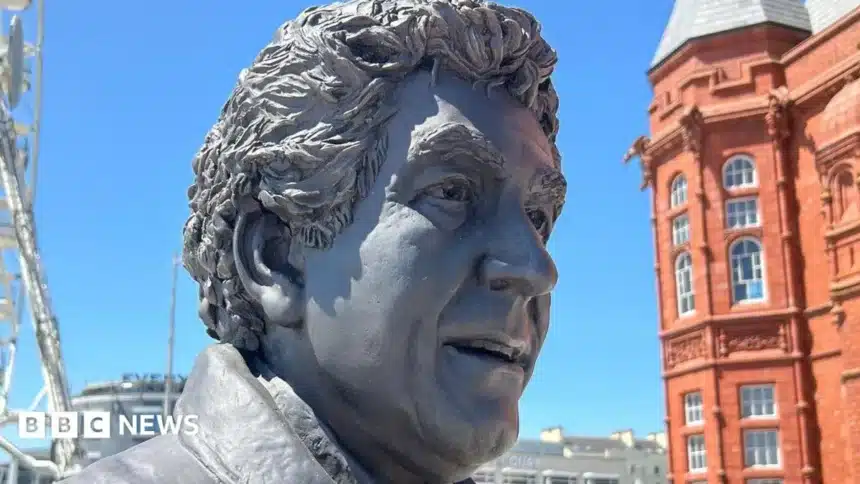
A new bronze statue honouring the late Rhodri Morgan, a pivotal figure in Welsh politics and the nation’s first First Minister, was unveiled in Cardiff Bay on [Date of Unveiling, if available, otherwise omit]. Hundreds gathered in front of the Pierhead Building to witness the dedication of the monument, which captures Morgan in casual attire, accompanied by his dog, Tel, gazing towards the Senedd – the Welsh Parliament he was instrumental in shaping.
A Monument to the ‘Father of Devolution’
The statue’s design, placed directly on the ground rather than on a plinth, was intentionally chosen to reflect Morgan’s accessible nature. His wife, Julie Morgan, noted that this placement symbolized his connection with the people. “He was someone who was close to the people, and it reflects that,” she stated.
Former First Minister Mark Drakeford hailed the statue as a lasting tribute to Morgan’s legacy, referring to him as the “father of devolution.” Drakeford emphasized Morgan’s crucial role, asserting, “without him we wouldn’t have the Senedd.” Morgan is credited with stabilizing Welsh devolution during its initial challenging year and served as First Minister for nine years, leaving a distinctive mark on Welsh governance.
A Politician of the People
Born in Cardiff and educated at Harvard, Rhodri Morgan was widely regarded as a leading political figure of his time. He stepped down from his role as First Minister in 2009 and passed away in 2017 at the age of 77 while cycling near his home.
Finance Minister Elin Jones described the unveiling as a significant occasion for Wales and for Rhodri Morgan’s family. “He was the chief builder of the Senedd in the hearts and minds of the people,” Jones remarked, highlighting Morgan’s deep impact on public perception of the Welsh Parliament.
Labour MS Shav Taj remembered Morgan as a “true friend of working people and the trade union movement,” underscoring his commitment to ordinary citizens and organized labour. Llywydd Huw Irranca-Davies spoke of Morgan’s charisma, noting that even those who had never met him felt a personal connection. “People who never met Rhodri felt they knew him as a friend,” he said.
Mark Drakeford described the day as “bittersweet,” a poignant reminder of the politician and individual they had lost. He recalled Morgan’s consistent approachability: “He was the same with everyone he met, he was a man of the people. You would see people crossing the road to talk to him.” Drakeford added that Morgan’s distinctive appearance and voice made him instantly recognizable, with many people remarking, “People recognised him, his hair and his voice.”
Years in the Making
Julie Morgan explained that the statue, which aims to capture the former First Minister’s “unstuffy” political style, was the culmination of eight years of dedicated planning and fundraising. “We’ve had a pandemic, cost of living crisis, but we’re finally here,” she commented, reflecting on the long journey to the unveiling. The project was supported by numerous fundraising events, including dinners and donations from individuals and groups across Wales, notably from organizations representing ethnic minorities.
Dilwar Ali from the Rhodri Morgan Trust expressed his satisfaction that the politician would now be permanently situated “in front of the Senedd where he spent so many years working for the people of Wales.” Ali further observed, “He was a man of the people and his statue will add to the streetscape of the bay where so many visitors pass by,” emphasizing the statue’s prominent location and its representation of Morgan’s connection to the public.
The Artist and the Foundry
The sculptor behind the monument is Andy Edwards, an artist with Welsh heritage who has created over 50 bronze sculptures, including a well-known work depicting The Beatles on Liverpool’s waterfront. The intricate process of casting the statue was undertaken at the Castle Fine Arts Foundry, located in Llanrhaeadr-ym-Mochnant, Powys, ensuring a significant Welsh connection to the artwork’s creation.
The statue stands not only as a likeness of Rhodri Morgan but as a symbol of his enduring impact on Welsh devolution and his deep connection with the people he served. It serves as a permanent fixture in Cardiff Bay, a place he helped to define through his political leadership.