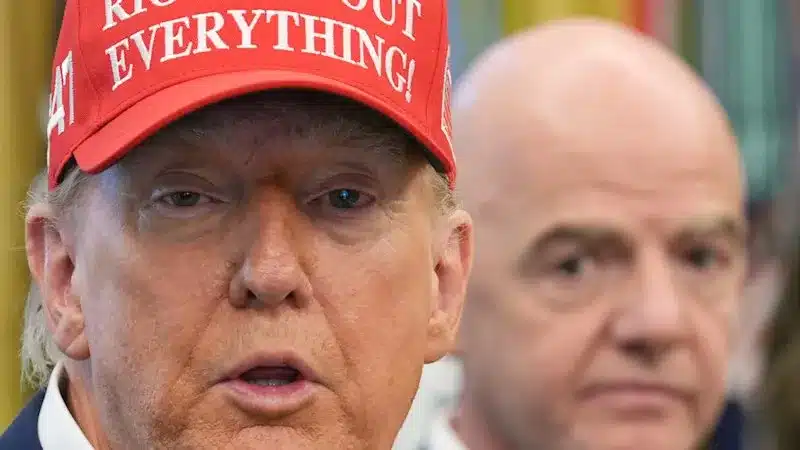
Former President Donald Trump has revealed his direct involvement in a request made to FIFA President Gianni Infantino concerning a red card suspension for U.S. World Cup player Folarin Balogun. Trump recounted calling Infantino to advocate for a review of the disciplinary action, a move that highlights complex dynamics of influence in international sports and politics.
Trump’s Intervention in Balogun’s Suspension
The former president described his conversation with Infantino, acknowledging that he could not directly order the FIFA president to overturn the suspension. “I can’t tell him what to do,” Trump stated, indicating some awareness of the impropriety. However, he emphasized the weight of a call from the President of the United States, especially when the U.S. is hosting the World Cup. Trump conveyed his desire for a review, suggesting that such a call carries significant implicit pressure.
The FIFA Disciplinary Committee stated that its decision to suspend the implementation of Balogun’s one-match ban was an independent action, taken under Article 27 of FIFA’s Disciplinary Code. Despite this official explanation, Trump’s account of his phone call makes it challenging to fully accept the independence of the committee’s decision. The incident offers a glimpse into Trump’s perspective on power and privilege.
Contempt for Rules and Favoritism
Trump reportedly expressed disdain for the concept of a one-match suspension, stating, “You can’t do that.” Furthermore, he appeared to argue that the rule should not apply to Balogun because of his status as one of the U.S. team’s top players. Trump suggested that sidelining such a player would cast a “big stain” on the competition. This sentiment was echoed by Secretary of State Marco Rubio, who told reporters that if Balogun were unable to play and Belgium won, it would “taint” their victory. Rubio posited that Belgium would ideally want Balogun to play, seemingly overlooking the potential for his presence to “taint” a U.S. win.
This perspective suggests a belief that a different set of rules applies to the elite or the “best” players, distinct from those for others. The former president also highlighted the success of the U.S.-hosted World Cup, citing large crowds and high television viewership. While these points may be factually accurate, Trump seemed to imply that the U.S.’s role as host should warrant leniency regarding Balogun’s suspension.
The Irony of Birthright Citizenship
An intriguing layer of irony surrounds Trump’s effort to shield the American star forward from disciplinary rules. Folarin Balogun, born in New York City in 2001 to Nigerian parents who were visiting the U.S., is an American citizen by birthright. His mother, reportedly too heavily pregnant to fly back to London, gave birth in a Brooklyn hospital. This status as a U.S. citizen by birthright is what makes him eligible to play for the U.S. Men’s National Team.
This principle of birthright citizenship is protected by the 14th Amendment, established in 1868. Recently, the U.S. Supreme Court narrowly affirmed this right, even amidst a conservative judicial landscape. The irony deepens when considering Trump’s long-standing campaign to end birthright citizenship. He had sought to implement changes to this policy, though his executive actions were ultimately tested and, in a recent decision, found unconstitutional by the nation’s highest court.
Birthright Citizenship: A Global Comparison
While Trump’s executive actions regarding birthright citizenship were struck down, the debate over the policy itself is ongoing. Most countries do not grant birthright citizenship as broadly as the United States. For instance, Australia does not have such a policy. According to research from the Pew Research Center, only 32 other countries offer birthright citizenship in a manner comparable to the U.S. system.
Trump was within his rights to challenge his executive order in the Supreme Court and abide by the outcome, however reluctantly. Balogun’s case, despite his soccer skills, might not be the most compelling argument for birthright citizenship. He is, in a sense, an “accidental American,” born in the U.S. due to circumstance rather than by the deliberate choice of parents seeking a new life in America, as has been the case for many immigrants throughout history.
Conclusion: A Clash of Principles
Proponents of birthright citizenship might point to individuals like Balogun as examples of the talent and potential that could be lost if the system were altered. The situation presents a notable paradox: the former president intervenes to protect a player from a rule, while simultaneously advocating for policies that could have prevented that same player from representing the U.S. in the first place. This intersection of sports, international relations, and domestic policy underscores the complex and often contradictory nature of governance and influence.