As wildfire smoke from Canada blankets vast swathes of the northern United States, concerns are mounting over the potential impact on major outdoor events, including the upcoming World Cup final. While the air quality forecast for New Jersey, the venue for the match, shows signs of improvement, uncertainty remains regarding the lingering effects of smoke pollution on athletes and spectators. The situation has also drawn a strong reaction from US President Donald Trump, who has threatened Canada with tariffs over the issue.
Wildfire Smoke Engulfs Northern US
Raging wildfires across Canada have sent plumes of smoke southward, creating hazy and sometimes hazardous air conditions throughout much of the northern United States. This environmental challenge has cast a shadow over outdoor activities and raised public health concerns. The intensity and duration of the smoke are heavily dependent on fire activity and prevailing weather patterns, making precise forecasting difficult.
World Cup Final Amidst Hazy Conditions
The highly anticipated World Cup final, scheduled for Monday morning AEST, is set to take place in New Jersey. Spanish player Mikel Merino has acknowledged the presence of smoke, noting that visibility and air quality have been affected. Despite these conditions, Merino expressed a commitment to focus on the game, stating, “For a game that is as important as a World Cup final, you have to be able to shut out external factors as much as possible.” He added that the team is taking precautions, thanks to the federation and organizers.
The Spanish team’s decision to practice outdoors in East Hanover, New Jersey, on Thursday, despite hazardous air quality, raised concerns among experts who suggested an indoor session might have been more prudent. Information regarding whether indoor alternatives were considered or feasible was not immediately available from FIFA or the Spanish Football Association.
Air Quality Forecast and Uncertainty
While the air quality in New Jersey saw some improvement by Friday, the forecast remains subject to change. Meteorologists are closely monitoring the movement of smoke plumes. Mark Parrington, a senior scientist at the Copernicus Atmosphere Monitoring Service, indicated that a subsequent smoky air mass might follow an expected rainfall on Saturday. “If the fire intensity really picks up again… it’s possible it puts more smoke into the atmosphere that then might quickly follow that rain event,” Parrington explained.
Jonathan Belles, a senior meteorologist with The Weather Channel app, noted that confidence in the forecast increases closer to the event. “The question is whether smoke behind that [rain] system reaches ground level over northern New Jersey on Sunday and, if so, how concentrated it becomes,” Belles said. Current models present a range of possibilities, from minimal ground-level smoke to levels that could pose risks to participants and attendees.
Health Implications of Wildfire Smoke
Medical experts and scientific studies highlight the significant health risks associated with wildfire smoke. The smoke contains particulate matter and other harmful pollutants that can affect nearly every system in the body, contributing to tens of thousands of deaths annually. Immediate effects can include aggravated asthma symptoms and increased emergency medical responses. Smoke can also trigger inflammation, potentially exacerbating pre-existing health conditions.
Chantal Darquenne, a professor of medicine at the University of California San Diego, explained that even moderate air quality could impact athletic performance due to the strenuous nature of sports like soccer. “It’s kind of a dose-dependent effect,” Professor Darquenne stated. “If it’s moderate, it’s going to be less of an effect but it’s still going to be there, especially because they are doing vigorous exercise during these events.”
President Trump’s Stance on Canada and Tariffs
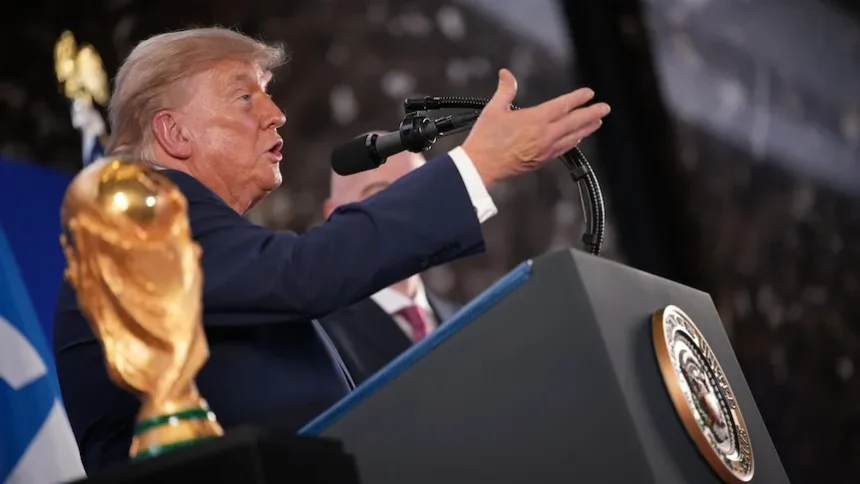
Amidst the environmental concerns, US President Donald Trump announced his intention to impose new tariffs on Canada, holding the nation responsible for the wildfire smoke drifting into the United States. “We are holding Canada responsible,” President Trump declared on his social media platform. He characterized the situation as an “unnecessary invasion” of “filthy, polluted and unhealthy air” that is “dangerous and totally unacceptable.”
The President was scheduled to meet with FIFA President Gianni Infantino prior to the final. White House officials, including Andrew Giuliani, executive director of the White House FIFA Task Force, have been in communication with FIFA and monitoring the wildfire situation.
Broader Impacts Across Sports
The haze from the wildfires has affected various sporting events. At the Meadowlands stadium, home to the NFL’s New York Giants and Jets and the venue for the World Cup final, some members of the New York Philharmonic wore masks and used specialized instruments during a halftime show rehearsal, indicating the pervasive nature of the smoke.
Baseball manager Aaron Boone of the New York Yankees commented on the smoke, noting that the team was monitoring the situation and had protocols in place, including oxygen level checks, if players experienced difficulties. “We’ll be communicating with our guys a lot. We’re able to test oxygen levels and things like that if guys are having trouble. So, we’re paying attention to it, and we’ll take the guidance from the league and the weather and the smoke people,” Boone said.
In a separate incident, a baseball game between the Cleveland Guardians and the Pittsburgh Pirates was postponed due to poor air quality, underscoring the widespread impact of the smoke on athletic competitions.
Looking Ahead
As the World Cup final approaches, all eyes will be on the sky over New Jersey. While efforts are being made to mitigate the impact of the smoke, the unpredictable nature of wildfires means that conditions could change rapidly. The health and safety of the athletes and the estimated 80,000 fans expected at the stadium remain the paramount concern.