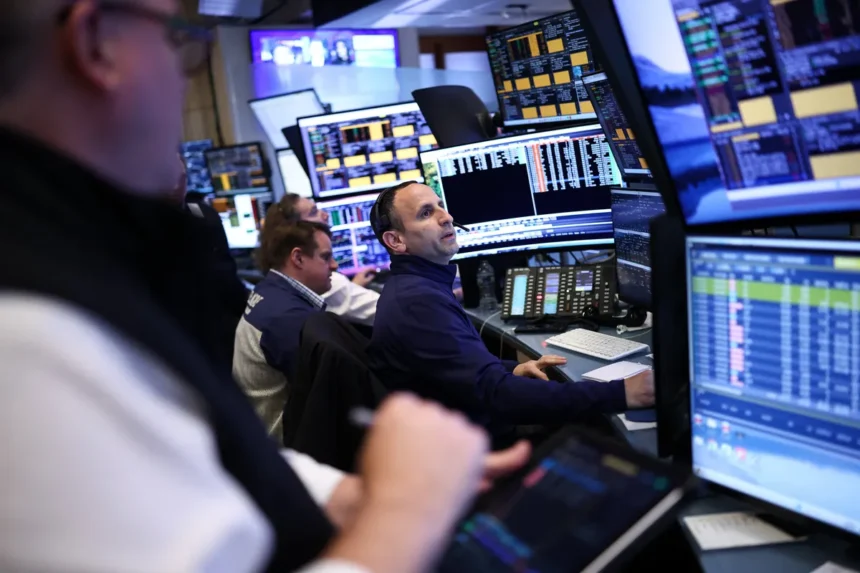
Canadian and U.S. stocks surged Wednesday after U.S. President Donald Trump declared a pause in the Iran conflict, shortly after issuing threats to dismantle its civilization. This fragile ceasefire represents the newest twist in a six-week war that has rattled global financial markets, with analysts warning of enduring economic fallout.
Neil Shearing, group chief economist at Capital Economics, highlights in a client note that lasting damage persists even if tensions ease and energy supplies normalize by late April. Persistent high oil prices threaten to fuel inflation across major advanced economies.
Portfolio Managers Capitalize on Volatility
Chris Thom, CEO of Vancouver-based Moat Financial Ltd., an options-focused portfolio manager, doubts the Iran war will conclude swiftly post-ceasefire. “These sorts of geopolitical events rarely end as quickly as they start,” he states.
Market turbulence suits Moat’s strategy of managing funds for individuals and families, including its new Active Premium Yield ETF. The firm increases energy sector exposure via cash-covered puts, which allow sellers to earn premiums as insurance against stock declines. “Those option premiums get way more expensive when the world goes crazy like it is right now. So the strategy benefits from volatility like this,” Thom explains.
Moat targets energy disruptions for prolonged effects, eyeing profits for firms like Cenovus, Canadian Natural Resources, and Suncor if oil stabilizes at $75-$85 per barrel. It reduces holdings in consumer discretionary stocks vulnerable to spiking gas prices.
Conservative DIY Investor Stays Steady
Retiree Stuart Peterson in Guelph, Ontario, emulates his grandfather’s Great Depression-era resilience with a conservative portfolio heavy in Canadian dividend stocks for income. He holds one year’s expenses in cash and two more in fixed-income funds, shielding him from war-induced swings.
“It really doesn’t affect me that much,” Peterson says, bolstered by his portfolio exceeding $1 million. He plans to “stay the course” amid escalation risks, learning from 2008 crisis withdrawals for his children’s education. Now, he avoids selling assets and shifts from U.S. holdings to Canadian index funds.
Research Analyst Eyes Long-Term Gains
Kelly Hirsch, president of Kaivalya Research in Vancouver, holds her investments steady despite Middle East war volatility since February. Her long horizon fosters optimism: “This instability will lead to innovation and accelerate changes in the longer term that, without the impetus, wouldn’t happen.”
She urges scrutiny of corporate governance, recalling COVID-19 vulnerabilities in overly efficient firms. Evaluating directors’ risk expertise and accountability mechanisms proves essential beyond mere metrics.
ETF Inflows Reflect Caution
Signs of defensive moves emerge as investors brace for war-driven economic strain. TD Securities analysts report in their Canadian ETF Weekly that equity ETF inflows hit $10.5 billion in March amid $19.1 billion total, despite downturns. First cash ETF positives since April 2025 and $4.8 billion into fixed-income signal risk reduction and waits for clarity.