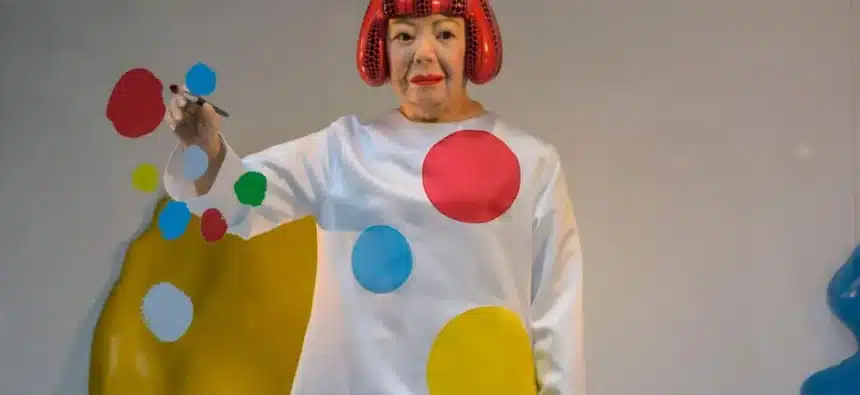
Renowned artist Yayoi Kusama, celebrated globally as the “polka dot queen,” has passed away at the age of 97. Kusama, whose vibrant and immersive art captivated audiences worldwide, died on August 14th in Tokyo. She had lived voluntarily in a psychiatric hospital for the latter half of her life, continuing her prolific artistic output well into her advanced years.
From Hallucinations to Global Fame
Kusama’s distinctive artistic vision, characterized by bold polka dots, net patterns, and mirrored infinity rooms, stemmed from vivid hallucinations she experienced from childhood. These visions, which she described as overwhelming and all-encompassing, became the foundation for her unique artistic language. Her work, ranging from monumental paintings and sculptures to immersive installations, often explored themes of self-obliteration, infinity, and the blurring of reality. This concept of “self-obliteration” involved covering her body and surroundings with repetitive patterns, aiming to dissolve her individual existence into the artwork itself.
Born in 1929 into a wealthy but reportedly troubled family in Matsumoto, Japan, Kusama began developing her signature motifs at the tender age of 10. She recounted in her autobiography, “A Personal History of Polka Dots,” how a tablecloth pattern transformed into a pervasive visual experience, filling her surroundings and even her own body. Art became her refuge and a means of coping with personal turmoil, including her father’s infidelity and her mother’s perceived regrets about her birth. “When I was sad or lonely, everything would be cured when I drew pictures,” she stated.
An Avant-Garde Pioneer in New York
Despite her parents’ objections, Kusama pursued her artistic studies in Kyoto. Her early career in Japan included her first solo exhibition in 1952. A pivotal moment came when a psychiatrist advised her to seek opportunities abroad. Kusama expressed a strong desire to leave Japan, which she described as “full of disdain for women” and restrictive in its traditions. Her correspondence with American modernist painter Georgia O’Keeffe provided further encouragement to pursue international recognition.
In 1957, Kusama moved to the United States, first to Seattle and then to New York City. The burgeoning art scene of the 1960s provided a fertile ground for her experimental approach. Despite facing significant challenges as an Asian artist in a predominantly white, male-dominated environment, and experiencing periods of extreme poverty, Kusama persevered. She became a prominent figure in the avant-garde movement, known for her radical “happenings” – public performances often involving nudity and body painting, such as those staged on Wall Street and in Central Park during the era of sexual liberation. She also founded a “Church of Self-Obliteration” and styled herself as the “High Priestess of Polka Dots,” further cementing her avant-garde persona.
Return to Japan and Late-Career Triumph
By 1973, Kusama returned to Japan, feeling burned out by her experiences in New York. She voluntarily admitted herself to a psychiatric ward, where she resided for the remainder of her life, continuing her artistic practice from within its confines. It wasn’t until the 1990s that her work achieved widespread mainstream recognition and commercial success. Her iconic pumpkins, which she described as her “life partners” due to their “generous, unpretentious looks,” became a signature motif, appearing in paintings and colossal sculptures that drew immense crowds.
In her later decades, Kusama experienced immense commercial success. Her large-scale artworks commanded millions of dollars at auction, and her exhibitions consistently attracted global attention, often becoming backdrops for social media sharing. In 2014, The Art Newspaper named her the world’s most popular artist, and her works consistently ranked among the most expensive. One “infinity net” painting, for instance, sold for nearly US$8 million in 2019.
A Legacy of Loneliness and Creativity
Despite her fame and fortune, Kusama maintained her unique artistic vision, which she attributed to the profound sense of solitude she embraced. “Creative thinking is born of loneliness… because I stood before the art all alone, I was able to forge my own path,” she explained. This deep introspection and solitary dedication fueled her relentless creativity throughout her life. She also published several novels, further diversifying her creative output.
In the years leading up to her death, Kusama continued to engage with the public and her art. In a 2017 interview, she expressed her enduring hope: “My wish after my death is that the eternally bright future, the beauty of human love and my soul will be passed on. Please love my artwork, even after I die.” Her passing marks the end of an era for contemporary art, leaving behind a legacy of groundbreaking work that challenged perceptions and inspired millions.