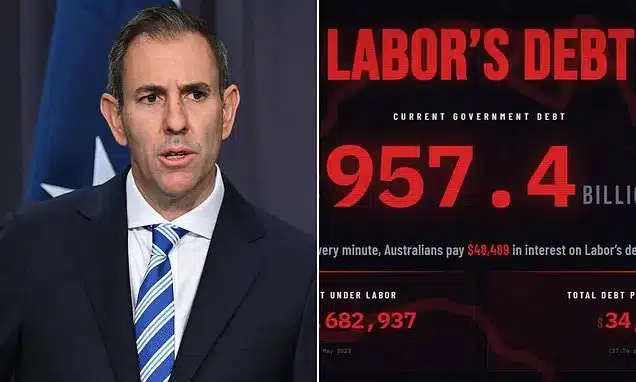
Australia’s national debt is on track to exceed $1 trillion in the next financial year, fueling intense political debate as the federal budget looms.
Coalition Launches Real-Time Debt Clock
The Coalition has introduced a National Debt Clock, a live tracker displaying Commonwealth debt increases in real time. It highlights interest costs rising at $48,489 per minute, underscoring the escalating burden of government borrowing.
This tool aims to illustrate the debt’s scale and its impact on future budgets, with borrowing levels continuing to climb.
Treasury Projections Signal Rapid Growth
Treasury estimates show gross Commonwealth debt surpassing $1 trillion next financial year, peaking at approximately $1.2 trillion by the end of the decade. Interest payments are projected to reach $25.5 billion this year, marking one of the budget’s fastest-growing expenses and consuming a larger portion of revenue.
The Coalition warns that these costs reduce funds available for essential services and tax relief. They note the $25.5 billion could hire over 200,000 nurses, provide 400,000 high-needs aged-care packages, upgrade 1,000 km of regional highways, or deliver about $1,600 in annual tax relief per taxpayer.
Government Defends Inherited Debt and Fiscal Repairs
Upon taking office in 2022, the Albanese government faced gross debt near $900 billion and net debt around $517 billion, stemming from prolonged deficits and pandemic spending.
Treasurer Jim Chalmers rejects mismanagement claims, emphasizing $114 billion in savings and reprioritizations across seven budgets and updates. “We’ve banked about seven in every ten dollars of upward revenue revisions,” Chalmers stated in Melbourne.
He highlighted real spending growth averaging 1.7 percent, down from a pre-COVID 3.2 percent average, with government spending dropping from nearly one-third to a quarter of the economy. “As a result, the budget is more than $233 billion better than when we came to office,” Chalmers added.
Opposition Cites Economic Risks
Opposition Leader Angus Taylor cautions Australia risks stagflation—weak growth, rising unemployment, and persistent inflation—due to what he calls flawed economic choices. He accuses the government of squandering revenue windfalls from high commodity prices like iron ore.
“This is a government that hasn’t used taxpayers’ funding effectively and the way it should be used,” Taylor said. “That money should be used properly, and instead we’ve got raging and rising inflation, interest rates that were going up before the Middle East crisis, and the Treasurer’s only solution is to blame everybody else.”
The federal budget is set for release at 7:30 p.m. on Tuesday, May 12.