Americans show heightened interest in Canadian affairs, particularly from the MAGA sphere, signaling an end to past indifference toward their northern neighbor.
New Democrat MP Leah Gazan introduced the acronym “MMIWG2SLGBTQQIA+” during an Ottawa news conference this month, sparking widespread mockery across U.S. media. Fox News highlighted it for laughs, while figures like Elon Musk and Ted Cruz weighed in online. This viral moment from a routine opposition event underscores a shift: U.S. audiences now engage deeply with Canadian political discourse.
Canadians once lamented their obscurity south of the border. Now, with American eyes turning north, that anonymity fades, potentially bringing unwanted scrutiny.
Trucker Convoy Marks Turning Point
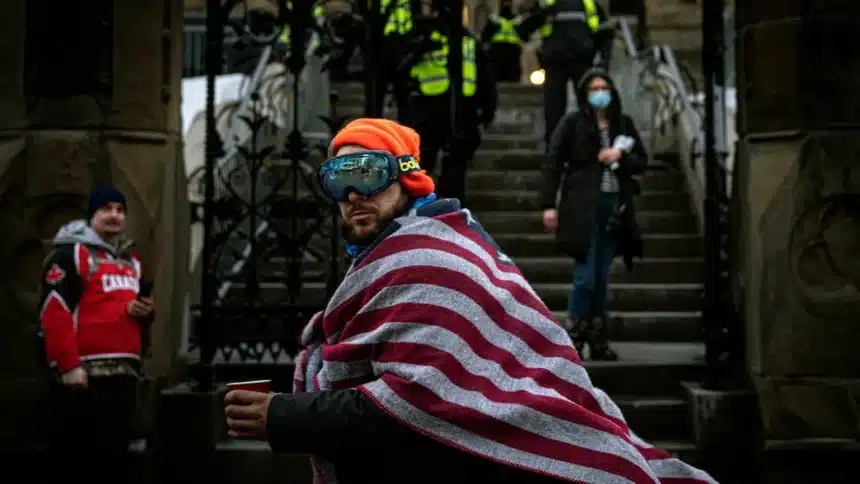
The 2022 trucker convoy captured U.S. attention, drawing support from Donald Trump and becoming a rallying cry for MAGA supporters. “Even before the convoy, Americans scrutinized Canadian lockdown and vaccination policies,” notes Aengus Bridgman, director of McGill University’s Media Ecosystem Observatory. These issues mirrored U.S. debates on public health and personal freedoms.
The convoy inspired donations and commentary from U.S. conservatives, marking rare emotional investment in Canadian matters. Bridgman observes sustained interest, evident in recent stories like the ostrich farm controversy. “Canadian issues—often around Indigenous rights, medical assistance in dying, or drug access—quickly gain traction when they fit U.S. culture war narratives,” he adds.
Canada as U.S. Political Foil
High-profile U.S. figures increasingly comment on Canadian events. U.S. Commerce Secretary Howard Lutnick recently criticized Canada, highlighting growing involvement. Patrick Lennox, former RCMP intelligence manager and author of At Home and Abroad, explains: “Canada contrasts sharply with the U.S., drawing right-wing ire.”
In MAGA circles, Canada appears as a weakened nation undermined by ‘wokeness,’ Chinese influence, and immigration, with free speech curtailed. Albertans emerge as rugged victims seeking U.S. refuge. Jennifer Welsh, head of McGill’s Max Bell School of Public Policy, links this to U.S. national security views: “It portrays allies like Canada as eroding Western values through liberal policies.”
Global Far-Right Interference Pattern
This fits a broader U.S. strategy targeting allies. Vice-President JD Vance recently visited Hungary, backing Viktor Orban despite diplomatic norms, and met Germany’s AfD leader to challenge liberal agendas. Similar interventions occurred in Poland and support for U.K.’s Nigel Farage against Sadiq Khan. “It’s an attack on U.S. partners,” Welsh states.
“The global far-right media operates borderlessly, amplifying successes across jurisdictions,” Lennox warns. Hungary’s polls dipped after Vance and Trump’s overt interference, yet such tactics persist.
Alberta Separatism Draws Fire
Expect U.S. meddling in Alberta’s summer separatism referendum. “We shouldn’t rule out senior officials campaigning there, given recent patterns,” Welsh cautions.
McGill researchers uncovered non-Canadian YouTube campaigns using AI-generated “slopaganda.” These inauthentic channels pose as Albertans, amassing 40 million views—matching genuine separatist content. Videos claim Alberta suffers economically, urging separation and U.S. annexation as future states.
“Creators show unfamiliarity with Canadian politics,” Bridgman reveals. One voice actor traces to Pennsylvania. While MAGA influencers often drive such efforts for clicks and profit, this campaign’s scale suggests deeper organization. “It’s troubling: inauthentic actors inflame divisions during pivotal times,” Bridgman concludes.