Hot Wheels Infinite Rush enters the open-world racing genre, drawing clear inspiration from titles like Forza Horizon, but struggles to carve out its own identity. Developed by Milestone, the game attempts to blend the familiar appeal of the Hot Wheels toy line with a realistic racing simulation set in a sprawling city. While it boasts impressive visuals and competent driving mechanics, the overall experience feels like a missed opportunity, failing to fully satisfy either younger players or seasoned racing enthusiasts.
A Muddled Vision for Hot Wheels Racing
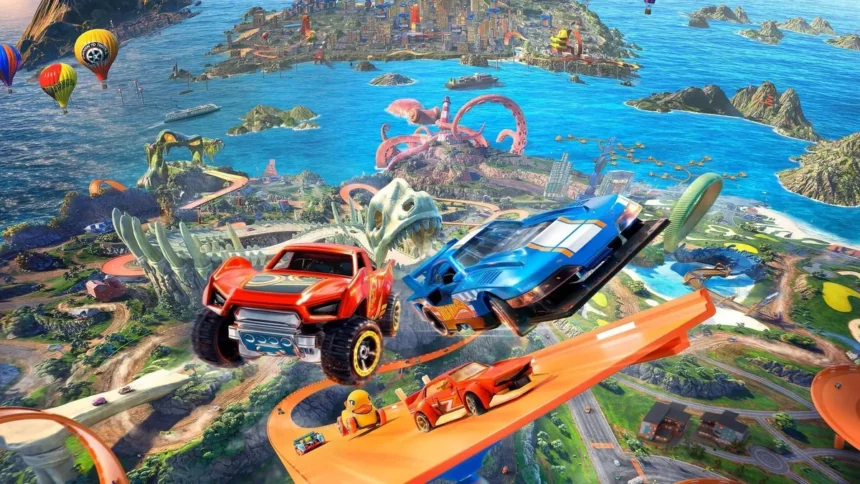
The core premise of Hot Wheels Infinite Rush is to bring the iconic toy cars to a vibrant, open-world environment. Unlike previous Hot Wheels games that often embraced a more whimsical, micro-scale setting within domestic spaces, Infinite Rush opts for a quasi-realistic approach. This shift, however, seems to dilute the unique charm of the Hot Wheels brand. The game features four distinct islands, each with its own theme: a bustling city, a dusty industrial zone, a tropical paradise, and an area inspired by Japanese aesthetics. These environments are visually striking, with realistic cityscapes punctuated by the signature bright orange Hot Wheels tracks and oversized, fantastical elements.
The cars themselves are meticulously modelled to resemble their toy counterparts, complete with details like painted-out windows and molded chassis information. This attention to detail is commendable, but it also contributes to the game’s central dilemma. The realistic handling model, while solid, makes the cars feel less like playful toys and more like scaled-down versions of actual vehicles. This disconnect between the toy aesthetic and the simulation-like gameplay leaves the game in an awkward middle ground, neither fully embracing the imaginative spirit of Hot Wheels nor offering the depth expected by hardcore racing fans.
Gameplay Mechanics and Structure
Upon starting Hot Wheels Infinite Rush, players are met with a deluge of tutorial screens and instructions, a stark contrast to the immediate accessibility of titles like Mario Kart. While the basic controls are easy to grasp, the game introduces a vehicle class system: Speeders, Drifters, Titans, and Versatiles. Although the distinctions are theoretically clear – Versatiles being all-rounders and Titans being the heavyweights – their practical impact often feels negligible. The game frequently assigns players specific car classes for races, sometimes forcing them into unsuitable vehicles, which undermines the intended strategic depth.
The game offers a variety of race types, including standard checkpoint races, drift challenges, elimination modes, and time trials. Beyond racing, players can engage in additional activities like stunt courses and photography tasks scattered throughout the open world. The overarching structure involves earning points to challenge the “Rusher” of each island, a boss-like figure reminiscent of gym leaders in Pokémon. However, only a fraction of the available races award these crucial points, leading to a potentially lengthy grind before these climactic encounters can be initiated. Despite this, the game provides ample rewards, most notably a collection of over 100 unique cars to unlock, which serves as a significant motivator.
A Missed Opportunity for Brand Integration
One of the most significant criticisms leveled against Hot Wheels Infinite Rush is its underutilization of the Hot Wheels license. While the cars are accurately modeled and the tracks are present, the game often feels like a generic open-world racer with Hot Wheels branding slapped on. The absence of people, both drivers and pedestrians, contributes to a sterile and characterless atmosphere. This emptiness is particularly noticeable when compared to the previous Hot Wheels Unleashed games, which successfully captured the imaginative essence of playing with toy cars in everyday environments.
The decision to abandon the more creative, micro-scale settings of earlier titles in favor of a quasi-realistic world is puzzling. This choice limits the potential for imaginative level design and fails to leverage the inherent fun of Hot Wheels as a brand. While the game does include a track editor, it feels like a superficial addition rather than a core feature that truly capitalizes on the brand’s creative potential.
Performance and Multiplayer
Hot Wheels Infinite Rush offers both split-screen and online multiplayer modes. However, the inability to engage in free-roam multiplayer sessions, a feature present in other popular titles, is a notable drawback. This limitation, coupled with the game’s overall lack of engaging content, led to a swift loss of interest from younger players, such as the nephew of the reviewer who is a devoted Hot Wheels fan.
The game’s presentation, while visually appealing in terms of environment and car models, is marred by long loading times and a confusing initial setup. The driving experience itself is described as solid but unremarkable. It lacks the distinctiveness or exceptional quality that would make it stand out in a crowded genre. Ultimately, the game’s appeal is hampered by its repetitive nature and a general lack of personality, making it too basic for serious racing fans and too restrictive for younger players.
Conclusion: A Drab Experience
Hot Wheels Infinite Rush presents a peculiar attempt to create a more family-friendly, open-world racer in the vein of Forza Horizon. Unfortunately, it falls short, offering a less enjoyable driving experience and a scarcity of unique features. The solid, albeit unexceptional, driving mechanics and the visual variety across its four islands are positive points. The abundance of challenges and the detailed car models also add some value. However, these strengths are overshadowed by a pervasive sense of mediocrity. The repetitive race types, a general lack of personality, and the underutilized Hot Wheels license contribute to a dull experience. Confusing tutorials and lengthy load times further detract from the overall enjoyment. The absence of cooperative free-roam in multiplayer modes also limits its social appeal.
With a score of 5/10, Hot Wheels Infinite Rush is a game that struggles to find its audience. It is neither compelling enough for dedicated racing aficionados nor engaging enough for younger players, resulting in a disappointingly finite appeal.