The Archbishop of Canterbury has denounced the widespread violence targeting innocent civilians in ongoing global conflicts while commending the Pope’s outspoken stance against numerous injustices during their landmark encounter in Rome.
Pope Leo XIV, the 267th pontiff and the first from America, assumed office in May of last year. The Most Rev Sarah Mullally serves as the 106th Archbishop of Canterbury and the inaugural woman in this position, confirmed during a January ceremony. On Monday, they joined in prayer at the Vatican, marking over 60 years since the pivotal 1966 meeting between Archbishop Michael Ramsey and Pope Paul VI—the first since the Church of England’s separation from Rome during the Reformation.
Deepening Ties Between Churches
Since that historic encounter, successive Archbishops of Canterbury and Popes have fostered strong professional bonds and personal friendships, a development unimaginable for centuries. Notably, this visit represents the first instance where the head of the Roman Catholic Church, which does not ordain women priests, hosts a female leader from the Church of England in Rome.
Pope Leo XIV welcomed Mullally, stating: “I am pleased to welcome you and your delegation to the Vatican … Since [1966], archbishops of Canterbury and bishops of Rome have continued to meet to pray together, and I am glad that we are continuing this tradition today.”
Shared Commitment to Peace
During the audience, Pope Leo XIV emphasized: “I have often mentioned that the peace of the risen Lord is ‘unarmed’. This is because he always responded to violence and aggression in an unarmed way, inviting us to do likewise.”
In a Sunday evensong sermon at St Paul’s Within the Walls, an Anglican church in Rome, Mullally declared: “God’s desire is life — life in its fullness, life shared, life given. And yet we look at our world today and often we see something very different: instead of making justice and peace a priority, we see terrible violence inflicted on innocent people in conflicts across the globe.”
Referencing the Gospel, she warned: “Beware of false prophets … you will know them by their fruits.” Mullally added: “In our increasingly polarised world, the Church is called to be something different: to be a place of encounter and dialogue across difference.”
In her address to the Pope, Mullally affirmed: “In the face of inhuman violence, deep division and rapid societal change, we must keep telling a more hopeful story: that every human life has infinite value because we are precious children of God. Your Holiness, you have spoken powerfully about the many injustices in our world today, but you have spoken even more powerfully about hope.”
Ecumenical Progress and Challenges
Despite advancing ecumenical relations between Anglican and Catholic leaders in England and worldwide, Pope Leo XIV highlighted persistent obstacles. “Certainly this ecumenical journey has been complex,” he noted. “While much progress has been made on some historically divisive issues, new problems have arisen in recent decades, rendering the pathway to full communion more difficult to discern. I know that the Anglican Communion is also facing many of these same questions at this time.”
These challenges likely include debates over same-sex relationship blessings, gay weddings in certain Anglican provinces, and women’s ordination—practices not recognized by the Roman Catholic Church. Nonetheless, he stressed: “It would be a scandal if we did not continue to work towards overcoming our differences, no matter how intractable they may appear.”
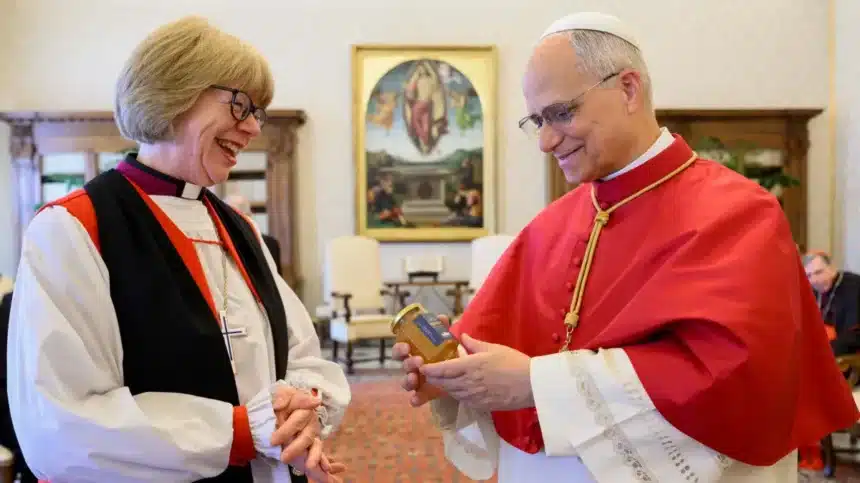
Mullally presented gifts to Pope Leo XIV, including a 1910 edition of The Dream of Gerontius by Cardinal John Newman—a former Anglican who converted to Catholicism and is now canonized—and honey produced by bees at Lambeth Palace in London.
After the meeting, Mullally reflected on her historic role: “I think we both recognise that, regardless of me being a woman, this is a significant moment in that both our churches have been on a journey together to deepen our friendship, to pray together and to seek that unity to which we are called.”
She avoided comment on an online image from President Trump depicting himself as Jesus, amid his public criticism of the Pope’s remarks on the war in Iran. On addressing political matters, Mullally explained: “First and foremost, I am a pastor and a spiritual leader. But of course, in sometimes speaking as a spiritual leader and a pastor and a Christian, there are things that we will say that may be perceived as political — but I am not a politician.”