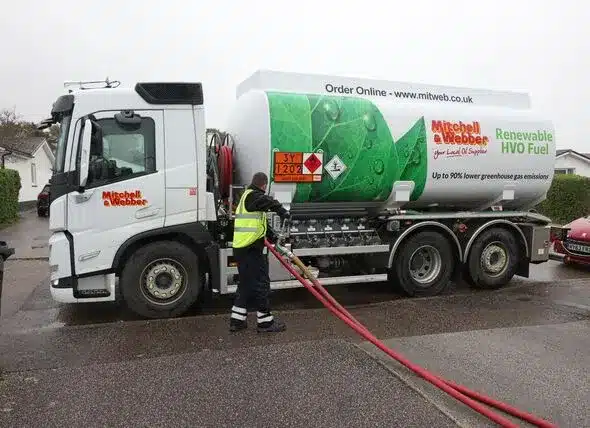
Nearly two million off-grid households across the UK stand to save tens of thousands of pounds by adopting Hydrotreated Vegetable Oil (HVO), a renewable diesel fuel derived from waste fats, vegetable oils, and animal fats, instead of installing heat pumps.
Dozens of residents in Cornwall’s Kehelland village, part of the 1.7 million off-grid population, could benefit significantly from this synthetic, paraffinic fuel. TV presenter Fern Britton, a Padstow resident, adapted her existing boiler for HVO heating. She shared: “I am an HVO user and I love it. I loved that my existing boiler was so swiftly adapted to take HVO, and that we are not in the house pumping extra carbon into the atmosphere.”
HVO Delivers Major Carbon Reductions
The Heating and Cooking Industry trade body OFTEC highlights that introducing a 20% HVO blend could achieve carbon savings equivalent to 347,000 heat pump installations.
John Weedon from family-run oil distributor Mitchell and Webber noted: “A lot of people in rural areas are off gas grid consumers. They can’t have gas so a lot of them have oil. They do want to look towards decarbonising but we also have fuel poverty in Cornwall and a lot of them will struggle to have a lot of money to put towards a new heating technology.”
He added that HVO avoids discarding functional boilers: “There’s also the argument that you don’t want to throw away something that works really well and can really heat your home. Therefore, this solution is a really desired solution.”
Mitchell and Webber sources HVO from Finland or the USA to replace kerosene, reducing emissions with minimal boiler modifications. Robert Weedon explained: “You can just completely drop in replacement at the 20% [blend] that we’re starting at and really you will see the advantage. It’s cleaner, the equipment will last longer and the householder doesn’t have to do anything more than just order their normal heating oil and it will come as a bio blend.”
Rural households, schools, and community halls could save substantial sums by skipping heat pump infrastructure costs.
Addressing Costs and Policy Needs
HVO costs 10% to 30% more per liter than traditional diesel, but an initial 20% blend adds just £60 annually on average, assuming Energy Act 2023 measures make renewable liquid fuels more affordable for off-grid homes.
John Weedon urged: “What we’re trying to get our energy department to look at is using HVO, a renewable fuel, instead of fossil fuel. Now we have to get it in place and it can come in as a blend to start with and the blend of 20% is quite a dramatic thing because we would take away 20% of all the fossil heating oil in the country and that’s equivalent to putting in 347,000 heat pumps in just an equivalent and that would be a tremendous thing to do.”
He emphasized no upfront costs for consumers and negligible ongoing expenses, calling for aligned duties: “Even though HVO is a little bit more expensive, it’s a far better product and if we can get the duties, the treasury to look at the duty because why have a fossil fuel heating oil with no duty yet there’s a duty on a renewable fuel that’s much better for the environment and there’s the duty on it so that doesn’t make sense.”
Proponents note HVO’s growing use in transport and events, potentially cutting emissions by up to 90%, though some materials may involve non-waste sources like palm oil relabeled as waste.
Government Stance and Resident Stories
A government spokesperson stated: “We have just increased the Boiler Upgrade Scheme grant to £9,000 for households most impacted by rising energy prices, especially in rural areas. We are also considering how other alternative heating options, including biofuels, can help more households access cleaner, cheaper heating.”
Steph and Nigel Uren, both 65 and married for 44 years, have heated their home with 100% HVO for four years. Their setup includes solar panels, an EV charger, and a Tesla battery bank. A 2022 heat pump assessment quoted £10,000 for three-phase power plus radiator costs. Steph affirmed: “We’ve been running on HVO for four years now and I won’t give it up, no matter what. For us it’s been beneficial financially, the house is warm and we have constant hot water. It’s brilliant.”
She added: “We looked at having a heat pump installed. For us it wasn’t viable. It would have cost us £10,000 to bring in phase three electric which we would need to run it. I feel everyone in this country, in rural areas, could benefit from HVO. It needs sorting. Get it sorted.”
Stephen and Nicky Thomas own a late-1800s granite-walled property running a 22-year-old boiler on 20% HVO. Secretary Nicky, 61, said: “You cannot force people to have certain things that do not work in their own homes.” Accountant Stephen, 66, pointed to limited village power supply: “Because we live in the country we’ve got five cables that feed the whole of the village.” Nicky concluded: “We’re not against heat pumps but we just want different options.” They accept the slight premium for environmental benefits, feeling they contribute to planetary health.