Major Changes to World Cup Broadcasts Spark Fan Debate
As the 2026 World Cup kicks off, viewers in the United Kingdom face a familiar broadcasting landscape dominated by the BBC and ITV. However, initial sentiment appears to be tipping in favor of ITV this year, following significant structural and presentation shifts by the BBC. A particularly scrutinized decision involves the cancellation of a dedicated tournament show from the traditional television schedule, a move that has already drawn considerable attention from fans.
Highlights Show Scrapped for Digital Access
In a departure from previous major tournaments, including Euro 2024, the BBC will not broadcast a traditional, scheduled daily highlights show on its main television channels. This represents a notable change from the usual format, meaning viewers accustomed to a fixed late-night recap on BBC One will need to seek content elsewhere. The broadcaster has countered suggestions that this signifies a reduction in coverage, explaining that the decision is a direct response to scheduling and time-zone considerations.
A statement from BBC Sport indicated: “BBC Sport is producing highlights from every single match so audiences are always across the moments that matter. Catch all the post-match reaction and highlights on BBC iPlayer, or dive in via the BBC Sport website and app.” The corporation argues that a conventional television broadcast slot is not ideal given the late-night and early-morning kickoff times of matches in North America.
The statement further elaborated: “It would be inaccurate to report that BBC Sport is not producing highlights for audiences; we are creating round-the-clock coverage throughout the tournament, across more platforms than ever before. Given the time difference – matches taking place late at night and in the early hours of the morning – we are producing highlights that can be accessed by fans at whatever time suits them, on BBC iPlayer on the BBC Sport website and app, and across social media.”
Gary Lineker’s Departure Leaves Hosting Void
Another significant alteration to the BBC’s presentation is the high-profile departure of long-time presenter Gary Lineker. This tournament marks the first World Cup in over two decades where Lineker will not anchor the studio coverage. The former England striker concluded his tenure last year following public controversies related to his social media activity and impartiality guidelines. While his departure from major international broadcasts for the network was anticipated, his exit was expedited following accusations of antisemitism, leading to his removal from the role.
Lineker’s sudden departure necessitated an overhaul of the BBC’s long-standing presentation plans. Gabby Logan, Kelly Cates, and Mark Chapman are now sharing the primary hosting duties, a role they also undertake on Match of the Day. His absence means many viewers will experience a considerably revamped punditry lineup, breaking a continuity that has been a staple for decades.
On-Location Studio Replaced by Virtual Set
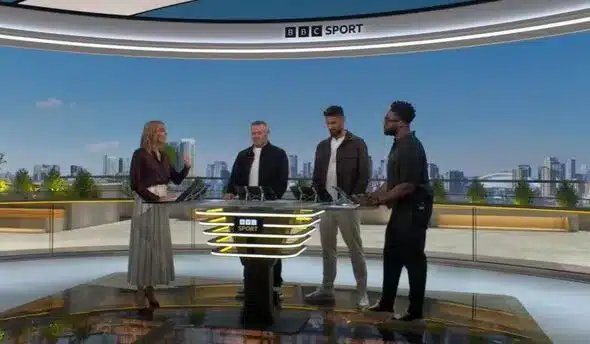
Perhaps the most striking change to the programming is the BBC’s decision not to establish a physical studio in North America. Instead, the initial phase of the tournament coverage will be anchored from its domestic base in Salford. This cost-saving measure relies heavily on a virtual studio, utilizing green-screen technology to project digital backdrops of the host cities behind the commentators.
This minimalist, studio-bound approach has faced considerable criticism from viewers and media analysts, with many describing the virtual aesthetic as uninspired and lacking the authentic atmosphere of a major international event. In contrast, rival broadcaster ITV has invested in a prominent physical studio in Brooklyn, featuring the New York City skyline as its backdrop. Critics observe that while ITV’s setup aligns with the scale of the North American event, the BBC’s reliance on a Salford studio risks making its coverage feel detached and overly clinical.