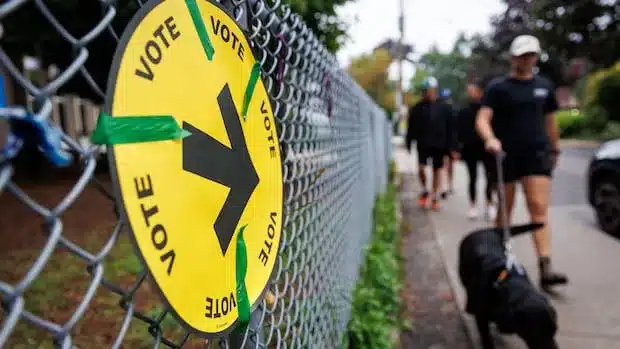
Voters are heading to the polls today in three federal byelections that will serve as a significant barometer of the Carney government’s popularity, particularly as a renewed trade dispute with the United States intensifies. The outcome of these contests could impact the Liberal party’s ability to maintain its majority in the House of Commons.
Key Ridings and Stakes
The byelections are being held in three distinct federal ridings: Beaches-East York in Toronto, Chicoutimi-Le Fjord in Quebec, and North Vancouver-Capilano in British Columbia. The results are crucial for the governing Liberals; securing at least two of these seats would solidify their majority status when all parliamentary seats are accounted for.
Polls are scheduled to close at different times across the country. In Beaches-East York and Chicoutimi-Le Fjord, voting concludes at 9:30 p.m. Eastern Time. Meanwhile, polls in North Vancouver-Capilano will close at 7 p.m. Pacific Time, which is 10 p.m. Eastern Time.
Background of Vacancies
The vacancies triggering these byelections stem from several recent departures. The riding of North Vancouver-Capilano became open following the appointment of former Liberal cabinet minister Jonathan Wilkinson to the prestigious role of Canada’s ambassador to the European Union in Brussels. This move created a vacancy that voters are now filling.
In Toronto, the Beaches-East York riding saw its former representative, Nathaniel Erskine-Smith, also a former cabinet minister, resign his seat. His departure added another contest to the electoral calendar.
The third seat, Chicoutimi-Le Fjord in Quebec, became vacant when Prime Minister Mark Carney appointed the incumbent Conservative Member of Parliament, Richard Martel, to the Senate. This strategic appointment by the Prime Minister reshaped the political landscape in that region, necessitating a byelection.
While other seats in the House of Commons may currently be vacant, only the voters in these three specific ridings are participating in elections today. This concentrated electoral activity makes these byelections particularly noteworthy.
The Shadow of Trade Tensions
These byelections are unfolding against a backdrop of heightened economic uncertainty, primarily due to a resurgence of trade friction between Canada and the United States. The specifics of the renewed trade war, including potential tariffs and their impact on Canadian industries and consumers, are a significant concern for many Canadians. The government’s handling of these international trade negotiations and disputes is likely to be a key factor influencing voter sentiment.
Economic stability and the government’s approach to international trade are often central themes in electoral contests, and this round of byelections is no exception. Voters will be assessing the Carney government’s performance not only on domestic issues but also on its ability to navigate complex global economic challenges.
Electoral Dynamics and Potential Outcomes
The political makeup of the House of Commons means that each of these byelections carries substantial weight. The Liberal party, aiming to maintain its majority, will be looking for strong performances across all three ridings. A significant loss in any of these seats could be interpreted as a blow to the government’s standing and could embolden opposition parties.
Conversely, the Conservative and other opposition parties will see these byelections as opportunities to gain ground and challenge the government’s mandate. A strong showing by the opposition could signal a shift in public opinion and put increased pressure on the Carney government.
The specific dynamics within each riding will also play a role. Local issues, candidate strengths, and historical voting patterns will all contribute to the final results. For instance, the urban, diverse riding of Beaches-East York may present different challenges and opportunities compared to the more regional focus of Chicoutimi-Le Fjord or the suburban nature of North Vancouver-Capilano.
Broader Implications
Beyond the immediate impact on the composition of Parliament, these byelections offer a snapshot of the national mood. The results will be closely scrutinized by political analysts, media, and the public alike for insights into voter priorities and confidence in the current government. The Carney administration’s policy agenda and its perceived effectiveness will undoubtedly be on the minds of voters as they cast their ballots.
The coming hours will reveal how the electorate is responding to the government’s stewardship, especially in the face of international economic headwinds. The outcomes will shape political discourse and strategy in the lead-up to the next general election.
Tracking the Results
Comprehensive coverage and analysis of the byelection results will be provided as polls close and the numbers begin to come in. Updates will track the progress in Chicoutimi-Le Fjord, North Vancouver-Capilano, and Beaches-East York, offering insights into the trends and potential implications for the Carney government and Canadian politics at large.