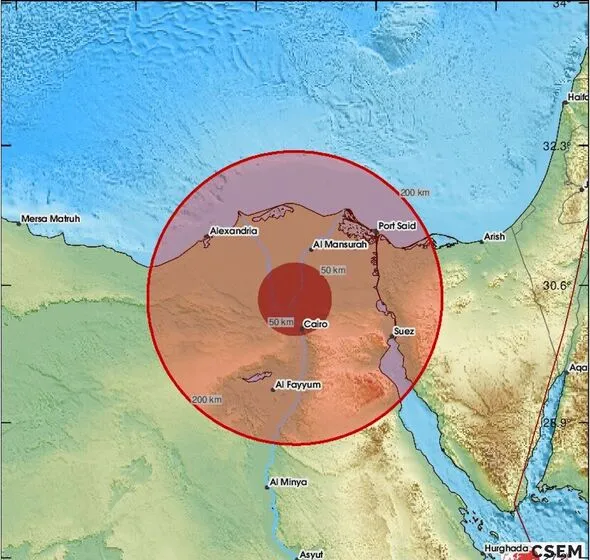
A significant earthquake, initially reported as magnitude 5.9 but later revised to 5.3 by seismological agencies, jolted the Egyptian capital of Cairo and surrounding regions early Tuesday morning. The tremor occurred shortly after 3 a.m. local time, causing buildings to shake and waking residents from their sleep. The United States Geological Survey (USGS) and the German Research Centre for Geosciences (GFZ) have provided updated readings on the seismic event.
Earthquake Details and Epicenter
The earthquake’s epicenter was located approximately 28 miles north of the city of Suez and about 70 miles south-southeast of Port Said, according to the USGS. While initial reports indicated a magnitude of 5.9, both the GFZ and the USGS revised this figure to 5.3. Despite the revised magnitude, the quake was characterized by a remarkably shallow strike depth of only 6.2 miles (10 kilometers) below the Earth’s surface. Seismologists often note that shallower earthquakes tend to produce more intense surface tremors, a phenomenon that appeared to be confirmed by eyewitness accounts.
The German Research Centre for Geosciences (GFZ) reported the magnitude as 5.4 with a depth of approximately 6 miles (9.6 kilometers). This slight variation in reported figures is common among different seismic monitoring agencies.
Tremors Felt Across the Region
The impact of the earthquake was not confined to the immediate vicinity of Cairo. Reports indicate that the tremors were felt across a wide geographical area. Residents in neighboring countries and distant regions, including Israel and the Dead Sea area, experienced the shaking. This widespread reach underscores the intensity and depth of the seismic activity.
Eyewitness Accounts and Public Reaction
Social media platforms became a hub for residents to share their experiences and reactions to the unsettling event. Many described being abruptly woken by the violent shaking of their homes. One resident shared, “It’s been a while since I’ve experienced an earthquake this strong. The whole house was shaking.” Another individual recounted their building swaying in an “unnatural way,” expressing a sense of alarm and disbelief.
The sudden and intense nature of the earthquake prompted immediate reactions from those affected. Many turned to prayer and calls for divine protection during the moments of intense shaking. The shared experiences highlight the universal human response to such natural phenomena, characterized by fear, surprise, and a reliance on community and faith.
Understanding Earthquakes and Their Impact
Earthquakes are caused by the sudden release of energy in the Earth’s crust, typically due to the movement of tectonic plates. This energy is released as seismic waves that travel through the Earth, causing the ground to shake. The magnitude of an earthquake is a measure of the energy released, with scales like the Richter scale or the Moment Magnitude scale used for measurement. The depth of the earthquake also plays a crucial role in its impact; shallower earthquakes generally cause more damage because the seismic waves have less distance to travel and lose less energy before reaching the surface.
Cairo, situated in a seismically active region, has experienced seismic events in the past. Understanding the geological context of such occurrences is vital for preparedness and mitigation efforts. The shallow depth of this particular earthquake, combined with its magnitude, contributed to the widespread and noticeable tremors experienced by residents.
Geological Context of the Region
Egypt lies near the boundary of the African Plate and the Arabian Plate, a region characterized by significant geological activity. The Red Sea Rift, a major geological feature, runs through the area and is associated with tectonic stresses that can lead to earthquakes. The Sinai Peninsula, where the epicenter was located relative to Suez and Port Said, is part of this tectonically active zone. Historical seismic records for the region indicate that moderate to strong earthquakes have occurred periodically, posing risks to populated areas.
The proximity of Cairo to these active fault zones means that the city and its inhabitants are susceptible to seismic events originating from the surrounding areas. The shallow nature of the quake suggests that the fault rupture occurred close to the surface, amplifying the ground motion felt by those living in the affected areas. This event serves as a reminder of the ongoing geological processes shaping the region and the importance of seismic monitoring and building codes designed to withstand such forces.
Preparedness and Future Considerations
Following the earthquake, emergency services likely assessed the situation, although initial reports did not detail widespread damage. The primary concern in the immediate aftermath of such an event is ensuring public safety and providing assistance if needed. For residents in seismically active zones like Cairo, preparedness is key. This includes understanding earthquake safety procedures, securing heavy furniture, and having emergency supplies readily available.
The frequency and intensity of earthquakes in the region necessitate ongoing geological research and the implementation of robust building standards. Public awareness campaigns can also play a vital role in educating residents on how to respond effectively during and after an earthquake. While this particular event was a moderate tremor, it highlights the ever-present geological forces at play and the importance of being prepared for seismic activity.
Conclusion
The 5.3 magnitude earthquake that shook Cairo and its environs served as a stark reminder of the region’s seismic activity. While the tremors were felt widely and caused considerable alarm among residents, the shallow depth of the quake amplified the shaking. Seismological agencies continue to monitor the region, and this event underscores the importance of preparedness, resilient infrastructure, and ongoing geological understanding for communities living in earthquake-prone areas.