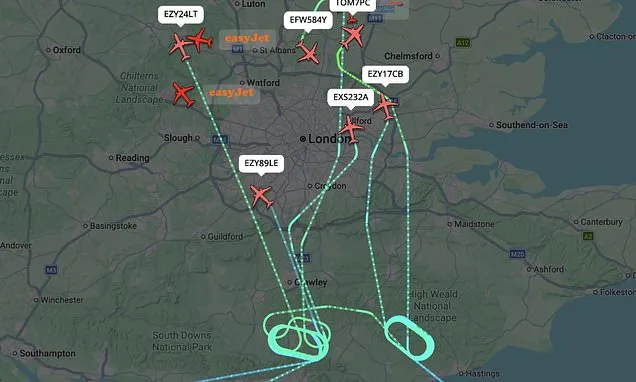
London Gatwick Airport experienced significant travel disruption overnight, forcing 14 flights to land at alternative UK airports due to a technical issue with an aircraft on the runway. The incident led to several planes declaring emergencies, primarily due to dwindling fuel reserves after being unable to proceed to their intended destination.
Aircraft Malfunction Triggers Runway Closure
The disruption began shortly after midnight when British Airways flight BA2673, arriving from Palma de Mallorca, encountered a problem shortly after landing. Reports indicate the aircraft experienced an issue with its nose wheel, rendering it immobile and unable to taxi to the gate. This left the plane stranded on the main runway, necessitating its closure by airport authorities to address the situation.
Emergency services, including fire crews and airport ground staff, were dispatched to the scene to assist with the disabled aircraft. While the exact nature of the technical fault is still under review, its impact on runway operations was immediate and substantial.
Emergency Declarations and Diversions
With the runway blocked, Air Traffic Control made the decision to divert all inbound flights. The situation escalated as nine of these diverted aircraft simultaneously broadcast emergency alert codes, commonly known as ‘squawking’ 7700. This code typically signifies a general emergency, and in this context, was widely understood to be related to low fuel levels, a critical concern for aircraft unable to land as planned.
The diverted flights originated from a range of European destinations, including Spain (Tenerife, Valencia, Lanzarote, Fuerteventura), Greece (Rhodes, Athens), Italy (Bari, Rome), and Morocco (Agadir). These aircraft were rerouted to various other airports across the UK, such as Birmingham, Bristol, London Heathrow, London Luton, and London Stansted.
One passenger’s account highlighted the confusion and inconvenience caused by the diversions. A parent shared on social media platform X that their daughter’s flight from Greece was initially diverted to Luton. Upon arrival, they learned the plane would only refuel before attempting to return to Gatwick, necessitating a lengthy drive back to the original airport.
Airline and Airport Response
British Airways confirmed the safe landing of its flight BA2673 and stated that passengers disembarked normally following the report of a technical fault. The airline emphasized that safety protocols were followed throughout the incident.
A spokesperson for Gatwick Airport acknowledged the runway closure, describing it as a ‘short period’ due to the technical issue. They confirmed that a ‘small number’ of flights were diverted as a consequence. Crucially, the airport authority stated that the ‘majority’ of these diverted flights eventually returned to Gatwick to continue their journeys. The spokesperson reiterated that ‘safety and security is our number one priority’ at all times.
Impact on Passengers and Future Operations
The incident underscores the complexities of air traffic management and the potential for cascading disruptions when unforeseen technical issues arise. While the runway was reopened after the disabled aircraft was cleared, the overnight diversions caused significant delays and considerable stress for passengers.
Aviation experts noted that the simultaneous emergency declarations, while alarming, were a procedural response to the challenging circumstances. The ‘squawk 7700’ alerts, particularly when linked to low fuel, are a critical communication tool between pilots and air traffic control, ensuring priority handling and resource allocation during emergencies.
Gatwick Airport, a major international hub, typically handles a high volume of air traffic. Incidents like this, though infrequent, highlight the importance of robust contingency plans and efficient communication between airlines, airports, and air traffic control services to mitigate the impact on travelers.
Conclusion
The technical issue at Gatwick Airport, which led to the diversion of 14 flights and several emergency declarations, has been resolved. While passengers faced considerable inconvenience and anxiety, the swift response from emergency services and airport operations ensured the safe management of the situation. The majority of affected flights were able to resume their journeys, with Gatwick Airport reaffirming its commitment to passenger safety as its paramount concern.