Germany’s head coach, Julian Nagelsmann, found himself in a tense post-match interview following his team’s unexpected exit from the World Cup. The 38-year-old manager faced pointed questions from reporters regarding the team’s performance and key decisions that led to their downfall, particularly after a penalty shootout loss to Paraguay.
Post-Match Tension and Reporter Exchange
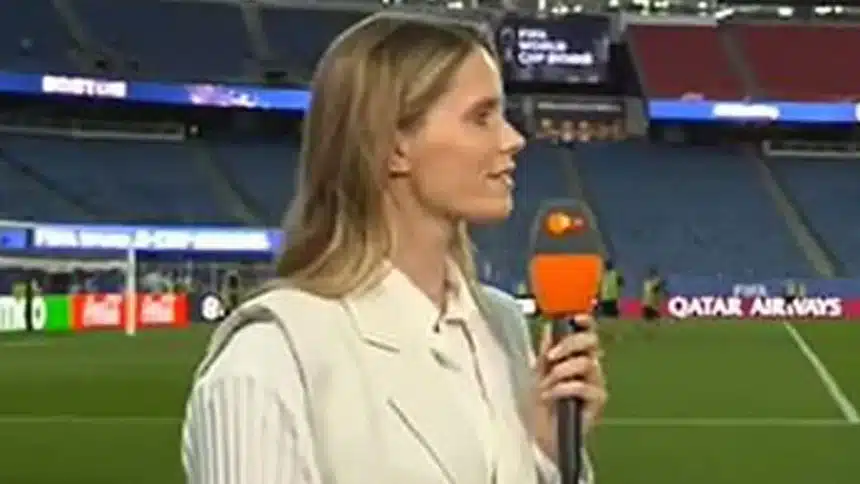
After spending considerable time with his dejected players on the field, Nagelsmann then addressed the media. Among the journalists was Lili Engels, a reporter for ZDF, who sought to understand the reasons behind Germany’s disappointing performance. The atmosphere grew strained when Nagelsmann became visibly frustrated with repeated questioning about specific incidents.
Disallowed Goal Sparks Controversy
A significant point of contention during the match was a disallowed extra-time header by defender Jonathan Tah. Nagelsmann vehemently criticized the decision by the referee and VAR, describing it as a “scandal” and a “joke.” He argued that the call, which negated what he believed was a legitimate equalizer, was inexplicable and unjust.
“I have no idea what he saw there. It’s truly a joke,” Nagelsmann stated, expressing his disbelief at the ruling. He later elaborated when asked to review the play, asserting, “It’s not just a scandal, it’s an absolute scandal. That is not even remotely a foul play.”
Criticism of Team’s Play and Nagelsmann’s Decisions
Beyond the controversial disallowed goal, Nagelsmann’s strategic choices also came under fire. The inclusion of the veteran goalkeeper Manuel Neuer, aged 40, was one such decision that drew criticism. Furthermore, the team’s overall build-up play was identified as a weakness.
Nagelsmann acknowledged these issues, explaining his perspective on the team’s offensive approach. “We had a very slow build-up play, it took ages to shift it from wing to wing,” he commented. “At some point, we switched to a sort of brute-force approach, and then, yes, it was important to make the balls sharp into the box.” He also pointed to the team’s efforts in the latter stages of the game, noting, “We did get an equalizer. At some point, I think we had six or seven players above 6ft 2in on the pitch too and had 11 or 12 corners.”
Frustration Over Repeated Questions
As the interview progressed, Engels continued to press Nagelsmann on the team’s early exit and the reasons for their performance, particularly the slow build-up play. Nagelsmann’s responses became increasingly curt, indicating his irritation at being asked to reiterate points he felt he had already addressed.
When asked for the third time about the slow build-up, Nagelsmann responded with evident frustration: “Yes, I just told you. The build-up play was too slow. I’ve already said that three times now.” This exchange highlighted the mounting pressure and Nagelsmann’s discomfort with the line of questioning.
Future Prospects and Commitment
Despite the intense criticism and the team’s World Cup failure, Nagelsmann indicated his desire to continue in his role. When questioned about his future, he stated his availability and willingness to lead the team through the upcoming Euro 2028 qualifiers, provided the German Football Association (DFB) wishes for him to continue.
“I am available,” Nagelsmann said. “If the DFB wants it, then I will do the Euro 2028, and if not then they have to tell me. I’m not someone who runs away.” His comments suggest a determination to remain in charge and attempt to rebuild the team following the disappointing tournament performance.
Public Sentiment and Potential Replacements
The public and media reaction in Germany has been largely critical, with calls for a change in leadership. Prominent figures like former Liverpool manager Jürgen Klopp have been mentioned as potential successors, reflecting the widespread dissatisfaction with the current coaching staff’s results.
However, Nagelsmann’s expressed commitment indicates he is not planning to step down voluntarily. The decision regarding his future now rests with the DFB, who must weigh the recent performance against his stated desire to continue and lead the team forward.
Conclusion
The World Cup exit has placed Julian Nagelsmann under significant pressure, marked by a tense post-match interview where his frustration with repeated questions became apparent. While facing scrutiny over tactical decisions and the team’s performance, Nagelsmann has signaled his intent to remain as Germany’s head coach, pending the DFB’s decision. The coming weeks will likely see further discussion and evaluation of his tenure and the future direction of the German national team.