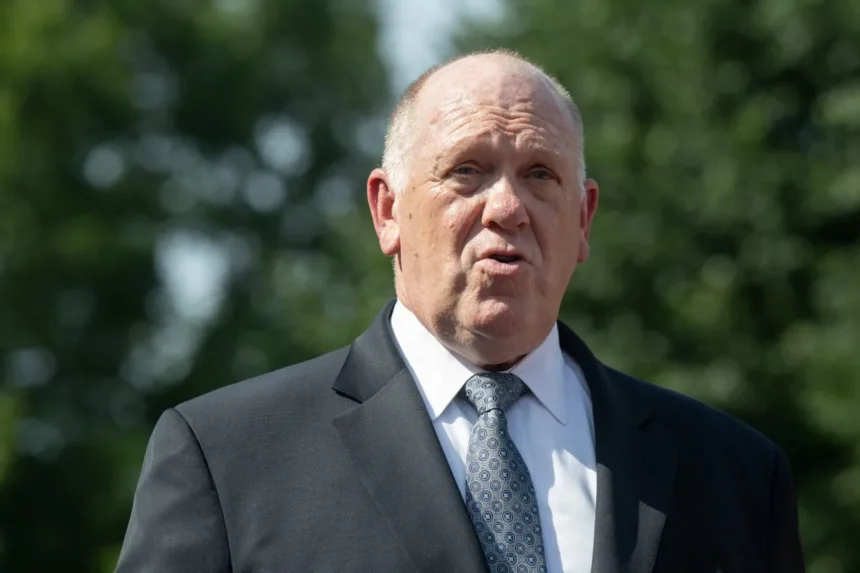
A senior official within U.S. Immigration and Customs Enforcement (ICE) has issued a stark warning, predicting further violence and “bloodshed” if Democratic politicians do not cease their criticism of the agency. The comments come in the wake of recent fatal encounters involving ICE officers and individuals during traffic stops.
Escalating Tensions and Official Warnings
Tom Homan, identified as the “border czar” and a former acting director of ICE, expressed grave concerns about the safety of federal agents. Speaking on Fox News, Homan stated that he fears for the lives of ICE officers, citing an increase in assaults involving vehicles and other violent incidents. He directly linked this perceived rise in danger to actions and rhetoric from Democratic leaders.
“I’m scared to death because assaults with vehicles are sky high. There’s been a lot of shootings. I’m scared to death that one of these days, our ICE officers aren’t going to be quick enough. The bad guys can be quicker,” Homan told Laura Ingraham. He elaborated on his view, asserting that Democrats have been actively undermining ICE’s authority and encouraging immigrants to resist or evade law enforcement. “It all goes back to the Dems who want to continually attack ICE and tell people to evade them, tell people don’t comply, tell people to resist, and tell people ICE isn’t a real law enforcement,” Homan said.
Homan concluded his remarks by stating, “There’s still going to be more bloodshed unless they shut their mouth and let ICE enforce the laws that they enacted.”
Homeland Security’s Stance and Specific Accusations
Homeland Security Secretary Markwayne Mullin echoed these sentiments on social media. Mullin reported a significant increase, over 1,300%, in vehicle attacks targeting federal agents. He specifically named prominent Democrats, including Congresswoman Alexandria Ocasio-Cortez and California Governor Gavin Newsom, accusing them of instructing their constituents to “openly defy” ICE.
These accusations stem from public guidance issued by Democratic figures aimed at informing immigrants about their rights when interacting with immigration enforcement. In February 2025, Ocasio-Cortez shared a “Know Your Rights” guide that advised individuals not to open their doors to ICE unless agents possessed a judicial warrant and to request agents leave if they lacked proper documentation. Governor Newsom’s office also released a similar fact sheet offering tips for identifying federal agents, while also cautioning individuals not to argue, resist, or obstruct officers, even if they believe their rights are being violated.
Recent Fatal Encounters
The heightened rhetoric follows two recent incidents where ICE officers discharged their weapons, resulting in fatalities. On Monday, Joan Sebastian Guerrero, a 25-year-old Colombian national, was killed by ICE in Maine. The Department of Homeland Security stated that the officer fired his weapon out of concern for “public safety.” Earlier, on July 7, Lorenzo Salgado Araujo, a 52-year-old Mexican man, was fatally shot by ICE in Houston. The department characterized this shooting as occurring in “self-defense.”
Policy Shifts and Presidential Intervention
In the immediate aftermath of these fatal shootings, Secretary Mullin reportedly issued an internal directive, seen by The Atlantic, that temporarily paused traffic stops. The directive advised federal agents to “prioritize other existing operational methods.” However, this pause was short-lived.
President Donald Trump intervened, overturning Mullin’s order. Trump posted on the social media platform Truth Social, emphasizing the importance of traffic stops as a crime-fighting tool for ICE. “We must be strong, tough, and smart, and we CANNOT give up one of I.C.E.’s most important and effective Crime Fighting tools, THE TRAFFIC STOP! Once we do, we are playing right into the criminal’s hands,” Trump wrote. He further stated, “The Radical Left Dumocrats would like to see this done, but it won’t happen on my watch.”
Broader Context of Immigration Enforcement
The exchange highlights the ongoing and often contentious debate surrounding immigration enforcement policies in the United States. Critics of current practices argue that aggressive tactics can lead to tragic outcomes and erode trust between immigrant communities and law enforcement. Conversely, proponents emphasize the necessity of these measures for maintaining border security and enforcing immigration laws, often pointing to the potential dangers faced by officers and the public.
The differing perspectives underscore the complex challenges involved in balancing law enforcement objectives with the protection of civil liberties and the promotion of community relations. The recent events and the strong reactions from officials on both sides suggest that these tensions are likely to persist.